4 October, 2026 | 12:07 AM


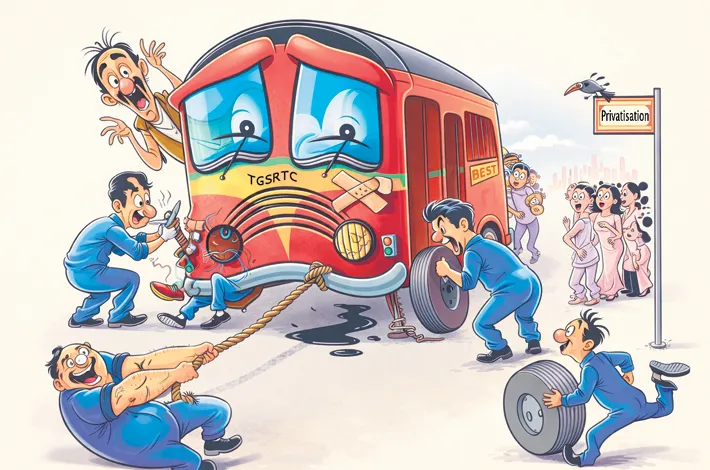
Road to Privatisation?
05-04-2026 12:00:00 AM
- GHZ staff must submit deputation options to management.
- Deputation preference submission deadline is set for April 15
- Officials identified surplus drivers, mechanics, helpers, and other employees
- Deputation divided into three categories based on roles
- Some drivers may be reassigned as conductors locally
- Mechanics may move to counters, parking, or ADC duties
- Changes linked to phased introduction of electric buses
- Around 500 EV buses already operate in Hyderabad, plans to introduce up to 2,000 more electric buses
- Private firms handle EV buses with outsourced staff
- Employees fear these steps may lead to privatisation
metro india news I hyderabad
Recent developments within the state-run transport corporation are reinforcing concerns among employees about a gradual shift toward privatisation, as internal directives signal major workforce restructuring. In the latest move, the Vice Chairman and Managing Director has issued orders to prepare a list of employees from the Greater Hyderabad Zone for deputation to other regions, asking officials to collect options from staff and submit the list to headquarters by April 15. This has triggered anxiety among workers in Hyderabad and across the state, who fear similar measures may soon be implemented elsewhere.
The decision comes in the backdrop of the government’s push to introduce electric buses as part of an environmentally friendly transport policy aimed at reducing carbon emissions. Around 500 electric buses have already been inducted into the fleet, and more are expected to be added in phases over the coming months. However, officials have identified that the Greater Hyderabad Zone currently has staff strength exceeding operational requirements, particularly in view of the new electric bus model.
An internal communication issued on April 1 to the Executive Director of the Greater Hyderabad Zone outlined the plan to redeploy surplus staff. Drivers, mechanics, helpers and other workers have been asked to indicate their willingness to work in other regions such as Karimnagar and other parts of Hyderabad zone. At the same time, drivers with educational qualifications of Class 10 and above are being given the option to work as conductors within the zone. Mechanics are also being considered for alternative roles, including Assistant Depot Clerks, bus pass counters, or parking drivers, provided they hold a valid heavy vehicle driving licence.
The deputation exercise has been divided into three categories based on qualifications and preferences. Employees can opt for transfers to other regions, role changes such as drivers becoming conductors, or reassignment of technical staff into support roles. The directive clearly states that the process should be treated as “most urgent,” indicating the seriousness and speed with which the administration intends to implement these changes.
Officials said the move follows detailed discussions held during a meeting on February 23, where staffing patterns in the Greater Hyderabad Zone were reviewed. It was concluded that excess staff needed to be relocated to other regions. However, employees and unions are interpreting the development differently, alleging that it is part of a larger plan to gradually privatise the corporation.
A key concern is the manner in which electric buses are being introduced and managed. While employees have largely welcomed the shift to cleaner technology, they argue that the operational framework benefits private corporate companies. These firms receive a central government grant of about Rs 36 lakh per electric bus and lease them to the corporation. More importantly, they handle operations through outsourced staff, including drivers, conductors, mechanics, supervisors and even officers.
This model has significantly reduced the role of existing corporation employees, forcing many into redeployment or deputation. Workers fear that such a system will eventually lead to job losses. Reports indicate that over the past decade, nearly 18,000 jobs have already been reduced. Traditionally, the addition of one new bus would create around five jobs, but unions claim that each electric bus now leads to a loss of about five jobs due to outsourcing practices.
The Greater Hyderabad Zone currently has around 13,000 employees, making it the most affected area as a large number of electric buses are being deployed in the city. Employees fear that they will be the first to be shifted out, with management likely to pressure them into relocating to distant regions. There are also concerns that this could gradually lead to handing over city depots to private players.
At present, most electric buses are operated by private companies with outsourced staff managing operations. Only a limited number of buses under the Mahalakshmi scheme, which provides free travel for women, have corporation conductors, while drivers and supervisory roles remain under private control. With plans to introduce up to 2,000 more electric buses in the Greater Hyderabad region, all expected to be run by outsourced personnel, apprehensions among employees are growing stronger.
The latest directive seeking deputation options is therefore being seen as a precursor to deeper structural changes. Employee unions have reacted sharply, recalling earlier warnings about privatisation and pointing to current developments as confirmation of those concerns. With discontent rising, indications suggest that workers may soon resort to protests or strike action if their concerns are not addressed.