17 October, 2026 | 4:00 AM


Sabarimala review petition- What might be Centre’s stand?
17-02-2026 12:00:00 AM
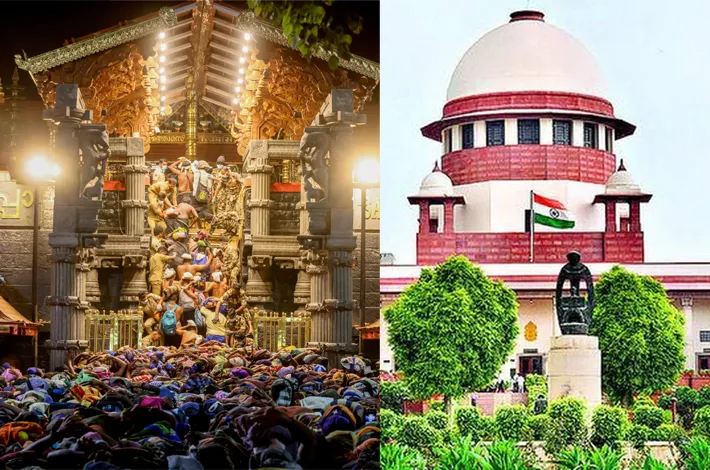
The Supreme Court of India has scheduled a major hearing on the contentious Sabarimala temple women's entry case, setting up a nine-judge Constitution Bench to begin proceedings from April 7, 2026. This development revives a long-pending review of the court's landmark September 2018 judgment, which permitted women of menstruating age (typically 10 to 55) to enter the famous Lord Ayyappa shrine in Kerala.
In a significant move during Monday's proceedings, the Central government, represented by Solicitor General Tushar Mehta, explicitly supported the review petitions challenging the 2018 verdict. The government argued in favor of overturning the earlier ruling, emphasizing the involvement of Hindu sentiments and traditions. The 2018 decision had held that excluding menstruating women was not an "essential religious practice" and that constitutional morality, including gender equality, must prevail over discriminatory customs.
A three-judge bench led by Chief Justice Surya Kant, along with Justices Joymalya Bagchi and Vipul M. Pancholi, outlined a tight timeline for the hearings. The nine-judge bench—whose members will be notified separately—will commence daily proceedings at 10:30 AM on April 7. Review petitioners and supporting parties, including the Centre, are slated to present arguments from April 7 to April 9, while opponents will be heard from April 14 to April 16.
Rejoinder submissions are expected on April 21, with the hearing potentially concluding by April 22. All parties have been urged to cooperate and submit written arguments in advance.The case involves seven framed questions for adjudication, centring on the interplay between freedom of religion (Articles 25 and 26) and fundamental rights, particularly equality under Article 14.
Key issues include the scope of judicial review over religious beliefs, the definition of "essential religious practices," the rights of religious denominations, and the role of constitutional morality in overriding discriminatory traditions. Beyond Sabarimala, the larger reference encompasses related matters of alleged gender discrimination in other faiths, such as the right of Muslim women to enter mosques, the practice of female genital mutilation in the Dawoodi Bohra community, and inheritance or entry rights for Parsi women who marry outside the community.
The Sabarimala issue has long polarized opinions in Kerala and nationally. Proponents of the 2018 verdict view it as a victory for women's rights and equality, arguing that barring women based on menstruation amounts to discrimination and violates constitutional guarantees. Critics, including many devotees and faith-based groups, maintain it concerns age-based regulation tied to the celibate nature of Lord Ayyappa, not broader gender bias, and urge respect for religious autonomy and sentiments.
Thousands of women already visit the temple annually, with restrictions applying only to those in the specified age group. Women's rights activist Charu Wali Khanna emphasized that exclusions based on gender or menstrual status contravene India's obligations under international conventions like CEDAW and constitute discrimination. Conversely, representatives of devotee groups, such as Rahul Easwar, described it as an "age regulation" rooted in faith, urging respect for Article 25's guarantee of religious freedom while acknowledging women's rights post-50.
The revival of the case comes after years in abeyance following the 2019 reference to a larger bench, with the matter resurfacing amid political sensitivities in Kerala, including ahead of assembly elections. The outcome could set broader precedents on balancing religious practices with constitutional rights across faiths. In the political context, the timing holds particular relevance for Kerala, where assembly elections are anticipated around April-May 2026.
The hearing will commence after the model code of conduct is likely in place, potentially limiting aggressive campaigning on the issue during the poll period. Analysts suggest this could provide some relief to the ruling Left Democratic Front (LDF) government led by Chief Minister Pinarayi Vijayan and the CPI(M), as the delay means no immediate need for a new affidavit or major policy shifts ahead of voting.
The LDF has maintained a progressive stance, supporting entry for women of all ages in line with constitutional principles, as reflected in its earlier affidavit before the court. This contrasts with the previous United Democratic Front (UDF) government's position, which aligned more closely with traditional customs. Over the years, however, the LDF's approach has reportedly softened somewhat, especially after electoral setbacks like the 2019 Lok Sabha polls, where it won only one seat in Kerala.
Opposition parties, particularly the Congress-led UDF, are expected to make the Sabarimala issue a major campaign plank. They are likely to press the LDF and the Chief Minister to clarify or reiterate their stand on women's entry, recalling how massive protests in 2018 benefited the opposition in subsequent elections, including 2019. The controversy, which has evolved from a purely legal and constitutional matter into a defining political marker in the state, is poised to resonate strongly with voters once again.