11 June, 2026 | 5:33 AM


Saving sparrows, one nest at a time
08-09-2025 12:00:00 AM
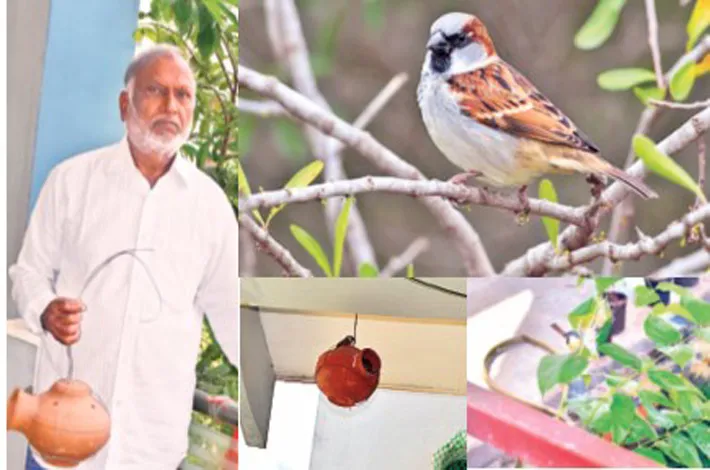
A retired postmaster’s quiet revolution
“Male sparrows are such handsome little things — they flit and turn so fast, they’re gone before you can even say ‘ah!’” chuckles Mohammed Abdul Razzak, 77, as he points toward a blur of wings darting across his balcony in Meerpet, Hyderabad.
While most retirees spend their golden years in quiet leisure, Razzak Saab — as he’s fondly known — has been on a quiet mission since 2009: distributing bird nests, free of cost, to anyone who wants to help a sparrow find a home.
It all began with a fallen nest
Razzak’s journey began in 2008, when he was posted in Marcharla, Mahbubnagar district, as a sub-postmaster. One morning, a sweeper complained about bird nests constantly falling off the office veranda.
“I decided to place a clay pot there — just to help. To my surprise, within 10 minutes, a sparrow had moved in,” he recalls. “In a few days, the chicks hatched and flew away. It moved me deeply. That tiny gesture gave them a home.”
What started as a spontaneous act of kindness turned into a lifelong commitment to sparrow conservation.
It wasn’t easy in the beginning. “The first few nests I made had wide openings. Crows could easily snatch the chicks,” he says. But after a few attempts, he perfected the design — compact, clay-built nests with just enough space for sparrows but not predators.
Since then, he has distributed over 3,500 bird nests across Hyderabad and the twin cities — from residential colonies to temples like Shiva Hills, Venkateshwara in Meerpet, Karmanghat, and Auto Nagar.
No strings attached. No money asked.
“If you want to help birds, just come and take a nest,” he says, with a humble smile.
Sparrows and the humans they love
“Sparrows are not wild birds,” Razzak explains. “They prefer living near humans — nesting in corners of our houses, nibbling on grains like jowar and rice. But they’re disappearing.”
His voice grows serious as he lists the threats: lack of water during summers, toxic cockroaches killed by chemical sprays, and urban predators like crows and cats.
“It’s just like the vultures. Diclofenac used for cattle killed them off when they fed on the carcasses. The same kind of unthinking use of chemicals is hurting sparrows now,” he warns.
Even fledglings — when they take their first flight — are often snatched away by predators. “Three chicks may fly in three different directions. Crows are watching, waiting.”
Razzak’s commitment doesn’t end with nests. Locals in Meerpet know they can call him when they find an injured or fainted bird. He nurses them with water and grains, reviving them until they’re strong enough to return to the skies.
“The dotted dove, bulbuls, sparrows — they all survive because some people still care,” he says gently. “They don’t ask for much. Just a little kindness, a bit of water, and a safe place to live.”