6 October, 2026 | 12:32 AM


SC calls CEC bluff
06-10-2026 12:00:00 AM
SC did not approve modified Form 6
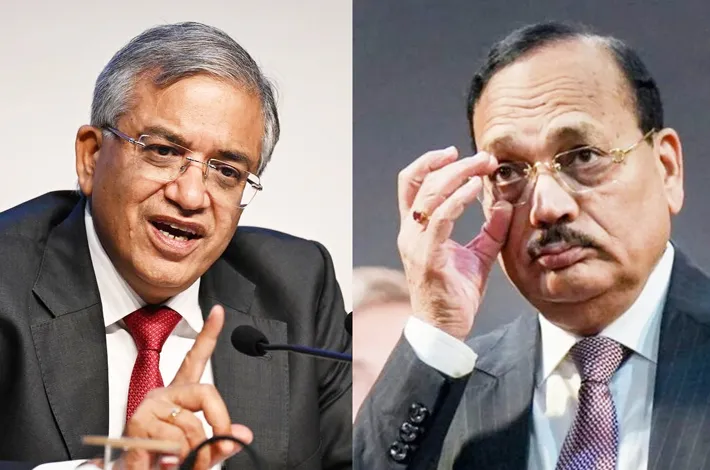
metro india news I hyderabad : In a pointed clarification during hearings on Monday, Chief Justice of India Surya Kant stated that the Supreme Court has not approved any modified version of Form 6 used for inclusion of names in electoral rolls. “Modified Form 6 has not been approved by us, let us be very clear,” the CJI observed, adding that the court would examine records to determine who introduced the changes once produced.
This remark came while a bench comprising the CJI along with Justices Joymalya Bagchi and V. Mohana heard petitions challenging aspects of the functioning of Chief Election Commissioner Gyanesh Kumar in connection with the ongoing Special Intensive Revision (SIR) of electoral rolls.
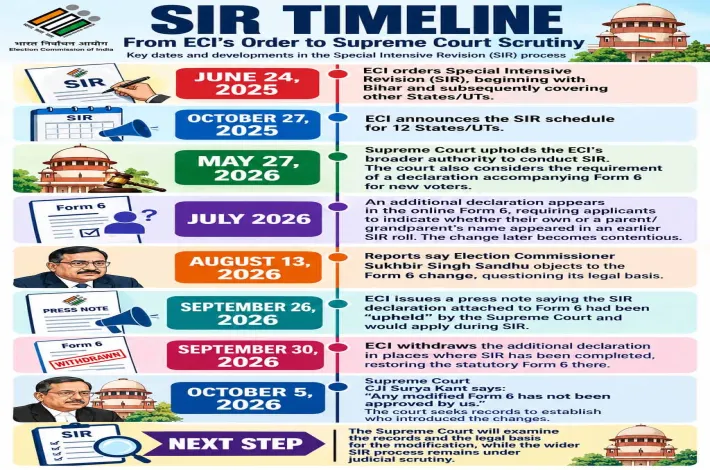
The observation directly addresses claims made by the Election Commission of India in a September 26 press note. The ECI had stated that the declaration attached to Form 6 for the SIR process had been upheld by the Supreme Court, while statutory forms under the Registration of Electors Rules, 1960, would apply outside the SIR period. Form 6 is the prescribed application for claims seeking inclusion in the electoral roll, particularly for new or first-time voters.
The modified version introduced an additional declaration requiring applicants to indicate whether their own name, or that of a parent or grandparent, appeared in an earlier SIR-era electoral roll. Critics have argued that this creates an extra hurdle, especially for those whose families do not figure in older rolls, and that altering a statutory form requires proper amendment of the 1960 Rules rather than unilateral digital changes on the ECI portal.
Reports indicate the online modification appeared in July 2026, after the Supreme Court’s May 27 judgment that upheld the broader SIR framework in the context of Bihar. That earlier ruling recognised residual authority for the Commission to devise documentation suited to intensive revision but stressed that such power is not unbounded and must align with the statutory scheme. The court on Monday made clear it had no occasion to examine or approve the specific later modification. Two Election Commissioners had reportedly raised objections to the changes, citing the need for formal rule amendments. The bench has now directed production of records to identify the source of the alteration.
Parallel concerns over the scale and manner of voter list revisions found strong expression in remarks by Justice Ujwal Bhuyan. Speaking at an event at NALSAR University of Law in Hyderabad, Justice Bhuyan noted that mass voter deletions reduce affected individuals to second-class citizens without voting rights. He emphasised that the Indian Constitution does not recognise two categories of citizens—those with voting rights and those without them. Any process resulting in the wholesale disenfranchisement of millions of Indian citizens, he said, would violate Articles 326 and 14. Article 326 provides for elections on the basis of adult suffrage, while Article 14 guarantees equality before the law.
Justice Bhuyan described such outcomes as intrinsically arbitrary and a direct strike at the foundation of the constitutional order. “No amount of whataboutery can justify” removing the voting rights of millions, he stated, calling it a negation of the constitutional order adopted under the Constitution of India. He linked the right to vote closely with citizenship itself, observing that it cannot be detached from the persona of an Indian citizen without effectively taking the soul out of the body. The right to vote, he recalled, is intertwined with India’s struggle for independence and stands as a manifestation of freedom secured after prolonged sacrifice.
On procedural safeguards, Justice Bhuyan reiterated established legal requirements. Citing precedents, including the principle affirmed in Lal Babu Hussain v. Electoral Registration Officer, he stressed that a voter’s name cannot be deleted from electoral rolls without proper notice and a hearing, except in the case of a deceased voter. Once enlisted, a name remains protected by due process. The Registration of Electors Rules and related provisions under the Representation of the People Act mandate notice, opportunity to be heard, and reasoned orders before deletion on grounds such as non-residence or other disqualifications.
Reports place the number of deletions across states and Union Territories in the region of 13.3 crore names from electoral rolls. In West Bengal alone, figures cited in public discourse have reached around 90 lakh. In Delhi, draft rolls excluded more than 47 lakh names, with over 33 lakh electors issued notices on grounds of mapping issues or logical discrepancies. Large numbers of appeals have followed, with the Election Commission reporting substantial volumes of challenges both against exclusions and inclusions.
These developments occur against the backdrop of the Supreme Court’s earlier affirmation of the ECI’s authority to conduct special intensive revisions under Article 324 of the Constitution read with Section 21 of the Representation of the People Act, 1950. The combination of the CJI’s insistence on examining the origin of Form 6 changes and Justice Bhuyan’s constitutional framing of voting rights as non-negotiable places the SIR process under heightened judicial and public examination.
Administrative exercises aimed at purifying rolls must operate with rigorous adherence to notice, hearing and equality so that eligible citizens are not left without the franchise that the Constitution guarantees. The production of records sought by the court and the continued monitoring of appeals will determine how these principles are applied in practice across the remaining phases of the revision.