13 September, 2026 | 8:00 PM


Telangana AEOs flag heavy workload, seek relief
19-01-2026 12:00:00 AM
metro india news I hyderabad
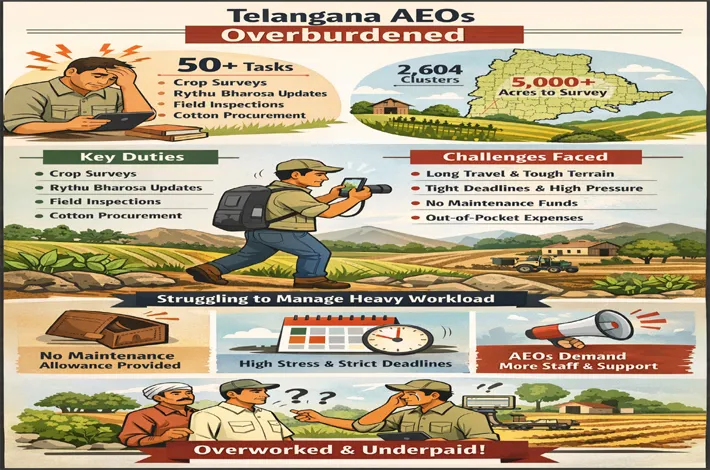
Agricultural Extension Officers (AEOs) in Telangana are reeling under an overwhelming workload, with more than 50 different responsibilities placed on their shoulders. Officers say the pressure has become so intense that many are unable to perform their duties effectively, while some are reportedly facing mental stress. Adding to their woes, maintenance expenses promised by the government are not being released regularly, forcing them to spend from their own salaries.
The Agriculture Department has divided village panchayats across the state into 2,604 clusters and assigned one AEO to each cluster. Every officer is responsible for surveying over 5,000 acres of land spread across three to five villages. During Kharif and Rabi seasons, AEOs must conduct crop surveys and upload detailed data on crops cultivated, land extent and farmer details into government portals. This information forms the basis for extending benefits such as Rythu Bharosa to farmers.
However, surveying such vast extents of land single-handedly has become a daunting task. AEOs are required to upload geo-tagged photographs from within a 25-metre range, which often means trekking through hilly terrain, rocky areas, forests, fields across streams, and regions with no proper road access. Officers say these field conditions make surveys physically exhausting and time-consuming. In several cases, land parcels with ‘by numbers’ require coordination with the Revenue Department, which further delays the survey process.
AEOs say pressure from higher officials has increased significantly. Failure to complete land and crop data entry within stipulated deadlines invites repeated reminders and scrutiny. Apart from crop surveys, officers are burdened with nearly 50 different tasks, including cluster reorganisation, maintenance of Rythu Vedikas, farmer registry updates, Rythu Bharosa, crop insurance, crop booking, urea app monitoring, crop cutting experiments, dairy procurement, Mee Survey, micro-irrigation surveys, farmer registry apps and even duties related to other departments.
At the field level, AEOs say they are struggling to juggle these multiple responsibilities. Even as they are coping with existing duties, the government has recently assigned them additional responsibilities related to cotton procurement.
At cotton mills, AEOs are required to record cotton arrival details, verify farmer information and facilitate purchases in a serial-wise manner. Officers point out that this task traditionally falls under the Market Department, yet the responsibility has been shifted to them, causing further strain. Sources say some AEOs are even opting for leave due to mounting administrative pressure.
Financial concerns are adding to their distress. AEOs say the government had promised a monthly maintenance allowance of Rs 9,000, but payments were made only for a brief period two to three years ago and stopped thereafter. As a result, officers are now spending from their own salaries for travel, mobile data, internet usage and other official expenses. With large land extents to survey, dozens of duties to perform and no maintenance support, officers say the situation has become unmanageable.
AEOs also complain that new assignments are given even before previous tasks are completed, leaving them confused about priorities. Despite this, they are expected to meet strict deadlines, increasing stress levels further. On the ground, farmers often question AEOs over delays in Rythu Bharosa payments or loan waivers, even though these are beyond the officers’ control.
The officers are urging the government to urgently reduce their workload and provide relief. They point out that covering 5,000 acres per cluster forces them to travel across five to six villages, making it impossible to complete surveys and data entry within fixed timelines.