10 October, 2026 | 2:08 PM


Telangana's turns up voltage in EV adoption
04-12-2025 12:00:00 AM
- EV Sales Surge: Telangana's EV sales have exploded from just 544 vehicles in FY19 to 259,053 by March 2025
- Achieving a remarkable 126% CAGR, with two-wheelers dominating at 84% and electric cars at 11% of the market.
- EV charging consumption under Category-IX jumped 291% in a year
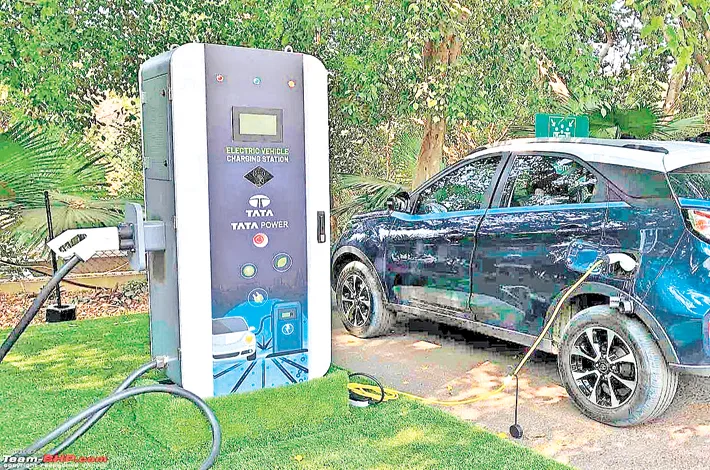
- The state now has over 1,036 charging stations and battery swapping stations (including 150 by TGREDCO and 599 private ones), up from previous levels, with a target of 6,000 by 2030 to support growing demand.
- Expert Insight: As TGREDCO Vice-Chairman and MD Vavilla Anila noted, "the number of EVs in Telangana has increased significantly in the last one year. Power consumption at EV charging stations in Telangana has increased four times in a span of one year."
Telangana is powering its way with an electric jolt as far as EV adoption is concerned. What began as a tiny spark-just 544 EVs sold in FY 2019-has now surged into a high-voltage wave of 259,053 electric vehicles by March 2025. Clocking a stunning 126% CAGR over six years. (JMK Research, TGREDCO). The state is providing a condusive eco-system with expanding charging networks, and tech-driven eco-system.
The push for e-mobility stems from Hyderabad's escalating challenges. With a population exceeding 10 million and approximately 8.6 million registered vehicles as of August 2025, the city grapples with severe urban mobility issues. Vehicular Pollution Load (VPL) stands at 1,500 tons per day, contributing 23% to overall air pollution, while PM2.5 levels often surpass 60 μg/m³—well above safe limits. Identified as a non-attainment city under the National Clean Air Programme (NCAP), Hyderabad has been allocated ₹880 crore from 2020-26 to slash PM levels by 40% through sustainable interventions. Sources like soil and road dust dominate at 52%, but vehicles remain a key culprit, prompting a shift to cleaner alternatives.
TGREDCO, designated as the State Nodal Agency (SNA) for EV charging infrastructure since December 2018, has been instrumental in this transformation. Under the Electric Vehicle & Energy Storage Policy 2020-2030 and the Telangana Clean and Green Energy Policy 2025, the state offers 100% exemption from road tax and registration fees for EVs, incentivizing uptake. Amendments to building rules mandate EV charging provisions in new structures, while a dedicated EV tariff of ₹6 per unit (with zero fixed charges) and an increased contracted load limit from 56 kW to 150 kW enable high-capacity DC fast chargers.
Strategic interventions have yielded impressive results. Collaborations with agencies like GHMC, TGIIC, TGSPDCL, and HMDA, alongside private Charge Point Operators (CPOs) under a PPP model, have expanded infrastructure.
Today, Telangana boasts over 1,036 charging stations, including 150 by TGREDCO, 227 by oil companies like IOCL and HPCL, 12 EVCS, 48 battery swapping stations (BSS), and 599 private EVPCS (EV Public Charging Stations). The TGEV app provides real-time visibility and booking, while TGSRTC is deploying dedicated EV depots to support 2,800 electric buses in Hyderabad over the next three years.
EV sales breakdown reveals two-wheelers dominating at 84%, followed by electric cars at 11%, with four-wheelers accounting for ~11% of sales. Charging consumption under Category-IX has surged 291% in a year, from 2.60 million units (MU) in September 2024 to 10.15 MU in September 2025. TGREDCO contributes 0.15-0.39 MU monthly, TGSRTC 0.04-7.81 MU, and others 0.47-1.95 MU. Shared benefits include land lease revenues for GHMC, HMDA, and TGSPDCL, plus TGIIC's gains from industrial park hosting.
The environmental payoff is substantial. Based on 10 MU consumption, EVs cover 60 million km monthly, avoiding 10,500 tons of CO₂ from internal combustion engine (ICE) vehicles (assuming 175 g/km emissions and 6 km/unit EV efficiency). After accounting for grid emissions, net reduction is 3,230 tons monthly. Pollutants like CO, SO₂, CO₂, and hydrocarbons are drastically cut or eliminated.
Looking ahead, TGREDCO targets 6,000 EVCS and BSS by 2030, with 200 more chargers by 2025 and a ₹300 crore proposal under PM E-Drive. Vice-Chairman and MD Vavilla Anila highlighted the four-fold rise in public charging consumption as evidence of EV proliferation, excluding home charging billed in regular electricity.