15 October, 2026 | 5:10 PM


The ‘Middle Class Manifesto’: India’s unsung engine of growth
07-05-2026 12:00:00 AM
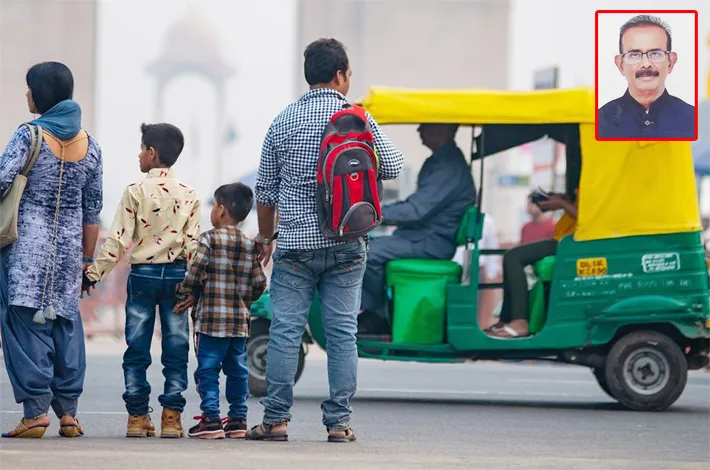
India’s middle class is not merely a demographic segment; it is the heartbeat of the world’s fastest growing major economy. Often described as the backbone of the nation, this segment drives consumption, contributes the bulk of direct taxes, and fuels the aspirations of a Viksit Bharat.
As India stands at the cusp of becoming an upper-middle-income country by 2030, the need for a clear and actionable “Middle Class Manifesto” is both urgent and essential. It is a responsibility that political parties must adopt and the middle class itself must champion.
Who are the middle class in India?
A middle-class household is typically defined as one earning an annual income between Rs 6 lakh and Rs 36 lakh at 2024–25 prices. According to the latest PRICE estimates updated for 2024–25 prices, the middle class comprises over 56 crore people across 12.6 crore households. This accounts for roughly 40 percent of the population and is expected to rise to nearly 60 percent in coming days. The middle class contributes approximately 60 to 61 percent of GDP in FY 2024–25 with personal income tax collections projected to reach Rs 14.66 lakh crore in FY 2026–27. It acts as a growth multiplier by investing in both human capital and physical assets.
What are their needs and problems including societal challenges?
Despite its contributions, the middle class bears a disproportionate tax and inflation burden while receiving relatively fewer subsidies. Rising costs of education, ranging from Rs 5 lakh to Rs 20 lakh for professional degrees, healthcare with high out-of-pocket expenses, and housing through EMIs on loans exceeding Rs 50 lakh consume nearly 50 to 70 percent of household income. Early loans combined with lifestyle inflation often lead to a debt trap and financial stress.
Red tape and bureaucratic inefficiencies persist, with excessive compliance requirements, office delays, customs bottlenecks and regulatory hurdles discouraging entrepreneurship and self-employment. Judicial delays remain severe, with over 5.39 crore pending cases, delaying justice in property, contractual, and consumer matters. Employability stands at only about 54.81 percent, reflecting a significant gap between education and industry needs.
What should political parties include in their manifesto?
Political parties must adopt a focused and actionable Middle Class Manifesto that directly addresses these concerns. Tax reforms should make the Rs 12 lakh zero-tax threshold permanent and index it to inflation. An education revolution must increase spending to 6 to 10 percent of GDP and integrate vocational skills and industry apprenticeships under an enhanced NEP framework to improve employability beyond 70 percent.
Healthcare security should expand insurance coverage, ensure universal access, and deliver affordable quality care. Affordable housing and debt relief should include higher income eligibility ceilings and interest subvention on education and housing loans.Bureaucratic reform should ensure full digitisation, time-bound approvals, and accountability through performance linked systems.
Judicial reforms must increase judge strength to at least 50 per million, adopt AI assisted case management, and enforce time-bound disposal. A strong self-employment ecosystem must simplify MUDRA and PMEGP schemes lending and mandate a Self Employment Lending Fund in all budgets, particularly at the state level. Infrastructure and urban development must accelerate metros, smart cities, and urban infrastructure.
The middle class must evolve into a decisive and unified vote base that rises above caste and party affiliations. It must remain immune to manipulation by corrupt political forces and instead take ownership of the political landscape by acting as informed and responsible political volunteers, supporting leaders and parties based on merit and governance. The guiding principle is simple. Demand transparent governance, honest leadership, meritocracy, and minimal red tape. The responsibility of leading Bharat towards becoming an economic superpower by Amrit Kaal 2047 rests significantly with the middle class itself.
-Dr. Boora Narsaiah Goud, Former MP,
Vice President
BJP Telangana