23 September, 2026 | 12:37 AM


The unasked Questions Let’s give El Nino credit
23-09-2026 12:00:00 AM
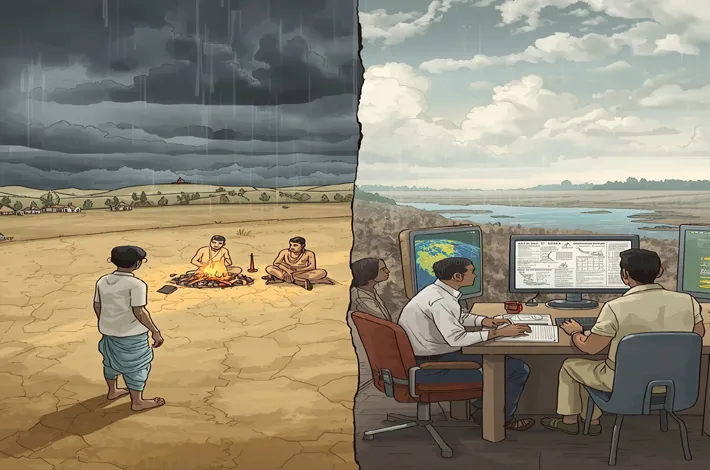
I have been following the rather strange conversation around rain in Telangana with a mixture of amusement and concern. On the one hand, we have meteorologists talking about El Niño, satellite images, rainfall data and weather models. On the other, we have a government organising a yagam to bring rain and political leaders accusing their opponents of performing black magic to stop it.
How did we get here?
In August, the Telangana government conducted a Maha Varuna Yagam at Nagarjuna Sagar, seeking abundant rainfall, full reservoirs and a good agricultural season. According to the government's own account, 108 ritwiks participated, 11 homa kundas were set up and the Chief Minister, ministers and other public representatives participated in it. Interestingly, the government itself referred to the possibility of below-normal rainfall because of El Niño.
El Niño is a well-studied climatic phenomenon involving unusual warming of parts of the Pacific Ocean, which can influence weather patterns across the world, including the Indian monsoon. So what exactly was the yagam expected to do?
Before someone accuses me of questioning people's faith, let me say this clearly. I have absolutely no problem with prayer. A farmer looking anxiously at a cloudless sky may pray for rain. A Chief Minister may pray too. Faith is deeply personal. But the government is not an individual.
That raises a question. If public money was spent on the yagam, should taxpayers be paying for a religious ritual at all? Article 27 of our Constitution says that no person can be compelled to pay taxes whose proceeds are specifically appropriated for promoting or maintaining a particular religion. The legal position on government expenditure connected with religion is more nuanced than a blanket prohibition. But India is a secular State, and governments must be able to justify how public money is spent.
A Chief Minister is free to have faith. But when acting as Chief Minister, the resources at his disposal belong to citizens of every faith and of no faith.
A government also has meteorologists, irrigation experts, reservoir data and weather forecasts at its disposal. If rainfall is likely to be deficient, I expect it to advise farmers, manage water carefully, protect drinking water supplies and prepare for drought. Then came an even more bizarre development.
Congress leaders accused BRS leader T Harish Rao of performing "kshudra pujas", or occult rituals, to prevent rain and create drought. Harish Rao denied the allegations, for which no evidence has been publicly produced. Yet Chief Minister Revanth Reddy repeated the black-magic charge in the Telangana Assembly.
Think about that for a moment. One set of rituals is supposed to bring rain. Another is allegedly being performed to stop it. Meanwhile, somewhere in between, El Niño is quietly doing what climatic phenomena do. It would be tempting to laugh this off as political theatre. Unfortunately, belief in black magic is not always harmless.
NCRB recorded 74 murders in 2023 in which witchcraft was identified as the motive. Telangana too has seen people beaten and killed after being suspected of practising black magic. When such beliefs can have deadly consequences, words spoken by people in authority matter.
Our Constitution asks citizens to develop "scientific temper, humanism and the spirit of inquiry and reform". It does not ask us to give up faith. It asks us to question, examine and look for evidence. Perhaps that is the distinction we are losing.
Pray for rain if prayer gives you hope. Perform a yagam with your own money if that is your belief but when a government confronts uncertain rainfall, I would rather have it looking at meteorological forecasts than the sacred fire. And I would certainly like to know whether taxpayers' money went into that fire. And when it doesn’t rain, please don't tell me the Opposition stopped them through black magic.
El Niño deserves at least some of the credit!
(A L Sharada is a sociologist and the former director of Population First)