18 October, 2026 | 1:02 AM


To Prevent Power Shortages...Prepare for the Next Five Years!
18-10-2026 12:00:00 AM
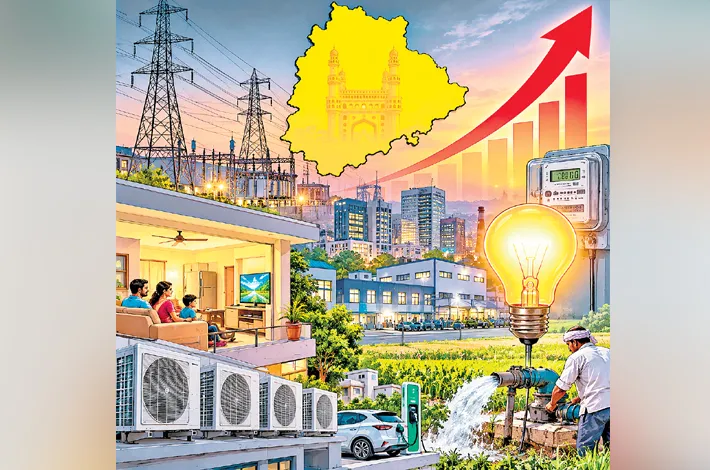
Along with solar and wind power, electricity must be purchased from other states. The plan needs to be implemented on a war footing. Installed capacity stands at 24,643 MW. Peak demand has already crossed 20,000 MW. The govt should take up solar power projects and battery energy storage systems (BESS) in the public sector.
metro india news I hyderabad
The impact of El Niño is being felt, with temperatures remaining 4 to 5 degrees higher than normal even in the winter season. Hydroelectric power generation has plummeted sharply. Due to coal shortages, thermal power stations—particularly the four units of the Yadadri Thermal Power Station (3,200 MW)—are operating at an average Plant Load Factor (PLF) of only 32 percent. The fourth unit has been shut down for the past fortnight. As a result, power shortages in the state have become clearly visible. Anxiety and protests are rising among farmers.
Cuts in supply to industries and commercial consumers appear unavoidable. Moreover, the steadily rising electricity demand is placing severe pressure on the state government and the power sector. During a review meeting, Chief Minister Revanth Reddy himself made it clear that power shortages could take a more serious form in the coming days. Power sector experts are now focusing on how to overcome the current crisis and prepare for future needs.
Only 24,643 MW Capacity
There is a clear need to expand the state’s installed generation capacity further. Currently, under the state government’s Telangana Genco, the available capacity from thermal, hydro, mini-hydro, and solar sources totals 9,624.96 MW. In addition, 76.31 MW of hydro power comes from interstate projects, 8,663.35 MW from the private sector (including private solar), 1,200 MW from Singareni, 1,000 MW from Chhattisgarh, 269.45 MW from other private entities, and 3,809.1 MW allocated by the central government. Altogether, the state’s total installed capacity stands at 24,643.17 MW.
Not Matching Requirements
Despite having 24,643 MW of installed capacity, generation is not matching the state’s demand. No power station operates at 100 percent capacity. The four units at Yadadri Thermal Power Station are running at an average PLF of just 32 percent. Although Genco has 2,430 MW of hydro capacity, reservoirs are full and plants are being operated only minimally, preventing full generation. Coal shortages mean thermal stations cannot produce at the desired levels. Shortages are therefore unavoidable.
Peak Demand Crosses 20,000 MW
On Thursday night, the state’s peak demand crossed 20,000 MW. On Friday afternoon, the Southern Power Distribution Company alone recorded a peak demand of 12,532 MW. Whether acknowledged or not, the reality is that full power supply to agriculture is not being provided. Farmer protests and demonstrations in many places stand as evidence. Thermal power costs up to Rs 6.60 per unit at the maximum, while hydro power can be generated at Rs 2.50–Rs 3.00 per unit. Because of shortages, however, power is being purchased from the open market at Rs 12– Rs 15 per unit. Alternative measures are urgently required.
Immediate Steps
With the government itself stating that the El Niño effect will intensify further by February, urgent measures must be taken on a war footing to mobilise power. Solar capacity needs significant expansion. At present, 8,219 MW of solar capacity is in private hands, while Genco has only 3 MW. The government should itself take up the approximately 7,500 MW of solar power it has recently resolved to develop. Solar plants can be built in a short period of three to six months; with war-footing execution and timely funding, they can be completed even faster. Large-scale Battery Energy Storage Systems (BESS) must be established to store solar power.
Adequate coal must be secured for thermal stations. Discussions should be held with Mahanadi Coalfields and Coal India, in addition to Singareni, to arrange supplies. Thermal stations should maintain at least 20 days of coal stocks and operate at a minimum 70 percent PLF. Wind power also offers scope for about 500 MW and should be utilised. If necessary, power must be purchased from the open market to meet immediate needs.
Preparing for Future Requirements
Alongside immediate action, a plan must be drawn up for future needs. Projects sufficient to meet electricity requirements for the next five years should be taken up. Pumped Storage Projects (PSP) should be prioritised; the Central Electricity Authority indicates potential for more than 20,000 MW of PSP capacity. These should be accelerated so that substantial progress is achieved within two to three years. Greater focus is also needed on additional solar and wind capacity as well as nuclear power. Full use must be made of the reverse-pumping systems at Srisailam and Nagarjuna Sagar. Alternative arrangements should be found so that the two states do not draw maximum water solely for irrigation and drinking needs; this would allow generation of about 2,000 MW of hydro power from the reverse-pumping systems.
Ongoing and planned thermal projects must be completed on a war footing. Singareni’s third unit (800 MW) should be taken up, and Yadadri’s fifth unit (800 MW) completed quickly. New pit-head thermal stations should be examined, and imported coal considered if required, while ensuring the state exchequer is not unduly burdened.
A comprehensive plan aligned with expected demand over the next five years must be prepared and implemented with equal rigour so that the state can generate its own power. Only then can shortages be overcome. Simultaneous execution of immediate measures and the five-year plan will resolve the present crisis and meet future requirements. If shortages persist, state development will suffer, industries will face difficulties and may close, conditions similar to those in the united state may reappear, youth will be affected, and ultimately both the state and the government will incur losses. Therefore, while taking immediate action on a war footing, the plan for future needs must also be implemented.