10 October, 2026 | 1:03 AM


WHO GUARANTEES?
10-10-2026 12:00:00 AM
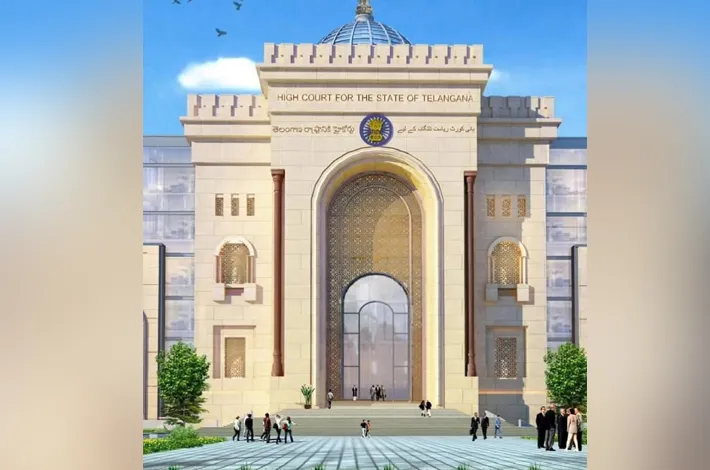
NEW HC BUILDING QUALITY & COSTS ?
Deviations raise cost concerns
Design deviation and excess claims: Concrete and grade slab thicknesses allegedly exceeded tender specifications, while separately claimed reinforcement supports and changes to the parking structure raised concerns over additional costs.
Consultant’s
objections and termination: Team One India reportedly flagged quality issues, design deviations and cost escalation before its contract was cancelled without advance notice and subsequently restored.
Cost escalation and accountability: The consultant warned that cumulative deviations could push costs significantly higher, potentially reaching Rs 5,000 crore relative to the existing tender value, raising questions over independent scrutiny and oversight of public expenditure.
metro india news I hyderabad
Telangana’s new High Court complex at Rajendranagar, one of the state’s biggest judicial infrastructure projects, faces questions over alleged construction deviations, quality control, cost escalation and independent oversight.
Administrative sanction of Rs 2,583 crore was granted through GO Rt No. 827 dated December 7, 2024, comprising Rs 1,980 crore for civil, electrical and mechanical, electrical and plumbing (MEP) works and Rs 603 crore for furniture and operative equipment.
Spread across approximately 100 acres, the complex has a total built-up area of 36.52 lakh square feet. The main civil works contract was awarded to D.E.C. Infrastructure and Projects (India) Private Limited at about 4.95 per cent above the estimated contract value of Rs 1,443.73 crore. Team One India Pvt Ltd was appointed principal consultant under an agreement dated November 2024, with responsibility for design, drawings, quality checks, bill certification and supervision. High Court judges have been involved in project oversight through monitoring mechanisms.
Deviations raise cost concerns
Team One India raised objections during the early stages of construction, flagging quality shortfalls, design deviations, slow progress, cost increases and allegedly unnecessary additional works. Its communications to the Roads and Buildings (R&B) Department pointed to what it described as an apparent alignment between department officials and the contractor that risked inflating public expenditure.
Deviations documented over a three-month period included plain cement concrete executed and claimed at 150 mm thickness against the tender-specified 75/100 mm, and grade slabs measuring 175 mm against the approved 125 mm. The consultant also questioned the adoption of soil-bearing capacity of 40-50 tonnes per square metre despite indications of proven capacity exceeding 70-100 tonnes per square metre, which it said resulted in over-designed foundations and higher costs.
Other objections concerned aluminium shuttering claimed instead of the specified system and separate claims for top reinforcement-supporting chairs, normally included in the contractor’s scope. The latter involved approximately 550 metric tonnes of steel.
The parking bay grid was changed from a two/three-bay arrangement to four bays, necessitating a post-tensioned slab system and altering the structural design. These changes, which the consultant said were accepted by the R&B Department, departed substantially from the approved tender provisions.
Team One India warned that such early-stage deviations could multiply as construction progressed, potentially pushing costs up by thousands of crores, with the increase possibly reaching Rs 5,000 crore relative to the existing tender value.
Consultant’s objections and termination
The department initially removed bill certification from Team One India’s responsibilities and assigned it to another consultant. After Team One India continued raising concerns about deviations and their financial implications, the R&B Department cancelled its contract without advance notice, prompting a protest from the consultant.
The government subsequently reversed the cancellation and restored Team One India’s assignment. However, public discussion of the earlier quality concerns, deviations and cost implications has since diminished, raising questions about whether independent scrutiny remains effective.
Project timeline and accountability
Officials have indicated a completion target around December 2027, or roughly three years from key commencement milestones. Inspections led by Special Chief Secretary-level officials in December 2025 emphasised timely drawings, faster contractor mobilisation and frequent progress reviews. Foundation events for additional zones have since underscored the project’s priority.
The central issue remains whether independent quality checks and financial oversight can prevent deviations from escalating into larger cost and construction problems. Who will verify that concrete thicknesses, foundation designs, reinforcement quantities and structural systems comply with approved tenders and sound engineering practice? And who will ensure that the final cost does not substantially exceed the sanctioned Rs 2,583 crore?
Judicial monitoring mechanisms could insist on transparent documentation of every deviation, independent third-party audits of soil data and material claims, and written approval of justified variations accompanied by cost-impact statements. The R&B Department remains responsible for contract management and public funds, while the contractor must comply with contractual provisions and the consultant must document professional concerns.
The new High Court complex is intended to serve generations. Its delivery on time, to specification and within controlled costs will depend on effective consultant indepen- dence, departmental accountability and judicial oversight. The handling of the reported early deviations and the consultancy contract will be an important test of these safeguards.