7 November, 2026 | 1:10 AM


A leap of faith into fiction
07-11-2026 12:00:00 AM
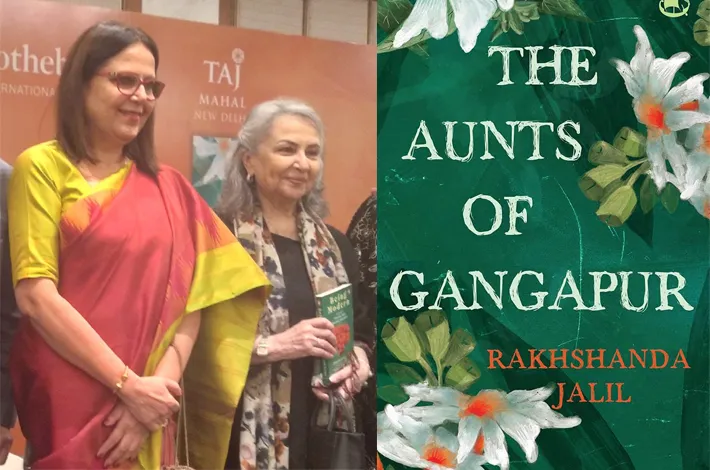
Rakhshanda Jalil never ceases to spring surprises. Her latest surprise is, a serious non-fiction writer, suddenly turns to fiction-writing, making her debut as Novelist. This is something least expected, or even imagined of her. Yet, she does it with such effortless ease and such spectacular success. "A leap of faith," is how Rakhshanda describes the transition, at the launch of her novel, The Aunts of Gangapur.
The book was launched by renowned film star and the undisputed intellectual in the world of Hindi Cinema Sharmila Tagore, historian William Dalrymple and Dastkar Co-Founder Laila Tyabji in New Delhi on November 5.
Hailing from Aligarh, Rakhshanda is married into Eastern Uttar Pradesh, the region of River Ganga; emerging as the symbol of syncretic culture that binds India together. Her novel, The Aunts of Gangapur, transports the reader into another world that seems a distant dream now. The Gangetic heartland of Eastern Uttar Pradesh, which gave birth to the Ganga-Jamni Tehzeeb, or the Composite Indian Culture that defines the national personality of India, provides the perfect setting for her novel.
Befittingly, Rakhshanda invokes Allama Iqbal's lines, Aie aabrood-e-Ganga, woh din hai yaad tujh ko/Utra tere kinaare jab kaarwaan humara (Oh waters of Ganga, do you remember the day when our caravan landed on your banks). Ganga maiya tohe pihuri chadaibe (Oh Mother Ganga, I offer this yellow dhoti to you), is a folk song of the region she quotes. This folk song finds its echo in the Hindi Cinema, Hey Ganga Maiya tohe piyari chadaibo, sanyaan se kar de milanva hai Ram, sanya se kar de milanva oh Ram in a Bhojpuri film, Hey Ganga Maiya.
The Aunts of Gangapur is a typical Muslim social, exploring the lifestyle that is anchored in the social mores. Escaping the Delhi smog, the protagonist Zuby moves to her husband's ancestral home in Gangapur. That's where the story unfolds, with the inevitable twists and turns. The novel recreates the magic of the Muslim Social genre of the Hindi Cinema of the 1960s. This genre delivered hits like Ghazal, Barsaat Ki Raat, Dil Hi To Hai, Mere Mehboob and Palki. Rakhshanda lends poetic cadence to her prose that is so mesmerizing.
Gendered spaces, segregation of Zenana, is part of pardah system practiced in Rajputs in Rajasthan, which is common with Muslim social mores, as well. This strikes a jarring note for the protagonist. Hailing from a nuclear family, finding herself suddenly in the midst of a large, extended family, that's when the culture shock comes for the newly-wed daughter-in-law.
Head uncovered, not coy or bashful, she seems so different, unusual bride. Seating arrangements are different for ladies and gentlemen. She is liberal, but finds her in-laws sectarian; she is Catholic, but she finds her in-laws Puritanical. Silver-lining is, she does not run them down, simply because they are different from her. Over the years, she empathizes with them and understands them, their worldview and their outlook on life; making the narrative truly stand apart.
After setting the stage, then the legendary Aunts are brought on to the centre stage. It takes the protagonist quite some time to understand the lives of her Aunts, not in plain black and white, but over a period of time, in shades of grey. There's Achchi Bi, whose actual name is hardly known to anyone in the family. How does she get such a name is, in itself, an interesting tale.
When she gets married and comes from Badayun, her parents-in-law call her Achchi Bahu; her husband addresses her as Achchi Begum; for the household and in the neighborhood, she is Achchi Bi, even as her real name is forgotten. "That is what goodness does... it defines you. My name is forgotten, lost somewhere along the way, and I became a good wife, a good daughter-in-law, a good mother, a good homemaker, a good cook, a good hostess, a good listener...." Sabr (patience) and Shukr (thanksgiving) become the pillars of her life.
In Gangapur, life is never stagnant, never the same. "Like River Ganga that lends its name to the town, life for its inhabitants is a relentlessly flowing river. The past and the present may fuse into one, like the wave -- when it rises it is water, when it falls it is water, making the river and the wave one -- but the river never runs backward. Good heavens, no!"
What started as a short story, stretched itself into a full-fledged novel. Interestingly, Rakhshanda neither leaves, nor moves away from, her essential moorings. She continues to do what she is known for, all along, introducing the new generation to a language that is seen more as a culture and a movement.
A renowned writer, literary historian, critic and translator, Rakhshanda Jalil has been instrumental in introducing a rave audience to the world of Urdu. She has exposed an entire new generation to Urdu Adab, Tehzeeb (literature and culture), casting a magical spell on Urdu lovers.
For Rakhshanda, only the medium is different; but her mission remains unchanged, of forging and strengthening Hindu-Muslim Unity. She opens up doors to the world that is defined by, and symbolizes, the Composite Indian Culture, for the younger generation. The Aunts of Gangapur forms part of her larger work.
(Venkat Parsa is a senior journalist based out of Delhi)