7 November, 2026 | 1:07 AM


Molecular Switches Tiny devices with many uses
07-11-2026 12:00:00 AM
Science Corner
Imagine a light switch in your home. With a simple flick, it changes from "off" to "on." Molecular switches work on a similar principle, but they operate on an incredibly small scale. A molecular switch is a molecule that can reversibly change between two or more stable structures or electronic states, each with different physical or chemical properties. These changes can be triggered by external stimuli such as light, pH, temperature, electrical signals, chemicals, ions, or biological molecules like enzymes.
For example, a molecule may exist in one form under visible light and switch to another form when exposed to ultraviolet light. Because the two forms often differ in colour, conductivity, or biological activity, the transformation can be observed and used in practical applications. Interestingly, the process is usually reversible, allowing repeated switching between states.
The ability of molecules to change properties in response to environmental conditions has been known for centuries. Robert Boyle observed acid-responsive colour changes in plant extracts in 17th century. In 1928, Otto Diels and Kurt Alder demonstrated light-induced structural changes in organic molecules. The first purposely designed synthetic molecular switches appeared in the 1980s through research at IBM and DuPont. Since then, the field has expanded dramatically, leading to advanced molecular machines. The significance of this work was recognized with the 2016 Nobel Prize in Chemistry awarded to Jean-Pierre Sauvage, Sir J. Fraser Stoddart, and Ben Feringa.
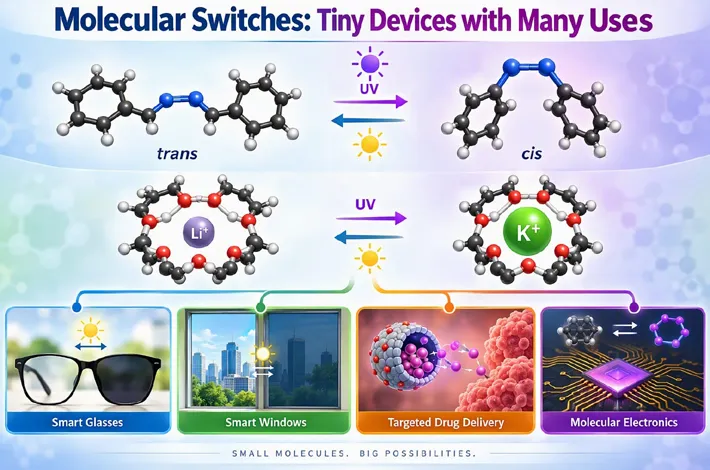
A classic example is an azobenzene-containing crown ether. In its trans form, it selectively binds smaller ions such as lithium and sodium. Exposure to light converts it to the cis form, altering the cavity size and favouring larger ions such as potassium and rubidium. In darkness, it returns to the original form. This behaviour resembles natural ion carriers that transport ions across biological membranes.
Molecular switches are commonly grouped according to the stimulus that controls them. Photoresponsive molecular switches, including azobenzenes, spiropyrans, diarylethenes, and stilbenes, respond to light by undergoing structural rearrangements. Electrochemical molecular switches change state when electrons are added or removed, altering their electrical properties. pH-responsive molecular switches respond to changes in acidity and are useful in sensing, indicators, and controlled drug release. Nature relies heavily on molecular switches such as proteins which function as biological switches. These switches regulate essential functions including cell growth, immune responses, cellular communication, energy production, metabolism, and gene expression. Without them, life could not function properly.
Molecular switches already play important roles in everyday technology. Photochromic eyeglass lenses contain light-responsive molecules that darken in sunlight and become clear indoors. Smart windows use molecular switching principles to control transparency, helping regulate building temperatures and reduce energy consumption. Chemical indicators such as phenolphthalein, methyl orange, methyl red, annatto, and curcumin change colour in response to acidity and are widely used in laboratories. Molecular-scale switching processes also contribute to liquid-crystal display technologies found in smartphones, laptops, televisions, and calculators.
They hold enormous potential for future, researchers are developing targeted drug-delivery systems that release medicines only under specific conditions, such as within tumours. They may also serve as molecular-scale transistors, logic gates, and memory elements for future electronics and data-storage devices. Other possibilities include nanotechnology, molecular machines and smart materials that automatically change colour, shape, stiffness, conductivity, or permeability in response to their surroundings. As molecular engineering continues to progress, these microscopic switches are likely to become key components of next-generation technologies.

(Dr Swarnabala Ganti- a seasoned chemist, Regulatory Affairs Specialist and R&D Scientist. She is a consultant at Swaram Biochem, AgriLife India & Som Phytopharma)