7 November, 2026 | 1:05 AM


Best funding round may be the one you never raise
07-11-2026 12:00:00 AM
STARTUPS, ON SATURDAY
Zoho, a software company that started in Tenkasi, reported a revenue of over US$1.5 billion and a profit of over US$350 million last year. Zerodha, a stockbroking app that is used by millions of Indians, reported a revenue of US$1 billion and a profit of US$500m. These are staggering numbers by any standards. What makes these numbers even more special is what these two companies have in common (apart from company names that start with Z). Neither company has ever raised or announced a funding round. No venture capital was required to build these companies from startups into behemoths. Their first funding came from their customer and so did their latest. 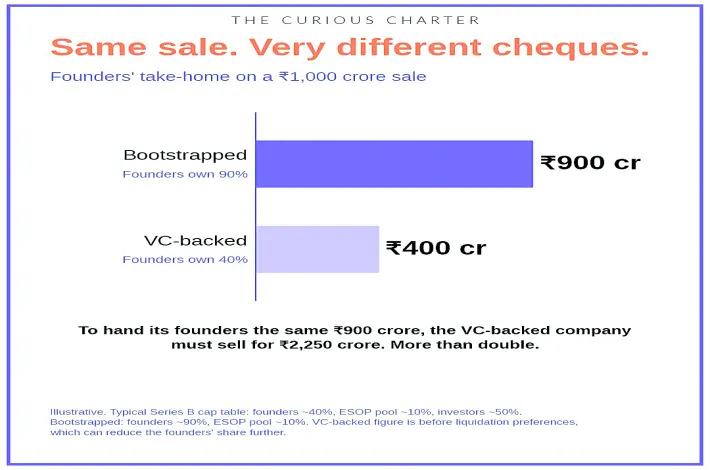
In a vast majority of the startup world, a funding round is often read as a report card. People in the ecosystem often equate doing well to raising money. This week I am looking at the counter thesis. Whilst venture capital is a powerful tool, it is still not the only tool. For any business, the most valuable funding may be the one they choose not to raise.
Every rupee of venture capital comes with an unwritten contract. I have written about two clauses in that contract in two different columns. The first is the Power Law: a fund needs one or two giant winners to return the entire fund, so every company in that portfolio is pushed to aim for the sky or die in the process. The second is the Clock: the money has to go back home in about ten years. So, get your act in that time frame.
The price for this funding is paid in ownership. Founders give away a good chunk of the ownership of the company at every round: Seed, Series A, Series B, stock options for employees and so on. A typical Series B company looks like this: Founders 40%, employees 10%, investors 50%. A bootstrapped company of the same size may look like this: Founders 90%, employees 10%. If both the companies are sold for Rs 1,000 crore, the Founders of the former get about Rs 900 crore and the latter about Rs 400 crore. Sometimes, the latter can be lesser because of clauses known as liquidation preferences. So, Founders need to ask a question with clear eyes before raising venture capital “Will this money help me build something more than twice as big?”
The reality is that most businesses around you have never raised venture capital. The kirana store, the family textile shop, the CA firm, the dental clinic. They grow on customer money. That is not a lack of ambition, it is a choice. Customer money is the cleanest capital there is. It costs no equity, asks for no board seat, and tells you the truth about your product every single time. Occasionally, giant tech companies (like Zoho) are also built in same manner.
If you are looking for a job, a funding headline is not the only sign of a good employer. A profitable company is in control of its own destiny. If you are a wannabe entrepreneur, you should chase customer success and not funding alone.
Point to ponder: Raising money can multiply the team and accelerate ambition. However, the healthiest cheque a business will ever receive is the one written by a happy customer
(Ravi Ravulaparthi is the CEO & Cofounder of Qapita)