7 September, 2026 | 10:47 AM


Adivasis Plight Worsens
13-07-2026 12:00:00 AM
Metro India News | Hyderabad
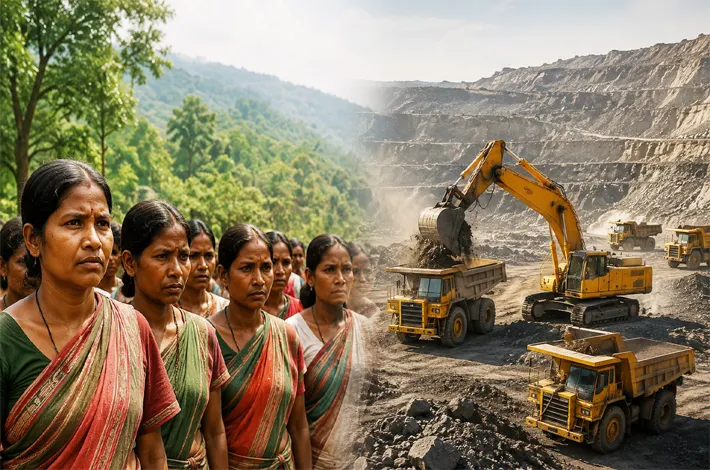
Senior Congress leader and AICC in-charge of Jharkhand K Raju targeted the Ruling BJP for the plight of Adivasis, following their displacement by Government and Project Developers mining in Scheduled Areas across States. Mining-induced displacement hurts Adivasis the most, as a large share of coal, bauxite, iron ore and other mineral deposits are primarily in the Scheduled Areas.
Speaking to Metro India, AICC Incharge of Jharkhand and Permanent Invitee to Congress Working Committee (CWC) K Raju said, "Historically, rehabilitation is focused on compensation for privately-owned land. Even this principle is not honoured under the BJP dispensation. Issue is no longer merely of the economic aspect. Adivasis are tied down to community resources, forest-based livelihoods, besides cultural ties to their ancestral territories in forest areas. Their deprivation is aggravated, when forced out of their natural habitat."
The Congress focus particularly on the development of the Adivasis. Dr B R Ambedkar provided reservations for Adivasis in education and employment. Free India's First Prime Minister Pandit Jawaharlal Nehru shaped the Tribal Policy, championing integration, over forced assimilation.
Nehru unveiled Tribal Panchsheel or Five Principles, mandating Tribal Rights, develop according to their own genius; protect their land,forest rights; training teams of Tribals to govern their own areas; administration should respect traditional Tribal systems; and achieving overall human development among Adivasis.
Rajiv Gandhi, along with Sonia Gandhi, travelled across the Tribal tracts, soon after assuming charge as Prime Minister in 1984. Apparently, his focus was on safeguarding their cultural rights, even while ensuring their social, educational and economic advancement. Sonia Gandhi is credited with Forest Rights Act, 2006, fulfilling the abiding Congress commitmennt for the welfare of Adivasis. Sonia Gandhi, who also brought Land
Acquisition Act, 2013, forcefully advocated Tribals gaining greater control over their resources and preventing their disposession and displacement. Now, focus has clearly shifted on to pursuit of corporate interests, at the cost of Tribal dignity and self-respect, Tribal self-governance and Constitutional guarantees and protection have taken a big hit. Under the BJP dispensation, all laws and legal guarantees merely on paper, with no sincerity for its implementation.
This trend has triggered powerful movements by Adivasis in different States. For instance, K Raju listed out protests during the past 12 years, like campaigns to protect tribal land in Niyamagiri in Odisha in 2014; anti-coal mining movement in Hasdeo Arand in Chhattisgarh, in 2021; Deocha-Pachami coal mine in Birbhum in West Bengal, threatening to displace over 21,000 residents, including more than 9,000 Indigenous Adivasis and Dalits from 2022; movement against bauxite mining in Sijimali, Kutrumali and Majhingmali in Odisha in 2023; movement against coal mines in Raigarh in Chhattisgarh in 2025; and protests against expansion of mining projects, road construction and new security camps in Bastar in Chhattisgarh, since early 2026.
Adivasis are demanding recognition of community Forest Rights; focused consultations in Gram Sabhas; protection of forests and water resources; and compliance with Forest Rights Act and Provisions of Panchayats (Extension to the Scheduled Areas) Act (PESA), 1996, whìch empowers local Gram Sabhas to govern themselves, manage natural resources and protect their traditional customs.
K Raju said, "The Modi Government at the Centre and the BJP Governments in the States act primarily at the behest of Big Corporates, rejecting out-of-hand Statutorily-Guaranteened Rights of the Adivasis. These include Forest Rights Act, 2006, as well as Right to Fair Compensation and Transparency in Land Acquisition, Rehabilitation and Resettlement Act, 2013, enacted by the Congress-led UPA Government, under the guidance of UPA Chairperson Sonia Gandhi."
The Congress leader is particularly concerned that protestors are being intimidated. This is done by way of the detention; placing restrictions on peaceful demonstrations; launching criminal cases against those resisting mining; deployment of police near Gram Sabha meetings, aimed at influencing participation and decision-making; questions over Forest Rights and consent remaining unresolved; and heightened surveillance over activists and community leaders.
Expansion in mining projects under the BJP dispensation has exposed the widening gap between the Constitutional promises and its implementation on the ground. The legal regime, comprising of the Fifth Schedule; Article 21 and 46 of the Constitution; Provisions of Panchayats (Extension to the Scheduled Areas) Act (PESA), 1996; and Forest Rights Act, 2006 framework, have all been weakened.
Result is the energence of a dangerous pattern of displacement, livelihoods loss, besides erosion of traditional rights. Now, the more fundamental question is whether, or not, the Government development policies uphold the Constitutional commitment to protect the dignity, autonomy and overall welfare of the Adivasis, added K Raju.
(Venkat Parsa is a senior journalist.)
"The Modi Government at the Centre and the BJP Governments in the States act primarily at the behest of Big Corporates, rejecting out-of-hand Statutorily-Guaranteened Rights of the Adivasis.”
K Raju
Senior Congress leader and AICC in-charge of Jharkhand