28 September, 2026 | 9:02 AM


Business takes flight at Wings India 2026
01-02-2026 12:13:00 AM
Wings India 2026 by the Numbers
Unprecedented scale: Over 150 exhibitors representing airlines, airport operators, OEMs, MROs, technology providers, training institutions, start-ups, publishers and state governments
Strong footfall: More than 75,000 business visitors and 1 lakh+ general visitors, including suppliers and vendors
Global participation: 2,000 delegates, with 200+ international participants
Aircraft showcase: 30+ static and flying aircraft on display
Business engagement: Over 500 structured B2B and B2G meetings and sessions
Industry impact: Reinforced Wings India’s position as Asia’s most comprehensive civil aviation platforma
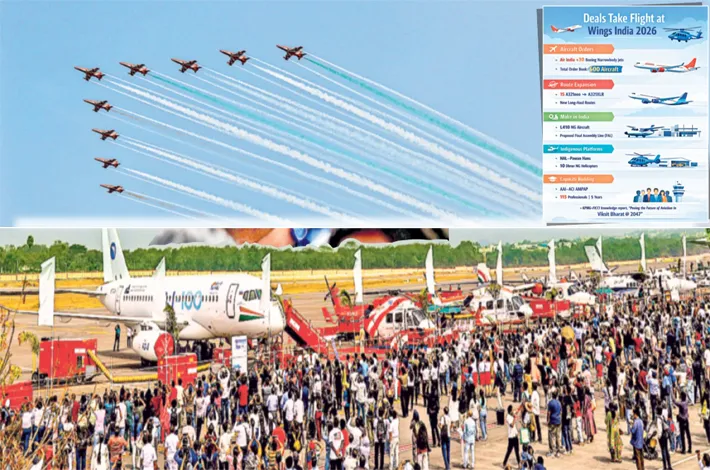
Several landmark industry announcements during the first two business days of Wings India 2026 underscored the strong momentum across India’s aviation ecosystem. Air India placed an additional order for 30 fuel-efficient narrow body aircraft with Boeing, taking its total aircraft order book to 600—among the largest globally. The airline also signed a multi-year agreement with Boeing Global Services for the Component Services Program covering its entire Boeing 787 fleet, including aircraft on order, strengthening long-term operational resilience and fleet support.
In another major development, Air India and Airbus agreed to convert 15 A321neo orders into the advanced A321XLR variant, enabling the launch of new non-stop long-haul international routes with greater range and fuel efficiency. Sakthi Group and Omnipol signed a Memorandum of Understanding to introduce the globally proven L410 NG 19-seater aircraft in India, including an assessment for setting up a Final Assembly Line (FAL), providing a significant boost to indigenous aircraft manufacturing under the Make in India initiative.
Hindustan Aeronautics Limited (HAL) executed a contract with Pawan Hans Limited (PHL) for the supply of 10 Dhruv Next Generation helicopters, reflecting growing confidence in indigenously developed civil aviation platforms. Strengthening capacity building and global alignment, the Airports Authority of India (AAI) signed an agreement with Airports Council International (ACI) for the Airports Management Professional Accreditation Program (AMPAP), under which more than 115 aviation professionals will be trained over the next five years.
Additionally, the KPMG–FICCI knowledge report, Paving the Future of Aviation in Viksit Bharat @ 2047, was released, outlining nine strategic themes to help India transition from being one of the world’s largest aviation markets to a global aviation ecosystem leader.
All heads skywards
The event was marked by spectacular aerial displays and an impressive static showcase highlighting both indigenous capability and global aviation excellence. The Surya Kiran Aerobatic Team (SKAT) enthralled audiences with breathtaking formations, flying nine indigenously built Hawk Mk-132 aircraft and executing high-precision manoeuvres, enhanced by tricolour trails from newly developed indigenous smoke pods.
The static display featured a wide and diverse range of aircraft. HAL platforms on display included the Hindustan 228, Dhruv ALH-NG and the LUH Civil Helicopter, alongside indigenous aircraft such as the Hansa-3 (NG). Regional aviation was represented by the IL-114-300 and SJ-100 aircraft. The commercial and business aviation segment showcased the A321neo, A220, Falcon 6X and PC-24.
Aircraft from major Indian carriers—including the Air India Boeing 787-9, Air India Express Boeing 737 MAX and Akasa Air Boeing 737-8 MAX—were also on display. In addition, training and aerobatic aircraft from Tecnam, Diamond Aircraft and Extra Aircraft were showcased, offering visitors a comprehensive view of the aviation ecosystem.