23 October, 2026 | 12:16 PM


PK leads the way
13-08-2026 12:00:00 AM
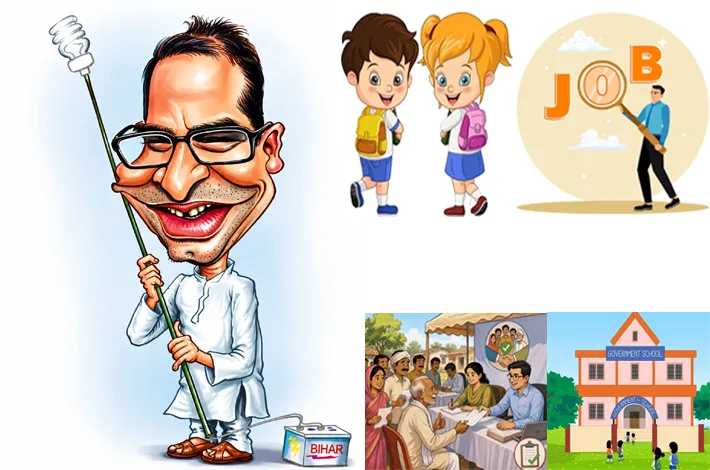
Kishore’s approach differs from the more gradual processes typically associated with govt schemes
New Benchmark for performance
- 10,000 private-sector jobs for local youth
- Better facilities in government schools
- Financial assistance for poor senior citizens
- Financial support for private-school students
vjm divakar
Newly elected MLA from Bankipur in Bihar and Jana Suraj Party founder Prashant Kishore has stirred a hornet’s nest with a series of announcements that have drawn widespread attention across political circles. Soon after securing his victory and assuming office, he initiated a door-to-door visit (called Abhar Yatra) across his constituency as part of a thank-you programme directed at the voters who supported him. During these interactions, Kishore outlined an ambitious set of commitments that stand apart from the conventional promises often heard in electoral cycles. Central to his declarations was the pledge to arrange approximately 10,000 private sector jobs for unemployed and eligible youth from Bankipur. Drawing on what he described as an extensive network spanning the country and personal contacts with influential figures, he stated that these placements would be secured within a year.
Eligible young people were asked to submit their CVs to his office so that the process could begin without delay. Kishore presented this as a practical response to the persistent challenge of unemployment, positioning himself as a facilitator who could bridge local talent with opportunities beyond the immediate region. Alongside the employment initiative, he addressed education and social welfare. Kishore assured residents that government schools in the constituency would receive the necessary facilities, an adequate number of teachers, and improved quality of instruction within a matter of months. He further committed to extending financial support to students enrolled in private schools, aiming to ease the burden on families who opt for such institutions. For senior citizens living in poverty, he promised a monthly financial assistance of Rs 1,100, framing it as a measure of dignity and basic security for the elderly.
These announcements, delivered with an emphasis on speed and personal accountability, have generated discussion about the role of individual legislators in addressing everyday concerns. Analysts note that Kishore’s approach differs from the more gradual processes typically associated with government schemes. By invoking private sector networks and setting a one-month timeline for job placements, he has introduced an element of urgency that many constituents find appealing. The focus on both public and private education, combined with direct cash support for the elderly, creates a multi-layered package that touches several segments of the population simultaneously.
The potential consequences of these measures extend well beyond Bankipur. Political observers suggest that the combination of rapid job facilitation, school upgrades, and senior citizen assistance could create pressure on other elected representatives to demonstrate similar responsiveness. In a landscape where public dissatisfaction with unemployment, uneven ed- ucational standards, and inadequate social safety nets remains high, Kishore’s visible actions may encourage voters to expect concrete deliverables rather than distant policy statements.
The reference to Gen Z-led protests at locations such as Jantar Mantar and Ranchi provides a useful parallel. Those demonstrations revived a culture of questioning authority and articulating demands for fairness. In a comparable way, Kishore’s steps could prompt citizens to ask their own MLAs, MPs, and local representatives for equivalent initiatives. If such expectations take root, the effect might travel from village panchayats to state assemblies and eventually to the national Parliament.
Legislators who have relied on traditional patronage or long-term infrastructure projects may find themselves compelled to show quicker, more tangible results in employment and welfare. The idea of a single MLA arranging thousands of private jobs through personal networks challenges the conventional understanding of an elected representative’s responsibilities. It raises questions about the boundaries between individual influence and institutional mechanisms, and about the sustainability of such commitments once the initial momentum fades. Supporters of Kishore argue that his background as a political strategist and organiser equips him with the contacts necessary to deliver on the job promise.
They point to the door-to-door outreach as evidence of genuine engagement rather than remote governance. Critics, however, caution that timelines of one month for 10,000 placements and “within months” for school improvements set a high bar that could invite scrutiny if results fall short. The monthly assistance of Rs 2,100 for poor senior citizens and support for private-school students will also require clear criteria, transparent selection processes, and reliable funding channels if they are to avoid perceptions of favouritism or temporary relief. Regardless of eventual outcomes, the announcements have already shifted the conversation.
Voters in other constituencies are beginning to discuss whether their own representatives can match this level of proactive intervention. Civil society groups monitoring governance indicators may use Bankipur as a reference point when evaluating performance elsewhere. Media coverage of the CV collection process and subsequent placement updates will likely keep the story in public view, maintaining pressure for accountability. The broader implication is the possible emergence of a demand-driven culture among the electorate. When citizens witness one legislator committing to rapid job creation, educational upgrades, and direct financial aid, they may transfer those expectations to every level of representation. This could gradually alter the relationship between the elected and the electors, moving it toward greater insistence on measurable progress in areas that affect daily life. Whether this develops into a sustained people’s movement for improved governance remains to be seen, but the initial spark has been lit in Bankipur through Kishore’s post-election actions.
In the coming weeks, attention will focus on the volume of CVs received, the pace of job placements, the first visible improvements in government schools, and the rollout of the senior citizen assistance. Each of these will serve as a test of the announcements’ credibility. Success could inspire similar efforts by others; shortfalls could temper enthusiasm. Either way, the episode has introduced a new benchmark against which political performance in Bihar and beyond may be measured. The cascading effect that Kishore’s measures are expected to produce rests on the willingness of citizens to convert observation into expectation and expectation into sustained demand for action from their representatives.