22 September, 2026 | 12:46 AM


Can Bharat Taxi withstand dominant Olar, Uber, Rapido
21-12-2025 12:00:00 AM
$200 billion, presence in 150 countries, 80 billion annual rides, market size increasing at 15%, and 50% market in Asia-Pacific are the summary statistics of ride hailing business. Ride hailing democratized the availability of vehicles for everyone. GPS, real time tracking, location based, and mapping technology for route optimization are its merits. By connecting nearest vehicles to the users, it inherently eliminates economic losses present in the traditional taxi system. Feedback is transparent due to the mutual rating by users and drivers on each other.
Dynamic pricing and surge pricing are value additions. Since ride hailing companies are aggregators, vehicle inventory and capital blockage are avoided. The business models include commission based and subscription based and few other variants. Ride hailing branched out to food delivery including cloud kitchens, freight delivery, courier service, and group passenger transportation. E-commerce uses nodal bank accounts as escrow system for revenue distribution between aggregator and seller.
Revenue is distributed after product receipt confirmation, expiry of fraud-reporting period, and KYC is met. But ride hailing business adopts batch payment mechanism paying the drivers weekly or monthly. Worldwide, ride hailing provides livelihood to 30 million people. Amidst many aggregators, less than 10 have 99% market share. They enjoy 50% gross margins with cost structure including technology, marketing and insurance and net profits ranging between 15% to 20%.Uber, headquartered in US, pioneered ride hailing concept in year 2009 and expanded to 70 countries.
Its expected annual turnover for 2025 is $50 billion with 50% from ride hailing. Didi Chuxing is world’s biggest in terms of volumes. It operates within China but is expanding to other countries. Grab is another big company headquartered in Singapore with presence in 9 eastern countries. Gojek is popular in Indonesia, Lyft is another popular aggregator in US, InDrive is popular in Russia, Careem is popular in UAE, and 99 is popular in Brazil.In India, Ola introduced ride hailing in year 2010 by adopting Uber’s model. Size of India’s total taxi market is Rs. 1,90,000 crs of which about 50% is with ride hailing.
In four-wheelers, Uber has 50% share, Ola 30%, Rapido 28% and others 2%. In autorickshaws, Uber has 40%, Rapido 30%, Ola 25%, and others 5%. In bikes, Rapido has 65%, and 35% by others.Annually, more than 1 lakh complaints arise. Drivers complain of aggregator charges up to 40%, delayed receipts, and unfair trade practices. Users complain about drivers’ bad behaviour, surged prices, long waits, sudden cancellations, and misguided trips. Regulation includes Motor Vehicles Aggregator Guidelines (MVAG) 2025, sharing minimum 80% to owner-drivers and 60% to aggregator-vehicles, Rs. 5 lakhs insurance, multiple platform permissions, compulsory induction trainings, and KYC verifications.
Despite open competition, government regulations, and demand, the triopoly is continuing and number of complaints are ever increasing. No driver and no customer is happy although no one can avoid using ride hailing system. Open Network for Digital Commerce (ONDC) helped Namma Yatra in Bangalore, Yathra Sathi in West Bengal, Odisha Sathi in Odisha, and Kerala Savaaari in Kerala to introduce subscription-based option. In this model, driver pays a fixed subscription fee and receives 100% fare. However, the ride hailing companies also shifted to subscription options and ONDC based aggregators lost edge.
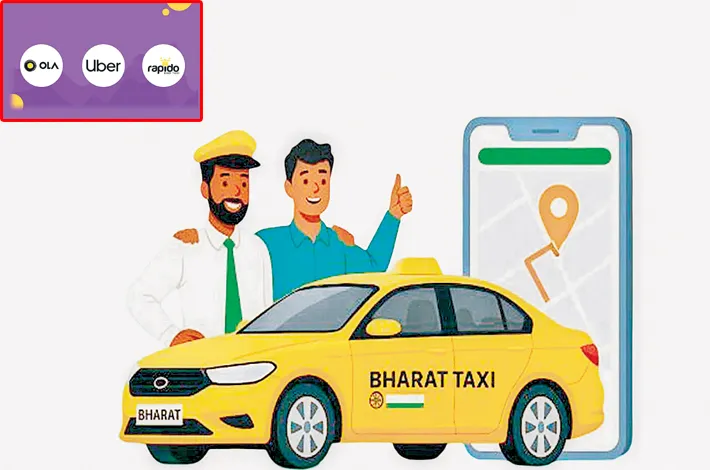
Now, Government of India established Sahakar Taxi Cooperative, with product brand as ‘Bharat Taxi’. This model is adopted from the US based ‘Drivers Cooperative’ which is a driver-members owned platform with fixed and transparent fee which has been performing well but could not dent the dominance of Uber and Lyft. Bharat Taxi has 8 PSUs as founding members with Rs. 80 crs as initial capital and will increase up to Rs. 300 crs. NABARD and other government agencies confirmed their support. Driver-members will be shareholders and will benefit from fares and also dividends.
Mandated to operate in Delhi, Uttar Pradesh, Gujarat, and Maharashtra and may expand to other states in due course. The prevailing extreme dependency on private intermediators, oligopoly situation, and unfair trade practices require Bharat Taxi initiative. However, Bharat Taxi should avoid using third party private servers, exposure of user data and ride requests, and lack of data isolation. Further, studying the challenges of Drivers Cooperative and similar entities, Bharat Taxi should adopt best technology and remain agile to compete Uber, Rapido and Ola failing which Bharat Taxi may ail and fail.
– Dr. Kishore Nuthalapati The author is CFO of BKEM Infra Projects Pvt Ltd