22 September, 2026 | 1:36 AM


Supreme Court ruling sparks outrage: Are the Aravallis under threat?
21-12-2025 12:00:00 AM
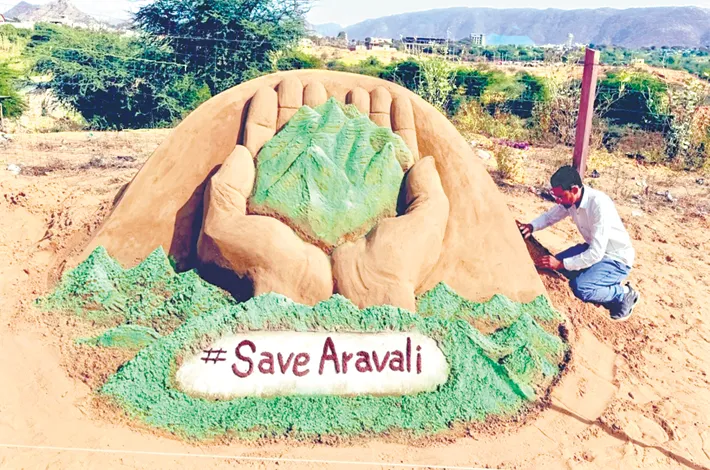
Environmentalists, legal experts, and activists slammed a recent Supreme Court judgment that redefines the Aravalli hills. The November 20, 2025, ruling accepts a government-proposed definition classifying only landforms rising 100 meters or more above local relief as protected "Aravalli Hills," potentially stripping legal safeguards from over 90% of this ancient mountain range. They argued that neither the Supreme Court nor the current government existed when these hills formed, questioning their authority to dilute protections. They further allege that rules have been altered to allow billionaire corporations and real estate giants to "destroy" the 2-billion-year-old Aravalli range, one of the world's oldest geological formations stretching 700 kilometers across northwest India.
The Aravallis serve as a critical ecological shield, preventing the eastward advance of the Thar Desert into Haryana, western Uttar Pradesh, and the Delhi NCR. They moderate wind velocities, recharge groundwater—each hectare capable of replenishing millions of liters—and sustain biodiversity. Experts warn that excluding lower ridges and inter-hill corridors could accelerate desertification, collapse aquifers, intensify dust storms in Delhi, and worsen air quality in an already choking region.
In Rajasthan, where the range is most extensive, only about 8.7% of 12,081 identified hills exceed 100 meters, leaving 91% vulnerable to mining, real estate development, and infrastructure projects. Environmentalists highlighted potential windfalls for mining corporations, stone crushers, cement manufacturers, and developers, who could transform protected land into golf courses and luxury apartments near the national capital. "Foreign investors will team up with politically connected companies," they claimed, predicting billions in profits while farmers, groundwater systems, and urban air quality suffer.
A former Solicitor General Ranjit Kumar, who provided information in earlier Aravalli cases, called the shift "disastrous." He noted prior Supreme Court bans on mining from 2002 to 2018 had allowed forest regeneration and water recharge. Kumar urged the court to revisit the order, arguing it contradicts established judgments protecting the entire range. Activists like Shubhra Puri from the Save Aravallis campaign described growing public response, with citizens emotionally rallying to raise awareness about interconnected ecosystems linking air, water, plants, and animals
At the same time, there is a section of legal fraternity who explicitly defended the judgment, argued that the ruling has been grossly exaggerated and mischaracterized as permitting outright destruction of the range. They pointed out that the decision, based on recommendations from a centrally empowered committee of experts, prohibits new mining leases except in cases involving atomic minerals, which he stressed are crucial for national security. They contended that mining activities have persisted in the Aravallis for decades amid definitional uncertainties about hill heights, and this judgment finally resolves those issues, paving the way for sustainable mining practices that eliminate discretionary powers previously exploited by unscrupulous elements.
Another attorney and jurist from the Supreme Court, provided a nuanced perspective that indirectly supported the judgment's framework while acknowledging governmental convenience. She highlighted that the judgment addresses practical realities, such as ongoing legal mining that cannot be abruptly halted without broader implications, aligning with prior court observations on avoiding complete bans that could lead to ill consequences in states like Haryana. She suggested that the definition provides a structured contour for real estate and development, though she criticized the trend of governments hiding behind judicial decisions rather than owning them.
A BJP leader from Haryana noted that the Rajasthan government in 2017 sought changes due to mining bans, and the Haryana government had previously floated criteria like excluding hills younger than 500 years from protection. He contended that the judgment's height-based criterion (100 meters or more) could protect
core areas while allowing development in non-essential zones, such as potential national parks or safaris in places like Mangar Bani, as proposed by those like Union Minister Manohar Lal Khattar.
Environmental groups have intensified the #SaveAravallis campaign, urging citizens from various walks of life to mobilize. As dust corridors threaten to open and groundwater crises loom, the debate underscores a broader tension between development, corporate interests, and preserving India's ancient ecological heritage.