21 October, 2026 | 9:54 AM


Constitution, Dharma, and the Sacred Land of Shri Rama
21-01-2026 12:00:00 AM
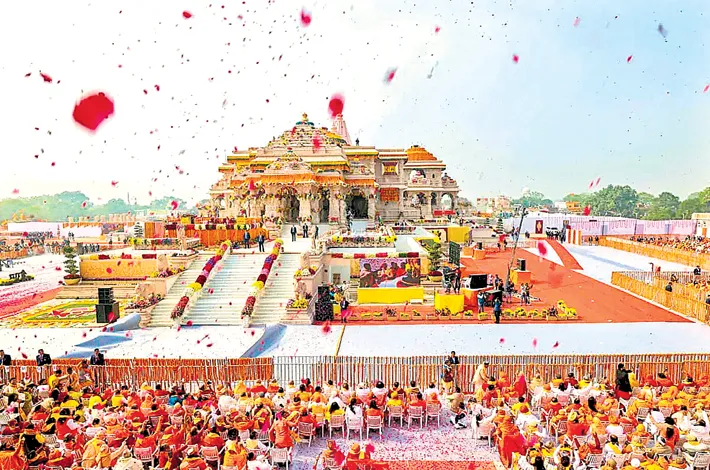
The history of Pakistan’s creation and its foundational objective, as detailed in Creating a New Medina by Shri Venkat Dhulipala, alongside the purpose of Article 2A of the Pakistan Constitution introduced during the Zia regime, provides a crucial lens to understand the deeper constitutional, civilisational, and spiritual significance of 22 January 2024—the auspicious date of the Ayodhya Pran Pratishta, when Shri Ram Lalla revealed Himself.
The resolution of the Article 363 dispute demonstrates that the pious intent of Article 26 of the Constitution of India—symbolically reflected in the original Constitution through the depiction of Shri Rama, Sita Devi, and Lakshmana—is to counter the objective of Article 2A of the Pakistan Constitution by reaffirming the legal and civilisational position as it stood on 22 January 1947, when the ancient sacred land remained undivided and dharmic practices were uninterrupted.
This principle flows directly from the Constituent Assembly Objectives Resolution of 22 January 1947, which embodied the ideals of Rama Rajya: Dharma, righteousness as the king of kings (Dharmam Kshatrasya Kshatram), and the protection of virtuous governance. These principles are to be read in conjunction with the Government assurance of 22 July 1947, guaranteeing the right to worship in one’s own way, alongside protection of language, culture, and religious traditions. Taken together, these instruments impose a legal limit on constituent law-making powers and operate under Article 26 read with Article 363, recognising the rights of the Deity and ensuring continuity of dharmic culture.
Significantly, this position existed as early as 15 August 1949 under the previous constitutional regime, when the Travancore Instrument of Accession was accepted. The duty of enforcement was expressly assigned to the devotional Tiruppan Alwar Ammal (SC/ST) community, highlighting the continuity of constitutional obligations toward Deity worship. This demonstrates that the constitutional recognition of religious and dharmic rights is neither incidental nor symbolic; it is a foundational element of the legal and civilisational structure of India.
The broader purpose is the protection of the dharmic character of Shri Rama’s ancient sacred land—a character intrinsically tied to the ongoing worship of the Deity. The constitutional duty to preserve this character stands in direct opposition to, and thereby nullifies, the objective underlying Article 2A of the Pakistan Constitution. In effect, Article 26 and Article 363 together affirm that the spiritual and civilisational integrity of the land, along with the rights of the Deity, must be maintained as a living constitutional commitment.
The historical motivation behind Pakistan’s creation is succinctly captured in a quote attributed to Jinnah, cited in the introduction of Creating a New Medina:
“I seek to secure the land for the mosque; once that land belongs to us, then we decide how to build the mosque.”
Extensive historical evidence in the book substantiates this articulation of intent, providing crucial context to interpret Pakistan’s constitutional provisions and to understand the civilisational stakes involved.
In essence, Article 2A reflects the original objective of Pakistan’s creation, as summed up in Jinnah’s statement above. The constitutional logic is clear: the aim is to extend Article 2A over the rest of the ancient land, thereby undermining the Deity of Shri Rama and attempting to erase the dharmic continuity of the region.
Against this backdrop, the constitutional, dharmic, spiritual, and civilisational significance of enforcing Article 26—which recognises the Gods of all religious denominations—and Article 363 of the Indian Constitution, alongside the events of 22 January 2024, must be understood with great care. Corrective legal, constitutional, and civilisational measures must ensure that the dharmic character of the sacred land, and the rights tied to Deity worship, are upheld, preserved, and respected, safeguarding the ancient heritage for future generations.
Rangarajan S, Chief priest of Chilkur
Key Constitutional Provisions of Pakistan: Article 2 declares Islam as the State religion.
Article 2A, introduced during the Zia regime, establishes that the principles and provisions set out in the Objectives Resolution, reproduced in the Annex, are a substantive part of the Constitution and shall have full effect.
The original Objectives Resolution of the Pakistan Constituent Assembly stated:
“WHEREAS sovereignty over the entire universe belongs to God Almighty alone, and the authority which He has delegated to the State of Pakistan through its people, for being exercised within the limits prescribed by Him, is a sacred trust.”
Later, “God Almighty” was replaced with “Almighty Allah”:
“WHEREAS sovereignty over the entire universe belongs to Almighty Allah alone, and the authority which He has delegated to the State of Pakistan through its people, for being exercised within the limits prescribed by Him, is a sacred trust.”