21 October, 2026 | 10:42 AM


Bengaluru polls stir ballot vs EVM storm
21-01-2026 12:00:00 AM
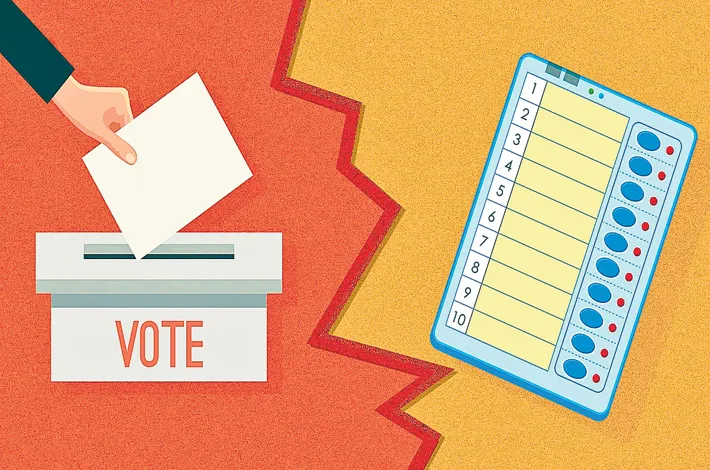
The Karnataka State Election Commission’s decision to conduct the upcoming municipal elections in Bengaluru under the Greater Bengaluru Authority using paper ballots instead of Electronic Voting Machines has reignited a long-simmering national debate on electoral credibility. Coming on the heels of a recommendation by the Congress-led state cabinet, the move has drawn sharp political reactions, with critics calling it a panic-driven rollback and supporters framing it as a corrective step to restore voter trust.
At the heart of the controversy is the Congress party’s renewed attack on EVMs, spearheaded in recent years by Rahul Gandhi, who has repeatedly alleged that electronic voting is vulnerable to manipulation and institutional bias. The party argues that paper ballots, especially in local body elections with limited electorates, reduce vulnerabilities linked to voter rolls and increase transparency. Congress leaders insist the decision reflects public sentiment rather than political insecurity.
Opposition voices, particularly from the BJP, see it very differently. They argue the shift represents selective distrust of institutions following repeated electoral defeats. EVMs, introduced nationwide to curb booth capturing, ballot stuffing and large-scale invalid voting, have been repeatedly upheld by the Supreme Court. Critics say abandoning them in municipal polls undermines decades of reform and sends a mixed signal to voters about the integrity of elections.
The irony has not gone unnoticed. Senior Congress leaders in the past had strongly defended EVMs. Abhishek Manu Singhvi once described a return to paper ballots as a regression to the dark ages, while Manish Tewari dismissed such ideas as unrealistic. It was under Rajiv Gandhi’s government in the 1980s that India began experimenting with electronic voting as a modern, tamper-resistant alternative. Today, the same party, whose governments in Karnataka, Telangana and other states came to power through EVM-based elections, is questioning the system selectively.
BJP leaders have seized on this contradiction, accusing Congress of hypocrisy. They argue that if EVMs are inherently flawed, Congress should reject not just defeats but also victories achieved through the same machines. One leader challenged Rahul Gandhi and Priyanka Gandhi to resign from their EVM-won seats if their distrust is genuine. Others warned that reverting to ballots risks reopening doors to older malpractices, citing incidents of ballot looting and violence in local elections in states like West Bengal.
Congress, however, has pushed back strongly. Party leaders say the decision was taken independently by the State Election Commission after consultations with all stakeholders, including the BJP, and not imposed by the state government. They point to past incidents, such as the Chandigarh municipal election controversy where a presiding officer was censured for manipulating ballot papers, to argue that doubts about electoral processes are not partisan inventions. According to them, raising concerns does not amount to rejecting democracy.
Support for Congress’s position has come from opposition allies like the DMK and the Samajwadi Party. They claim the problem goes beyond machines to include alleged voter list manipulation, duplicate voting and administrative bias favouring the ruling party at the Centre. Some leaders argue that even when opposition parties win convincingly, as the DMK did in Tamil Nadu, the margins could have been larger without what they describe as systemic interference. For them, the demand for paper ballots is as much about challenging institutional neutrality as about voting technology.
The Congress has also cited international examples, noting that countries such as Germany and the Netherlands rolled back electronic voting after concerns over verifiability and transparency. In their view, paper ballots offer a tangible audit trail that reassures voters, especially at the grassroots level. They argue that in municipal elections, where stakes are local and logistics manageable, ballots are a reasonable alternative.
Critics counter that these arguments conflate unrelated issues. Voter roll inaccuracies, they say, are administrative problems that ballots do not solve. Unlike EVMs with VVPATs, paper ballots offer no instant verification mechanism and can actually make post-poll disputes messier. BJP leaders insist that the Supreme Court has repeatedly found no evidence of EVM tampering, including after extensive audits involving VVPAT slips, and warn that questioning the system without proof erodes public faith.
As Bengaluru prepares for its first ballot-based civic election since EVMs were introduced in municipal polls in 2015, the debate has moved beyond technology to larger questions of political accountability. Is the return to paper ballots a genuine attempt to rebuild trust, or a symbolic gesture aimed at deflecting blame after electoral losses? Does it strengthen democracy by offering choice, or weaken it by politicising institutions?
What is clear is that the Karnataka decision has reopened an unresolved national argument. With opposition parties increasingly vocal about electoral processes and the ruling party firmly defending existing systems, the battle over ballots versus machines has become a proxy for deeper anxieties about power, credibility and the rules of India’s democratic contest.