15 September, 2026 | 11:01 AM


Digital Shield or Spy Trap?
05-12-2025 12:00:00 AM
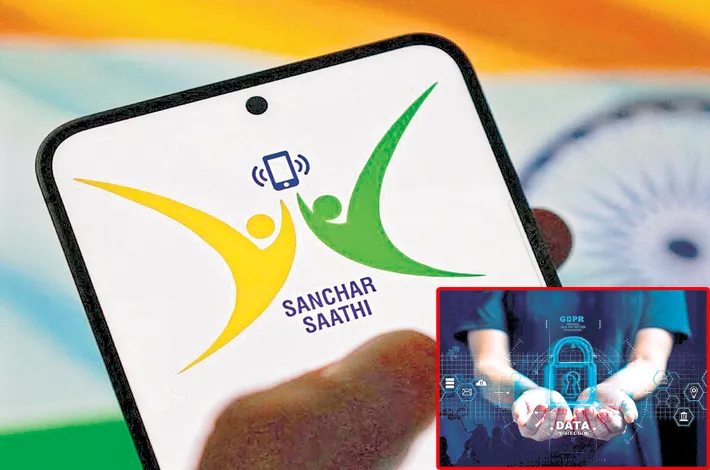
- 1.25 crore app downloads reported
- 42 lakh stolen phones blocked
- 26 lakh stolen phones recovered
- 22.68 lakh cyber fraud cases in 2024
- 10 lakh fake SIM cards detected
- 2.63 lakh fake IMEI numbers identified
India is witnessing one of its most polarising conversations on digital privacy and surveillance, sparked by the Sanchar Saathi app. Originally launched as a cyber-security initiative, the app’s evolution into a state-mandated tool has raised urgent questions: Is it a protective digital shield against cybercrime, or a doorway to intrusive surveillance? Citizens, political parties, tech experts, and global companies are sharply divided, making this debate a national flashpoint.
Sanchar Saathi was introduced as part of India’s digital safety roadmap. The web portal went live in May 2023 to combat stolen mobile phones, fraudulent SIM cards, cloned IMEI numbers, and telecom-linked cybercrime. Its mobile app followed in January 2025. For nearly two years, it functioned voluntarily, allowing users to check SIM connections, verify IMEIs, block stolen devices, and report suspicious communications through its Chakshu feature. Government data highlighted its impact: over 1.25 crore installations, 42 lakh stolen phones blocked, 26 lakh devices recovered, and thousands of fraudulent SIMs deactivated. On the surface, it seemed like a successful citizen-friendly tool.
The turning point came on December 1, 2025, when the government issued a directive mandating that all new smartphones sold in India must come with Sanchar Saathi pre-installed, giving manufacturers 90 days to comply. This move transformed the app from a voluntary security assistant into a state-embedded tool, sparking widespread political and public backlash. Opposition leaders accused the government of normalising digital surveillance. Priyanka Gandhi described it as a modern monitoring mechanism disguised as public safety. Shiv Sena’s Priyanka Chaturvedi warned of a “Big Brother-style system,” while CPI(M) leaders feared the app could become undeletable. Central to these concerns was the principle that if one app could be imposed today, multiple intrusive apps could follow tomorrow.
The ruling party defended the initiative vigorously. Union Minister Jyotiraditya Scindia clarified that the app remains optional, deletable, and inactive unless users voluntarily register via OTP. He emphasised that India faces unprecedented levels of mobile-based cybercrime and voluntary downloads alone are insufficient for protection. BJP leaders compared the controversy to Aadhaar and Aarogya Setu, both initially resisted but ultimately integrated into India’s digital infrastructure.
Despite government reassurances, privacy concerns persisted. The app’s permissions—access to SMS, call status, phone identity, and device management—provoked fears of potential misuse. Officials stated that the app does not access photos, camera, microphone, or real-time location. Privacy researchers warned that future updates could expand permissions and that pre-installed apps often enjoy enhanced privileges, limiting user control. Critics argued that combining Sanchar Saathi with existing databases like Aadhaar, PAN, and telecom KYC could create near-complete behavioural profiles of citizens, representing a structural vulnerability rather than a hypothetical risk.
Pro-government technologists countered that private apps like Facebook, Instagram, and Truecaller collect even more data. But experts pointed out a key difference: voluntary private apps cannot wield state coercion. A government-backed app carries enforcement powers, making data collection fundamentally different in nature and risk.
The debate escalated internationally when Apple refused to pre-install the app, citing violations of its privacy and security principles. With 4.5% of India’s smartphone market, Apple’s stance hinted at a potential standoff and highlighted that concerns are not just political but also about global standards of data governance. Other manufacturers, including Samsung and Xiaomi, are reportedly reviewing compliance risks.
Legal experts have weighed in, arguing that the directive may violate consent principles outlined in the Supreme Court’s Puttaswamy judgment, which enshrined privacy as a fundamental right. Cyber law specialists stressed that no single app can resolve India’s cybercrime challenges, which require a holistic ecosystem of awareness, enforcement, and technology. Controversy also surrounds a potential contradiction: while ministers claim the app can be deleted, clause 7B of the directive reportedly obliges manufacturers to ensure it cannot be removed—further fueling mistrust.
Supporters, however, highlight the app’s tangible successes in recovering stolen phones and detecting SIM fraud. They note that the app remains inactive unless users grant permissions and engage its features. One cybersecurity expert added that if surveillance were the goal, Section 69 of the IT Act already provides stronger powers, making the app unnecessary for state spying.
In response to mounting pressure, the government recently softened its position, stating that mandatory pre-installation will not be enforced “for now.” Yet the debate continues, raising a profound question for India: How can the nation balance digital security with individual privacy?
With cyber fraud rising and mobile devices deeply linked to banking, identity, and communication, India requires effective protection tools. At the same time, safeguarding autonomy and privacy is equally crucial. Sanchar Saathi is now more than an app—it is a symbol of India’s digital crossroads, reflecting the challenges of safeguarding citizens while preserving personal freedoms in a rapidly evolving technological landscape.