13 October, 2026 | 12:07 PM


Mahalanobis Built It. Modi Broke It
02-12-2025 12:00:00 AM
Just as the BJP government, and its apologists, were gloating over 8.2% GDP growth during Q2, the IMF’s verdict came in quietly but landed like a thud: India’s economic data downgraded to Category C—the second-worst grade, reserved for countries whose numbers simply cannot be relied upon. Growth should be celebrated. But growth built on shaky data eventually collapses under its own weight.
True to form, many BJP acolytes instantly blamed this on “sixty years of Congress mess.” In their universe, Nehru is apparently still running the National Sample Survey while Modi is an innocent bystander. I would have explained the history to them, but what’s the point? They get their statistics from the BJP IT cell over their morning cup of tea.
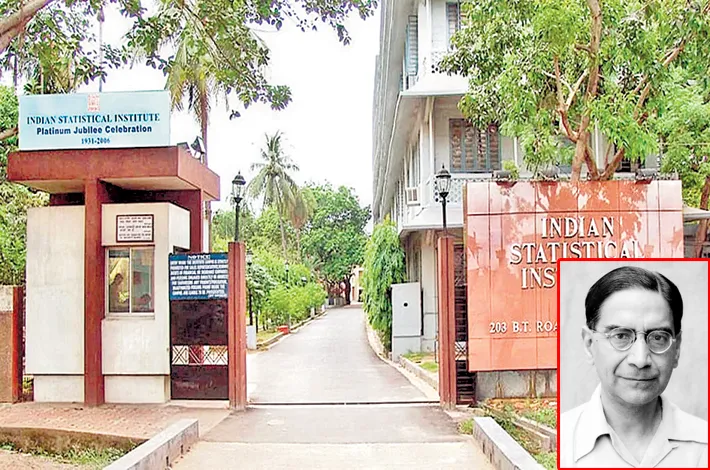
But here’s the inconvenient truth they will never know because they never read-India’s statistical system in the early decades wasn’t just competent—it was revolutionary. Just after Independence, when most newly freed nations were scrambling to build basic administrations, India—under the audacious vision of Prasanta Chandra Mahalanobis—was building something far more sophisticated: a scientific, large-scale, sample-survey-based statistical architecture unlike anything the post-colonial world had ever seen.
The Indian Statistical Institute (1931) became a hub of intellectual energy; the National Sample Survey (1950) began collecting data on a scale that surprised even richer countries. Village surveys, crop-cutting experiments, consumption studies, employment mapping—no developing nation attempted anything comparable.
And the world noticed. Astonishment → Admiration → Emulation. Delegations from Africa, Asia and Latin America came to study our methods. The UN showcased India’s surveys. International scholars debated India’s innovations. Mahalanobis’s statistical ideas were cited in methodological discussions across the UK, US and USSR. For decades, India wasn’t a laggard. It was the model.
This scientific confidence extended to technology. With Nehru’s backing and Homi Bhabha’s support from TIFR, Mahalanobis pushed for early computerisation—despite Cold War suspicion about selling advanced machines to a non-aligned nation. Yet India acquired the HEC-2M in 1955, one of Asia’s earliest computers, and used it for statistical processing. That alone set India decades ahead of most of the developing world.
If Mahalanobis’ ambition matched the scale of the country, Nehru backed him with political protection, autonomy, funding, and—crucially—faith in scientific governance. As Nikhil Menon writes in Planning Democracy, Mahalanobis was not merely gathering numbers; he was “building a way for a new nation to know itself.”Mahalanobis’s global reputation was formidable: he sat on UN committees; UNESCO and FAO consulted him; Joan Robinson, Jan Tinbergen, and Soviet planners engaged with his ideas. Menon describes him as someone who “imagined statistics not as numbers but as a national mirror.” He was India’s most internationally recognised scientist after Homi Bhabha.
This is precisely why the decline today feels so tragic. It is a fall from a genuine high point. Over the last decade, we’ve seen-The 2017–18 Consumption Survey suppressed because it showed falling consumption, the PLFS unemployment report showing 45-year-high joblessness buried until after the 2019 election, two National Statistical Commission members resigning in protest, GDP “revisions” that magically uplift NDA-era numbers and deflate UPA-era ones, former CEA Arvind Subramanian suggesting GDP may be overstated by 2.5 percentage points, trade, industrial output and tax data showing unexplained spikes, then quiet corrections. A statistical system hollowed out by vacancies, interference, and “alignment.”
The house Mahalanobis built—once admired globally—has been turned into a propaganda pulpit. What began as a scientific mirror has become a political vanity camera. And that’s why the IMF’s Category C sting-not because the world wanted to embarrass us but because the world remembers what we once built—and can see, all too clearly, what we’ve allowed to decay.
— GS Seda
The author is a retired Indian Air Force officer and writer