24 October, 2026 | 10:50 PM


Diversifying trade: India looks beyond the US?
24-12-2025 12:00:00 AM
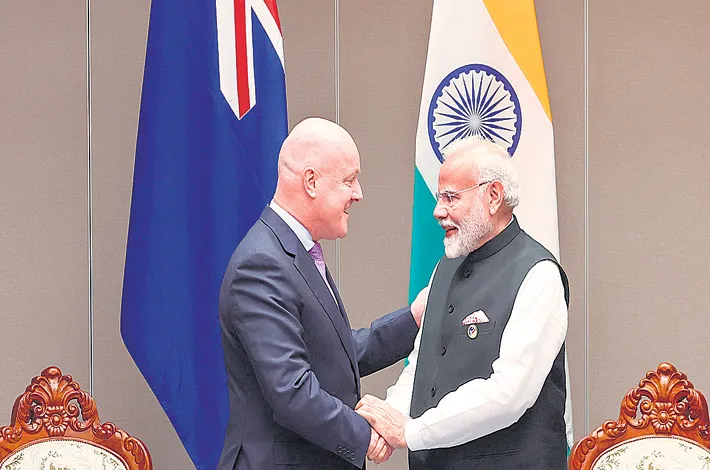
In a significant step to diversify its export markets and safeguard against global protectionist pressures, India has concluded a comprehensive Free Trade Agreement (FTA) with New Zealand. Announced jointly by Prime Minister Narendra Modi and his New Zealand counterpart Christopher Luxon, the pact marks India’s third major trade deal in 2025, following agreements with the United Kingdom and Oman.
Negotiations for the India-New Zealand FTA began during Luxon’s visit to India in March 2025 and were fast-tracked, concluding in a record nine months. Officials say the rapid progress reflects the strong political will on both sides to expand economic cooperation. The agreement is expected to be formally signed in the first half of 2026, after completing all necessary legal reviews.
Under the terms of the pact, Indian exports will gain zero-duty access to New Zealand across all sectors, including textiles, pharmaceuticals, engineering goods, automobiles, and IT services. This is expected to significantly enhance India’s export competitiveness and provide Indian businesses with new opportunities in a high-value market.
New Zealand, in turn, will see tariffs eliminated or substantially reduced on nearly 95% of its exports to India. More than half of these products will become duty-free immediately upon implementation. Key New Zealand exports benefiting from the agreement include sheep meat, wool, seafood, coal, timber, apples, and honey. Notably, the FTA provides New Zealand with its first access for certain items such as apples and honey into the Indian market, highlighting the strategic importance of this deal for both nations.
This development comes as India continues to diversify its trade portfolio amidst uncertainty over a potential bilateral trade agreement with the United States. Tensions have increased following the imposition of steep 50% tariffs on several Indian exports to the US, prompting New Delhi to seek alternative markets and reduce reliance on a single trading partner.
Experts suggest that India’s approach complements rather than confronts US trade policies. A US-based analyst described the tariffs as “shock therapy” to the traditional global trade system, while India’s FTAs aim to create a more balanced and resilient trading environment. By expanding trade networks, India not only secures new export markets but also leaves room for future collaboration with the United States when conditions allow.
Indian economists also note that India has used the current global slowdown and US trade tensions to pursue domestic reforms, including labour market adjustments and reductions in the Goods and Services Tax (GST). These measures, alongside a continued focus on export growth, have yielded strong results, with exports rising 19% in November 2025 alone.
The Confederation of Indian Industry (CII) welcomed the India-New Zealand FTA as a positive step in 2025’s broader strategy of trade diversification. A senior CII office bearer highlighted that India’s economy has demonstrated strong macroeconomic discipline, achieving around 8% growth in recent quarters, supported by moderate inflation and low interest rates. He emphasized that despite perceptions of a slowdown in private investment due to trade uncertainties, company surveys and reports indicate healthy growth, rising capacity utilization, strengthened balance sheets, and robust IPO activity. Commerce Minister Piyush Goyal reiterated that the new agreements are intended to benefit all regions and sectors of India. According to him, India’s expanding network of FTAs provides a strategic advantage, positioning the country to maintain export growth, generate employment, and enhance economic resilience amid global tariff disputes and geopolitical tensions.
Analysts describe the India-New Zealand FTA as historic, not only for its immediate commercial benefits but also for signaling India’s proactive strategy in navigating an unpredictable global trade environment. By creating diversified market access, India reduces vulnerability to external shocks while promoting long-term economic stability and growth.
In addition to the immediate impact on trade flows, the agreement is expected to encourage collaboration in technology, services, and sustainable industry practices, strengthening bilateral ties beyond mere trade. Experts see the FTA as a model for India’s future economic diplomacy—balancing engagement with traditional partners while exploring new opportunities globally.
As India celebrates its third major trade deal this year, the agreement with New Zealand underscores the government’s strategic vision: to pursue export-led growth, enhance global competitiveness, and protect national economic interests against external uncertainties. In a world increasingly shaped by tariffs and trade tensions, India’s expanding network of FTAs is designed to anchor its economic ambitions and build resilience for the decades ahead.