24 October, 2026 | 9:43 PM


SHANTI Law: Energy breakthrough or risky gamble?
24-12-2025 12:00:00 AM
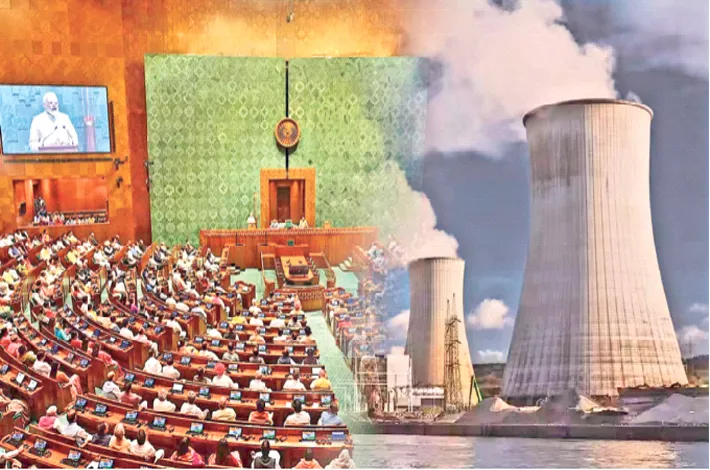
On December 22, 2025, President Droupadi Murmu gave her assent to the Sustainable Harnessing and Advancement of Nuclear Energy for Transforming India (SHANTI) Bill, 2025, formally making it law. The legislation repeals the Atomic Energy Act of 1962 and the Civil Liability for Nuclear Damage Act of 2010, consolidating India’s nuclear governance under a single framework. For the first time, private companies can build, own, and operate nuclear power plants, and up to 49% foreign direct investment (FDI) is allowed in certain nuclear activities.
Supporters describe the law as transformative for India’s energy landscape. The government aims to increase nuclear capacity from the current 8.8 GW to 100 GW by 2047, attracting over $200 billion in investments. The SHANTI Bill reforms the liability regime, aligning it more closely with international standards. Under the new system, operators bear primary responsibility for damages, with graded caps based on reactor size, while government-backed funds cover excess claims. Critics, however, have raised concerns about exemptions in cases of natural disasters, armed conflicts, or terrorism, as well as potential favoritism toward foreign interests, particularly from the US.
Currently, nuclear power contributes just 1.5% to India’s installed capacity and 3% to electricity production. The government views the bill as part of a broader clean energy push, including a Rs 20,000 crore small modular reactor (SMR) research and development mission announced in the FY26 budget. Proponents argue that SHANTI will drive economic growth, create millions of jobs, and support decarbonization in sectors like steel, cement, and AI-driven data centers.
Industry leaders have expressed optimism. The CEO of a nuclear fuel management firm called the bill a “momentous event” since 1992 and showed strong interest in SMR projects. He predicted the law would improve air quality in polluted cities like Delhi by reducing reliance on fossil fuels. A senior executive at Larsen & Toubro (L&T) highlighted the company’s “technology-agnostic” approach and plans to support safe, fast-track plant construction, extend the life of aging facilities, and requested policy support like viability gap funding for initial SMRs and a level playing field through reduced GST compared to renewables.
A former director at Bhabha Atomic Research Centre said the bill removes key hurdles for foreign vendors, particularly around the right of recourse, providing greater comfort for international investment. Experts emphasized the need for standardized reactor designs, bulk manufacturing, and even removing the 49% FDI cap to attract more capital, arguing that projected investments could double or triple without compromising sovereignty. They cited India’s 8% GDP growth, rising energy needs from AI, and hard-to-abate industrial sectors as drivers far exceeding the 100 GW target.
Politically, a BJP spokesperson defended the bill, framing it as a step toward “energy atmanirbharta” by 2047. He noted that previous regimes saw sluggish nuclear growth and emphasized that operator liability remains, though the financial risk now rests primarily with plant operators. He dismissed claims of monopoly or duopoly, pointing out that government entities, joint ventures, and private firms are all allowed to participate in reactor operations.
Opposition voices, however, warn of systemic risks. A Congress MP acknowledged the need to expand nuclear energy but criticized the law for favoring private and foreign interests. He highlighted that the government can license operations—including mining and waste management—to private or foreign entities, raising potential safety concerns. He also lamented the dilution of supplier liability, pointing out that capped coverage of around Rs 3,900 crore falls far short of costs seen in global nuclear disasters like Chernobyl or Fukushima, leaving questions about funding shortfalls.
The SHANTI law represents a major shift toward a mixed public-private nuclear model. While challenges remain—workforce development, ecosystem building, public acceptance, and robust safety oversight—the consensus among industry experts is that the legislation positions India for energy abundance and leadership in clean power by 2047. Future reforms in incentives, international partnerships, and standardized reactor deployment will be critical to fully realizing the law’s potential.