11 October, 2026 | 1:04 AM


Fine rice shortage looms large
11-10-2026 12:00:00 AM
In Telangana as private traders outbid government
metro india news I hyderabad
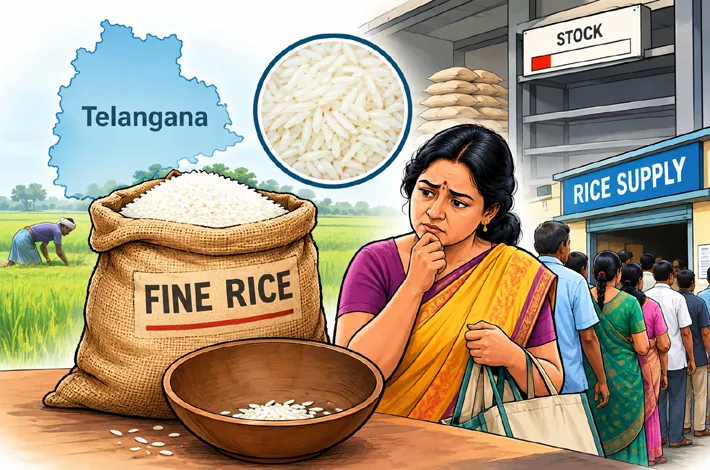
The Telangana government’s ambitious scheme to distribute fine variety rice through the public distribution system faces a serious challenge, with experts and trade sources warning of potential shortages if authorities fail to act with advance planning. Despite efforts to procure fine paddy from farmers by offering the minimum support price along with a bonus, expected arrivals during the current kharif season and the upcoming rabi season may fall short of targets, according to business circles.
Nationwide, the impact of El Nino is expected to reduce paddy yields significantly this year, and early field-level signs are already causing concern. Demand for fine rice is projected to rise further across the country in the coming year, prompting private traders to enter the market aggressively. Traders from other states have begun purchasing fine paddy directly from farmers near mills in Telangana and transporting it out of the state.
The state government pays a minimum support price of Rs 2,461 per quintal for fine variety paddy this year, along with a bonus of Rs 500, taking the total to Rs 2,961 per quintal. Private traders, however, are offering between Rs 3,900 and Rs 4,400 per quintal in the open market, which is roughly 40 to 50 per cent higher than the government’s rate. These purchases are taking place even while the paddy remains green, particularly in districts such as the erstwhile Nizamabad, Nalgonda, Khammam and Mahabubnagar where harvesting has started. Traders from Andhra Pradesh, Karnataka and Tamil Nadu have queued up at these locations.
If this trend continues, the government may find it difficult to procure fine paddy in line with its targets. Farmers could prefer selling in the open market rather than bringing their produce to official purchase centres, raising doubts about the success of the fine rice distribution scheme.
Stocks of fine rice available with the Civil Supplies Department are already dwindling. Officials indicate that existing reserves in Civil Supplies godowns are likely to last only until March next year. Without adequate procurement from the current kharif crop and the subsequent rabi season matching government estimates, these stocks could be completely exhausted. That would leave the public distribution system without sufficient fine rice for ration shops.
In addition to Civil Supplies holdings, fine paddy grown in the state has been milled and supplied to the Food Corporation of India. FCI godowns still hold some fine rice stocks. Reports suggest that FCI is currently diverting these stocks to meet requirements of other states. While the movement of rice from local godowns is a regular practice, the inclusion of fine variety rice in such transfers is noteworthy at a time when private traders are also lifting large quantities from farmers at premium prices.
Trade sources point out that open market demand for fine rice is set to intensify in the months ahead, pushing prices higher. Once that happens, the government may find it hard to secure supplies even if it decides to purchase later. Against this backdrop, experts advise the state government to move early and procure the fine rice stocks currently held by FCI. FCI prices remain lower than open market rates, which would limit the financial burden on the state. The government should also prevent the further diversion of these stocks to other states and instead store them in its own godowns for future local needs.
Meteorologists have cautioned that the El Nino effect is likely to persist until the next monsoon season. This means the 2027 kharif crop is still about a year away. The public distribution system will require continuous supplies of fine rice until then. With Civil Supplies stocks projected to run out by the end of March, the limited fine rice currently available with FCI must be secured without delay. Combined with whatever quantities arrive from the ongoing kharif and coming rabi seasons, these stocks can help the system weather the period of uncertainty.
Failure to take such measures could lead to disruptions and shortages in the fine rice distribution scheme in the months ahead. Trade and expert circles stress that the government needs to prepare a clear roadmap covering the period until the next monsoon to ensure uninterrupted supplies to ration card holders.