11 October, 2026 | 1:03 AM


Musk Calls Ambani ‘Prime Minister’
11-10-2026 12:00:00 AM
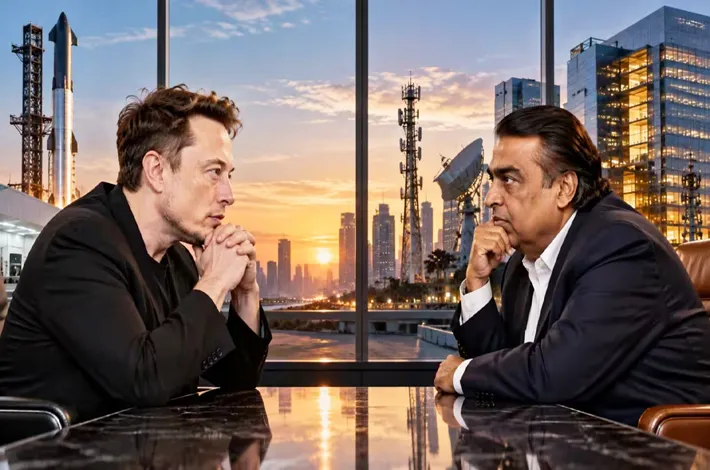
Elon Musk Escalates Starlink India Dispute with Sarcastic Broadside at Mukesh Ambani
metro india news I hyderabad
SpaceX and Tesla CEO Elon Musk intensified his public campaign for regulatory clearance of Starlink satellite internet services in India on Friday, with a pointed and sarcastic open letter on X addressed to Reliance Industries chairman Mukesh Ambani as “Prime Minister Ambani.”
In the post, which quickly amassed hundreds of thousands of likes and widespread media coverage, Musk wrote: “Dear Prime Minister Ambani, Please accept my humble apologies for not realizing that you are the real boss of India. Naturally, you would prefer to maintain your monopolistic exploitation of the great people of India, but would you nonetheless consider allowing Starlink to compete?”
He argued that large parts of India still lack internet access, denying children educational opportunities and small businesses the chance to reach global markets. “Starlink would change their lives for the better,” Musk stated. In a follow-up post, he highlighted Starlink’s proven role in disaster response worldwide, noting that the service has maintained communications when terrestrial networks fail, and said allowing it in India would help “save men, women and children throughout India.”
The remarks mark the sharpest escalation yet in a multi-day online campaign. Earlier in the week, Musk accused unnamed “oligarchs” of blocking Starlink to preserve a “monopolistic chokehold,” calling the delay “a crime against the people of India.” On Thursday he named Ambani directly, asking: “Is Ambani the real boss of India?” while noting that Starlink is licensed in more than 165 countries and has spent five years meeting Indian requirements.
Starlink has secured key approvals, including a Global Mobile Personal Communication by Satellite (GMPCS) licence from the Department of Telecommunications in June 2025 and authorisation from the Indian National Space Promotion and Authorisation Centre (IN-SPACe) in July 2025 for its first-generation constellation. It has also signed distribution partnerships with both Reliance Jio and Bharti Airtel. However, commercial operations remain stalled pending security clearance from the Ministry of Home Affairs, final spectrum assignment, and foreign direct investment approval for the wholly foreign-owned entity.
India’s government has firmly rejected claims of discrimination or monopoly protection. Communications Minister Jyotiraditya Scindia stated that India does not permit monopolies in any sector and that three operators—Starlink, Reliance Jio’s satellite arm, and Bharti-backed Eutelsat OneWeb—hold licences and stand at broadly the same regulatory stage. All must complete security assessments before spectrum can be assigned. The Digital Communications Commission has already endorsed a spectrum usage charge of around 4-5% of adjusted gross revenue (with a lower rate for rural and remote areas), but the framework still requires further inter-ministerial and Cabinet-level clearances.
The spat has drawn political reactions. Leader of the Opposition Rahul Gandhi responded to Musk’s earlier comments with a cryptic “Welcome to India, Elon. Wait till you discover the other guy,” later emphasising the need for a level playing field free of political patronage.
Implications for India
Musk’s high-profile intervention shines a spotlight on India’s unfinished digital connectivity agenda. Despite the dramatic expansion of mobile broadband driven by Jio and others, significant gaps persist in remote, hilly, border, and island regions. Satellite broadband is widely viewed as a complementary solution that can deliver high-speed internet where fibre and towers are uneconomical, potentially accelerating education, telemedicine, e-commerce, and agricultural services in underserved areas.
At the same time, the episode underscores tensions between rapid technological adoption and national security priorities. Indian officials have consistently framed security vetting of foreign satellite systems—particularly those operating across borders without full local control of gateways and data—as non-negotiable. Domestic players, including Jio’s planned sovereign low-Earth orbit constellation, are positioned as alternatives that may better align with strategic autonomy goals.
For India’s telecom market, already dominated by a handful of large operators, the eventual entry of Starlink and rivals could intensify competition, pressure prices, and expand capacity. Yet prolonged delays risk slowing innovation and leaving rural citizens without viable high-speed options longer than necessary. Spectrum policy choices—administrative allocation versus auction-style approaches—will also shape the economics of the nascent satellite broadband sector.
Politically, the public nature of Musk’s criticism tests the government’s narrative of a transparent, non-discriminatory regulatory environment. It may increase pressure for faster resolution of pending clearances while reinforcing the importance of treating all licence holders equally. For Ambani’s Reliance, which has transformed India’s digital landscape through Jio, the episode raises questions about perceived influence even as the company itself pursues its own satellite ambitions and has partnered with Starlink for distribution.