26 September, 2026 | 3:52 PM


From Left to Right
02-01-2026 12:00:00 AM
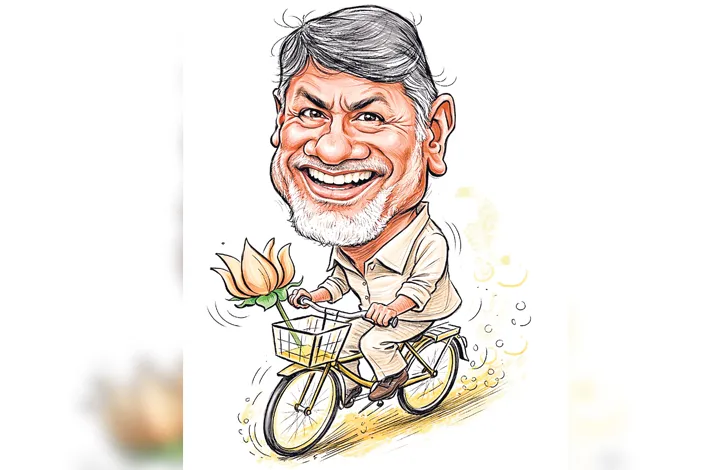
Chandrababu Naidu's Redefined Secularism!
Nara Chandrababu Naidu, the current Chief Minister of Andhra Pradesh and president of the Telugu Desam Party (TDP), has long been regarded as a pragmatic and reform-oriented leader in Indian politics. His recent engagements, including a meeting with Rashtriya Swayamsevak Sangh (RSS) chief Mohan Bhagwat at the Bharatiya Vigyan Sammelan in Tirupati in December and a visit to the Shri Ram Janmabhoomi Mandir in Ayodhya on December 28 have sparked discussions about his ideological trajectory. During these events, Naidu praised the "greatness of Sanathana Dharma," highlighted Lord Hanuman's superiority over fictional superheroes like Superman, and described Ram Rajya as a "benchmark for good governance." He is also scheduled to meet Bhagwat again in January, potentially signaling a deeper engagement with cultural and nationalist themes.
Naidu's entry into politics was rooted in the Indian National Congress, a party historically associated with secularism, socialism, and centrist policies under leaders like Indira Gandhi. His early career reflected the Congress's emphasis on welfare and development. In 1978, at age 28, he was elected to the Andhra Pradesh Legislative Assembly from the Chandragiri constituency on a Congress ticket, marking his formal debut. From 1980 to 1983, he served as a minister in successive Congress governments, handling portfolios like Cinematography (1980-1981) and Technical Education and Minor Irrigation (1982-1983). This period aligned him with the party's secular, pro-poor ideology, focusing on rural development and education in a state dominated by Congress's one-party rule.
A pivotal shift occurred in 1983 when Naidu joined the newly formed Telugu Desam Party (TDP), founded by his father-in-law, actor-turned-politician N.T. Rama Rao (NTR), in 1982. TDP emerged as a regional force, positioning itself as anti-Congress and non-BJP, emphasizing Telugu self-respect (atma gauravam), welfare schemes like subsidized rice, and socialist policies aimed at farmers and the underprivileged. Naidu's move was facilitated by his 1980 marriage to NTR's daughter, Bhuvaneswari, but he quickly proved his mettle as a strategist. Re-elected from Chandragiri in 1983 on a TDP ticket, he became a key organizer, helping TDP sweep to power and end Congress's dominance in Andhra Pradesh.
When TDP lost in 1989, Naidu served as party coordinator, strengthening its opposition role and rebuilding its base. His ascent culminated in 1995 saw his appointment as Chief Minister on September 1, 1995. As CM from 1995 to 2004, he pivoted TDP toward economic liberalization, earning the moniker "CEO of Andhra Pradesh." Initiatives like Vision 2020 focused on IT infrastructure, transforming Hyderabad into "Cyberabad" with investments in software parks and attracting companies like Microsoft. Ideologically, TDP under Naidu blended regionalism with pro-business reforms, maintaining a secular stance while implementing welfare programs like Janmabhoomi for community development.
Naidu's alliances reflect his adaptive ideology. In 1998, TDP allied with the Bharatiya Janata Party (BJP)-led National Democratic Alliance (NDA) under Atal Bihari Vajpayee, providing external support to the central government from 1999 to 2004. This partnership was framed as developmental rather than ideological, with Naidu justifying it as aligning with public sentiment for Vajpayee's leadership. However, TDP lost the 2004 state elections amid anti-incumbency over agrarian distress, despite national NDA gains. Out of power until 2014, Naidu rebuilt TDP's image as a secular, regional alternative.
The 2014 bifurcation of Andhra Pradesh into Andhra and Telangana reshaped Naidu's politics. Re-allied with BJP, TDP won in residual Andhra, and Naidu became CM again (2014-2019). He pushed for a new capital, Amaravati, and special status for the state, but tensions arose over unfulfilled promises. In 2018, TDP exited the NDA, accusing the BJP of neglecting Andhra's interests. This break reinforced Naidu's secular democrat image, as he criticized the central government's handling of federal issues. The 2019 elections were disastrous; TDP won only 23 seats, losing to YSR Congress Party (YSRCP), and Naidu faced legal challenges, including a brief arrest in 2023 on corruption charges.
Naidu's 2024 comeback marked another realignment. Forming the NDA with BJP and Jana Sena, TDP secured 135 seats, enabling his fourth term as CM starting June 12, 2024. Post-victory, Naidu played a kingmaker role in Narendra Modi's third term, with TDP's 16 Lok Sabha MPs crucial for the coalition. This phase shows continuity in pragmatic alliances, but recent actions suggest a nuanced engagement with cultural nationalism.
In December 2025, at the Tirupati science conclave, Naidu shared the stage with Bhagwat, lauding RSS's role in nation-building and advocating for Indian epics over Western superheroes to instill values. He echoed Bhagwat on population growth for India's global dominance by 2047. His Ayodhya visit, where he became the first serving South Indian CM to pray at the Ram Mandir post its January 2024 inauguration, emphasized spiritual upliftment and Ram's timeless ideals. These statements on Sanathana Dharma and Hindu icons like Hanuman and Arjuna represent a public embrace of cultural themes, contrasting his earlier focus on technocratic governance.
Naidu's evolution appears driven by political exigencies rather than a linear ideological pivot. From Congress's secular socialism to TDP's regional welfarism, and through oscillating NDA ties, he has adapted to electoral realities. Critics view recent moves as a shift toward right-wing ideology for coalition stability, while supporters see them as consistent with his developmental ethos, now infused with cultural pride.
Data from his tenures shows consistent growth focus: Andhra's GSDP rose 10.5% annually during 1995-2004, and post-2014, it attracted Rs 2.5 lakh crore in investments. As of 2025, with Andhra's economy rebounding under his leadership, Naidu's trajectory underscores a blend of secular roots and pragmatic nationalism, shaped by over four decades in politics.