5 October, 2026 | 5:26 AM


India has one doctor for every 811 Indians
05-12-2025 12:00:00 AM
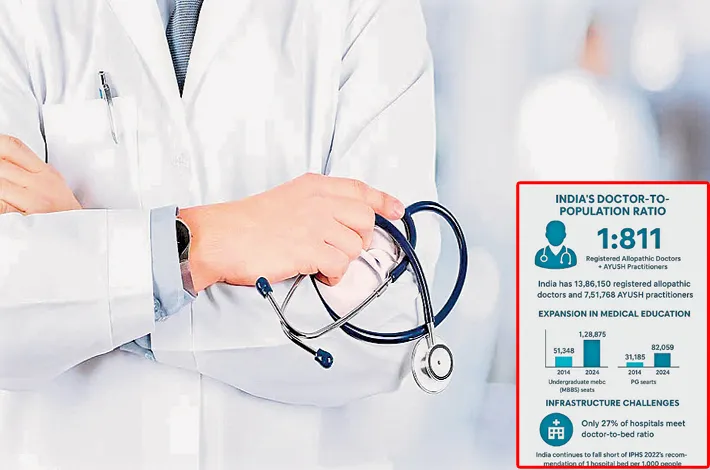
India currently has about one doctor for every 811 residents, according to data from the Union Ministry of Health and Family Welfare, indicating a growing workforce but also exposing serious gaps in distribution and infrastructure. Health Minister J. P. Nadda said the country now has 13,86,150 registered allopathic doctors and 7,51,768 AYUSH practitioners. Assuming that 80% of these professionals are actively available, the doctor-population ratio stands at roughly 1:811, better than the World Health Organization’s (WHO) recommendation of one doctor per 1,000 people.
However, public health experts argue that this headline number masks persistent challenges. They point out inequities between urban and rural regions, a shortage of specialists, and inadequate health facilities that limit the actual availability of care. Improving ratios, they say, do not automatically translate into accessible or quality healthcare.
To bridge these gaps, the government has significantly expanded medical education infrastructure over the past decade. The number of medical colleges has risen from 387 in 2014 to 818, more than doubling national training capacity. MBBS seats increased from 51,348 to 1,28,875, while post-graduate seats grew from 31,185 to 82,059 during the same period.
Nursing capacity has also expanded. According to the Indian Nursing Council (INC), India has 42.94 lakh registered nursing personnel as of March 2025, supported by 5,253 nursing institutions—809 government and 4,444 private. These institutions collectively produce around 3.87 lakh new nurses every year.
Despite this progress, infrastructure remains a major bottleneck. Only 27% of hospitals meet the required doctor-to-bed ratios, and an even smaller percentage have adequate nursing, paramedical staff, diagnostic services, or essential support systems. Experts warn that while India may now meet or exceed WHO’s doctor-population benchmarks on paper, the ground reality in many public hospitals still reflects shortages of beds, equipment, and trained specialists.
The Indian Public Health Standards (IPHS) 2022 recommend one hospital bed per 1,000 people, with two beds per 1,000 considered desirable for a robust health system. India continues to fall short of these targets, highlighting a widening gap between human-resource generation and facility readiness.
As India rapidly expands medical colleges, nursing institutions, and schemes aimed at upgrading healthcare facilities, the coming years will test whether increased numbers alone can strengthen the system—or whether longstanding issues of access, equity, and distribution will finally receive the sustained attention they require.