10 October, 2026 | 11:58 PM


Kolkata’s Historic Dawn
10-05-2026 12:00:00 AM
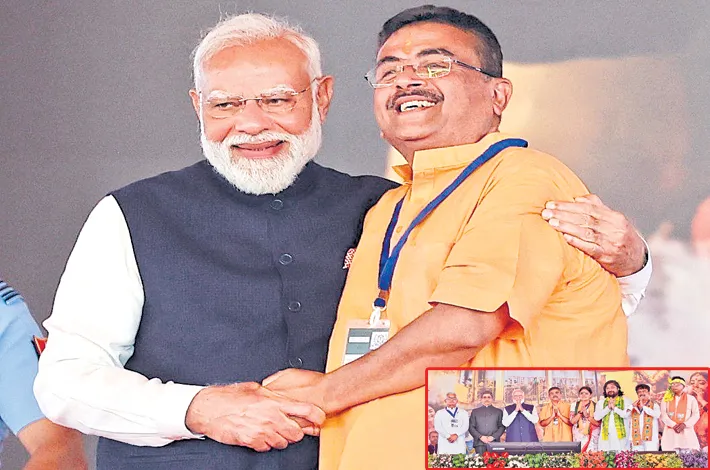
Suvendu Adhikari Sworn In as WB’s First BJP CM
Metro India News | Kolkata
Under a sky painted in hues of saffron and azure, the iconic Brigade Parade Ground in the heart of Kolkata witnessed a seismic shift in Country’s politics today. Suvendu Adhikari, a battle-hardened leader from the sands of Nandigram, took the oath as the ninth Chief Minister of West Bengal — and the first from the Bharatiya Janata Party (BJP) — marking the end of an era dominated by Trinamool Congress (TMC) and the dawn of a new political chapter in this culturally rich eastern state.
The ceremony, held on the birth anniversary of Rabindranath Tagore, blended solemn constitutional duty with vibrant Bengali festivity. As Governor R.N. Ravi administered the oath of office and secrecy, Adhikari, dressed in a crisp kurta-pajama, repeated the words with a steady voice that carried the weight of decades of political struggle. Thousands of supporters, waving lotus flags and chanting “Jai Shri Ram” and “Bharat Mata Ki Jai,” turned the sprawling ground into a sea of saffron. Folk artists from Purulia performed energetic Chhau dances, while baul singers filled the air with soulful melodies, evoking the timeless spirit of Bengal’s syncretic culture.
Prime Minister Narendra Modi, Union Home Minister Amit Shah, and a constellation of NDA leaders graced the occasion, underscoring the national significance of this victory. Modi, who earlier paid floral tributes at Tagore’s residence and interacted warmly with locals — even touching the feet of a 97-year-old supporter — addressed the gathering with characteristic fervor. “Today is not just a change of government; it is the fulfillment of Bengal’s aspirations for development, safety, and cultural pride,” he declared, as the crowd erupted in applause.
Adhikari’s ascent is the culmination of a remarkable journey. Born on December 15, 1970, in Karkuli village of Purba Medinipur to a political family — his father Sisir Adhikari was a former Union Minister — Suvendu cut his teeth in grassroots politics. He began with the Congress, joined TMC in 1998, and played a pivotal role in the Singur and Nandigram movements that helped topple the Left Front’s 34-year rule in 2011. As a TMC leader, he served as a minister and Lok Sabha MP, known for his organizational skills and fiery oratory.
The 2021 Assembly elections marked his dramatic shift. Defeating Mamata Banerjee herself in Nandigram, Adhikari joined the BJP amid growing disillusionment with TMC’s style of governance. He emerged as the Leader of Opposition and spearheaded the party’s aggressive expansion. In the 2026 polls, BJP secured a decisive mandate with around 207 seats in the 294-member Assembly, ending TMC’s 15-year reign that began in 2011. Adhikari not only retained Nandigram but also triumphed in key contests, symbolizing the erosion of TMC’s once-formidable grassroots machinery.
The Brigade Parade Ground, a venue steeped in history — from hosting Soviet leaders during the Left era to massive rallies under Mamata Banerjee — today symbolized continuity and rupture. Once a bastion of leftist mobilization, it now echoed with the promise of “Sabka Saath, Sabka Vikas” infused with Bengal’s unique flavor. Security was tight, yet the atmosphere remained jubilant. Families picnicked on the lawns, street vendors sold rosogollas and jhal muri, and young volunteers distributed leaflets outlining the new government’s vision.
Alongside Adhikari, five ministers took oath, including senior leaders like Dilip Ghosh, Agnimitra Paul, and others, signaling a blend of experience and fresh energy. The cabinet is expected to prioritize industrial revival, law and order, and infrastructure — areas where the previous regime faced criticism. Adhikari, in his brief remarks, struck a conciliatory but still firm note: “Fear will be replaced by hope (Bhoy out, Bhorsha in). This government will work for every Bengali, irrespective of caste, creed, or political affiliation. Bengal will reclaim its glory as the intellectual and economic powerhouse of India.”
Political analysts view this as more than a routine power transfer. West Bengal, with its rich literary heritage, revolutionary past, and economic potential, had long remained an outlier in the BJP’s national footprint. The party’s breakthrough here — building on steady gains since 2019 — reflects deeper shifts: disillusionment with alleged corruption and violence under TMC, aspirations for better jobs among the youth, and a desire for cultural assertion among a large section of the population.
Congress and Left parties expressed concerns over “majoritarianism,” even as they acknowledged the mandate. Across social media and streets, celebrations continued late into the evening, with fireworks lighting up Kolkata’s skyline.
As the sun dipped low over the Hooghly, casting a golden glow on the Victoria Memorial in the distance, one could sense history turning a page. Suvendu Adhikari, the son of the soil who navigated the treacherous currents of Bengal politics, now shoulders the responsibility of steering the state toward progress. For millions, this swearing-in is not merely ceremonial; it is the beginning of a renaissance — where the Ganges of development meets the cultural depth of Tagore’s Bengal.