13 October, 2026 | 12:20 PM


Land acquisition for Mumbai 3.0 opens
27-04-2026 12:00:00 AM
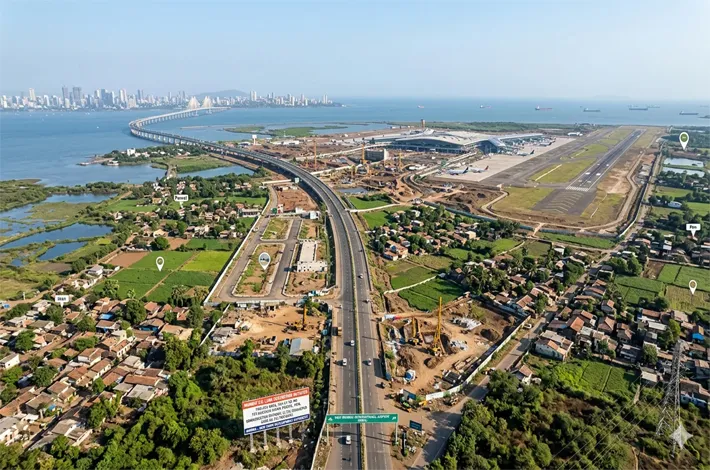
Land acquisition for Mumbai 3.0 opens on 27th April amidst the momentum for the mammoth Mumbai 3.0 picking up. The 323.44 sq. kms project officially termed as Karnala-Sai-Chirner (KSC) New Town was announced in year 2024. Also called as ‘Mumbai 3.0’ and ‘Maha Mumbai’, ‘KSC New Town’is in the vicinity of Mumbai Trans Harbour Link and Navi Mumbai Airport. Originally the project was conceived in year 2013 as Navi Mumbai Airport Influence Notified Area (NAINA) with 560 sq. kms but was later changed.
Mumbai 3.0 is intended to be a transit oriented, datacentre driven, and clean energy location connecting green field nodes and not intended merely as an incremental brownfield expansion unlike Navi Mumbai, the Mumbai 2.0. Mumbai 3.0 is claimed as a fourth-generation city. Referred 10 years back by World Economic Forum, 4th generation city is a sustainable and technology-driven urban development with smart infrastructure, social connectivity, clean energy, and environment friendly ecosystem.
For the land aggregation, MMRDA offered 3 compensation options to the landowners. First option is mutual consent at a negotiated price based on market prices and adjustments as per merits of the exact land location. The 2nd option is transferable development rights (TDR) or floor space index (FSI) without any cash. The 3rd option is land pooling with 22.5% developed land share to landowners. If landowners do not respond to any of the 3 options, their lands will be acquired under compulsory acquisition as per land acquisition law.
Historically, land pooling is used in various countries. Germany adopted the model in late 1800s. South Korea adopted between 1934 to 1984, Taiwan in 1960s, Indonesia and Nepal in 1970s, Isreal and Sweden in various periods. In India, land pooling was first adopted in Gujarat through 1915 Act under Town Planning Schemes between 1920 to 1990s. About 2,47,300 acres was acquired by reconstituting the land and taking 40% of owners land for roads, social infra and government structures. Pune adopted the model in 1990s. Punjab and Chandigarh explored in 2010, Rajasthan, Andhra Pradesh, and Delhi between 2014 to 2020s.
In land pooling, landowners gained between 15% to 50%. In some cases, those who sold prior to the pooling gained more as subsequently land prices cooled and remained dull for a long time. However, landowners in Mumbai 3.0 area did not sell their lands before land pooling commenced. Gains expected to them range between 13% lowest and optimum 35% depending on land price scenarios. These are comparable to the gains of farmers in Andhra Pradesh between 10% to 30% due to value appreciation of lands.
However, Mumbai 3.0 is different since substantial external infrastructure is already in place including Navi Mumbai airport, multimodal corridor, Atal Setu, JNPT access, besides proposed Metro Rail, roads, and water tanks. Due to these factors, analysts expect that land acquisition in Mumbai 3.0 will succeed.
Dr. Kishore Nuthalapati
(The author is the Regional Director of PRMIA, US for Hyderabad Chapter. He is also serving as the CFO of BEKEM Infra Projects Pvt Ltd, Hyderabad. Views are personal and are not of any organizations he is or was associated with.)