22 October, 2026 | 7:24 AM


Left, Right, Centre: India at 100 years of ideological crossroads
14-01-2026 12:00:00 AM
Observers point out that centrism faces a deeper challenge in today’s polarised political climate. Nuanced positions often appear indecisive to a generation drawn to sharp, emotionally resonant messaging. The clarity of majoritarian nationalism and the ideological certainty claimed by radical positions tend to overshadow compromise-driven politics
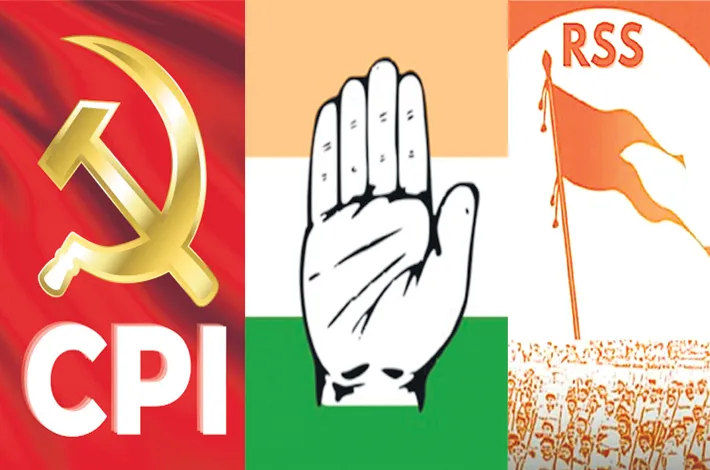
As India moves through 2026, its political landscape arrives at a rare historical moment where its most influential ideological streams converge in time. The Communist Party of India completes 100 years, the Rashtriya Swayamsevak Sangh enters its centenary year on Vijayadashami in 2025, and the Indian National Congress, already more than 140 years old, reflects on the centenary of its landmark Belagavi session. Adding to this convergence, Dravidian politics in Tamil Nadu also marks a hundred years. Together, these milestones invite a deeper debate on how India’s political soul has evolved and where it may be headed.
In the immediate aftermath of Independence, India chose a broadly centrist political path under Jawaharlal Nehru. This outcome was not inevitable. Both left-wing and right-wing ideologies were active and ideologically confident during the freedom movement. The communists mobilised workers and peasants, while right-wing groups articulated cultural nationalism. Yet it was the Congress, under Mahatma Gandhi’s moral and political leadership, that occupied the ideological centre and emerged as the dominant force in the new Republic.
Veteran Congress leaders and a pro-Congress section of the media argue that Gandhi’s greatest strength was his unmatched connection with the masses. In a deeply poor and diverse country, his simplicity, symbolism, and ability to communicate directly with ordinary people proved decisive. Movements such as the Quit India agitation of 1942 became defining national moments owned almost entirely by the Congress, with neither the left nor the right playing a comparable role. Gandhi’s accommodative idea of secularism, rooted in coexistence rather than strict separation, helped hold together a fragmented society. His choice of Nehru as successor reflected faith in modernity, science, and democratic institutions.
The left, particularly the Communist Party of India, was a formidable political force between 1925 and 1947. It led major peasant and worker struggles such as the Telangana armed movement and the Tebhaga agitation, placing land reforms and economic justice at the centre of its politics. However, many analysts note that the communists prioritised class struggle over the broader national freedom movement. After Independence, their political influence steadily declined. Today, the left governs only Kerala and has a marginal presence in Parliament, a sharp contrast to its early prominence.
Political commentators attribute this decline to a mix of ideological rigidity and organisational weaknesses. The left leadership remained deeply committed to textbook Marxism and struggled to adapt it to India’s complex social fabric. Caste, a defining feature of Indian society, was often treated as secondary to class, limiting the movement’s reach. Repeated splits weakened organisational unity, while long uninterrupted rule in West Bengal led to stagnation, bureaucratisation, and the rise of local strongmen. A highly centralised structure further reduced flexibility in responding to regional aspirations.
Right-wing politics, especially through the RSS and its affiliated organisations, followed a markedly different trajectory. A senior Chennai-based journalist notes that the RSS remained largely subdued in the first two decades after Independence. The assassination of Mahatma Gandhi and the subsequent ban pushed it into isolation. During this phase, the organisation focused on cultural work, discipline, and cadre-building rather than electoral politics, quietly expanding its grassroots network. The resurgence of the right began in the late 1970s and gathered pace in the 1980s. Events such as the Meenakshipuram mass conversions, debates around minority appeasement, Rajiv Gandhi’s handling of the Shah Bano case, and the Ram Janmabhoomi movement became critical turning points. These developments helped consolidate a majoritarian narrative centred on cultural identity and nationalism. Over time, the Bharatiya Janata Party translated this ideological mobilisation into sustained electoral success, culminating in a decisive political shift after 2014.
Another section of the media argues that the decline of Congress-led centrism over the past 15 to 20 years has been equally significant. The party gradually lost its grassroots connect, with once-active networks like the Seva Dal becoming largely symbolic. Dynastic leadership, allegations of corruption during the later UPA years, and an inability to speak convincingly to an aspirational, post-liberalisation middle class weakened its appeal. While the BJP now secures roughly 37 to 44 percent of the national vote, a sizeable section of voters remains politically unsettled.
Observers point out that centrism faces a deeper challenge in today’s polarised political climate. Nuanced positions often appear indecisive to a generation drawn to sharp, emotionally resonant messaging. The clarity of majoritarian nationalism and the ideological certainty claimed by radical positions tend to overshadow compromise-driven politics. The past decade is widely seen as a regime shift, with right-wing nationalism becoming the dominant framework under Narendra Modi.
Yet this dominance has been pragmatic rather than doctrinaire. Welfare schemes and state intervention, traditionally associated with socialist politics, have been blended into a strong nation-first narrative. As India marks a century of its competing ideologies, the political spectrum appears more consolidated than ever. Still, the presence of opposition spaces, regional movements, and ongoing ideological debates suggests that India’s contest of ideas is far from over — it has simply entered a sharper and more complex phase.