6 October, 2026 | 6:02 PM


Longest-running mushaira continues to regale audience
09-04-2026 12:00:00 AM
Venkat Parsa
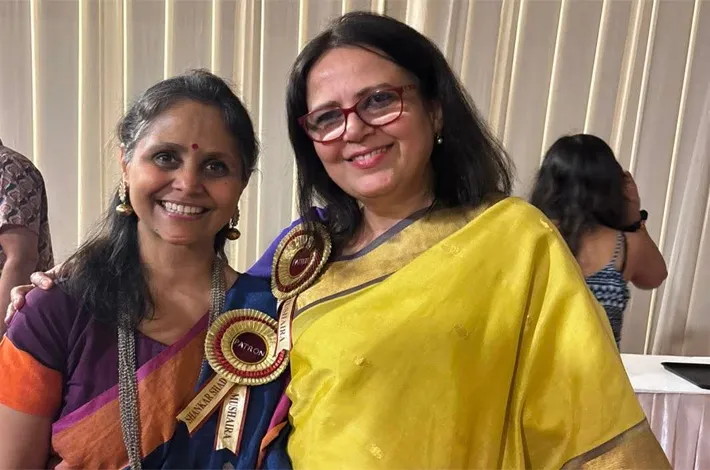
Shankar-Shad Mushaira has come to symbolize celebration of Urdu. Easily the longest running Mushaira, annually it is held in Delhi, home of Mir Taqi Mir, Mirza Ghalib, Mohammed Ibrahim Zauq, Momin and Daagh Dehlvi. Traditionally, it has always been Indo-Pak Mushaira; but, following the diplomatic suspension, in the recent past, it has turned into Kul-Hind Mushaira.
Organized by DCM Shriram Industries Group, in the past years, Shankar-Shad Mushaira served as a platform for the likes of Kaifi Azami, Sahir Ludhianvi, Firaq Gorakhpuri and Ahmad Faraz. Legendary Dilip Kumar was a regular at Shankar-Shad Mushaira, as Mehmaan-e-Khusoosi, or Chief Guest. People used to flock to the mushaira to hear Dilip Kumar's speeches -- andaaz-e-sukhan, tarz-e-bayaan -- he spoke impeccable, refined Urdu.
Jalil's pioneering role
In recent years, Shankar-Shad Mushaira has come to be curated by Rakhshanda Jalil, an authentic voice of Urdu language and culture and author of ‘Whose Urdu Is It Anyway.’ Line up of poets ranged from the young to the old, like Zubair Ali Tabish, Iqbal Ashhar, Hilal Fareed, Charan Singh Bashar, Sunil Kumar Tang, Rajesh Reddy, Saif Nizami, Shakeel Azmi, Sheen Kaaf Nizam, Shabeena Adeeb and Hina Rizvi Haider and Wasim Barelvi, among others. Poet-lyricist Javed Akhtar was the star attraction at the Mushaira.
Ganga-Jamni Tehzeeb
In his inaugural address, Justice Dhulia, former Supreme Court Judge quoted from Urdu hai mera naam, a Nazm of Iqbal Ashhar, who was also compering the event. It says, Kyun mujhko banaate ho taassub ka nishana/Main ne to kabhi khud ko Musalman nahi mana/Dekha tha kabhi main ne bhi khushiyon ka zamana/Apne hi watan mein hoon magar aaj akeli/Urdu hai mera naam, main Khusrau ki paheli (Why do you make me an object of prejudice ; I never considered myself to be Muslim; I, too, did witness happier times; but, today, I am alone in my own country; Urdu is my name, I am Khusrau's first). It literally set the stage for the Mushaira.
Few know that Justice Dhulia delivered the landmark judgment, upholding use of Urdu, alongside Marathi, on Patur Municipal Council signboard in Maharashtra he had ruled-Urdu “is the finest specimen of Ganga-Jamni tehzeeb, or the Hindustani tehzeeb.” He went on to say, Urdu is an Indian language and language is culture and it should not be tied to religion, nor should it become a cause for dividing people.
Hyderabadi Poets
Saif Nizami and Rajesh Reddy are from Hyderabad, once the cradle of Urdu. It was in Hyderabad that the first Diwan in Urdu poetry, Quliyaat-e-Mohammad Quli Qutub Shah, appeared, which predates Diwan-e-Ghalib of Mirza Ghalib.
Hyderabad was also home of Wali Deccanvi. Rajesh Reddy's compositions were rendered by Ghazal singer Jagjit Singh.
Iqbal Ashhar, a poet, himself, raised the bar, with his compering. It is extremely difficult to manage the excitement of the audience, ensuring that they remain engaged between poets being called out to recite their compositions, Daawat-e-Sukhan.
74-year tradition
Shankar-Shad Mushaira continues to draw crowds. There is an interesting story behind it. In pre-Partition years, Lala Shankar Lall and his son Murli Dhar Shad, both Urdu poets themselves, used to hold Mushaira in Lyallpur in present-day Pakistan. If Mushairas in Lyallpur are taken into account, it is 74 years of hosting Mushaira. If it is counted from post-Independence era from 1954, this year marks the 57th edition.
After their passing away, in memory of his elder-brother Shankar Lall and his son Murli Dhar Shad, DCM Group's Bharat Ram formed Shankar Lall-Murli Dhar Memorial Society in 1953. Under its aegis, Shankar-Shad Mushaira was launched in 1954.
All along, it is serving as a platform for showcasing the rich legacy of Urdu literature and celebrating the beauty of the language. Madhav Bansidhar Shriram and his wife Divya Shriram of DCM Group, have taken upon themselves the task of continuing the family tradition of hosting Shankar-Shad Mushaira.
Quality Poetic Work
Some real good and quality poetic work was showcased in Shankar-Shad Mushaira. One of Zubair Ali Tabish's couplets from his Ghazal, borders on the philosophical, Woh jis ne aankh ataa ki hai dekh ne ke liye/Usi ko chhod ke sab kuch dikhaai deta hai.
A couplet from his Ghazal, Suno Munsif, says, Mere lashkar mein shirkat ki ijaazat maang ne waalon/Main parcham thaam kar tanha jo khada, tab kahaan the tum.
Another poem of his concludes on a romantic note, Jung ladni chaahiye poori dileri se, magar saamne mehboob ho to jung haar jana chaahiye.
Hina Rizvi Haider recited some of her interesting couplets, like Mez pe khaane waale jab dur huve, tab yaad aya/Ghair bhi apne ho jaate the, farsh ke dastar-khwaanon par.
Changing Face of Mushaira
At the sametime, it must be acknowledged that the very face of the Mushaira has undergone a sea-change. Mushairas no longer are conducted in traditional bhaitakh style. Poets are now seated on the sofas. Candle is customarily placed in front of the poet reciting his kalaam, passing it around, to bring focus on the poet, whose turn it is to recite his own compositions. Dispensing with it, a Mushaira now begins with the lighting of the traditional lamp, signalling a departure.
Order for Daawat-e-Sukhan, inviting poets to take the mike, has virtually been dispensed with. Suited-booted poets remind that traditional attire, like the sherwani, is now a thing of the past. Etiquette in a Mushaira is also passe. Instead of the customary expressions like Subhan Allah and Wah-Wah, whistling has got precedence; mukarar has given way to shouting repeat; sometimes poets are even heckled, which militates against the culture of a Mushaira, as respect for a poet is non-negotiable.
Poetic standards, too, are not really encouraging, as poets seem to go along with trending themes, rather than writing from what springs from their hearts. Ideological leanings, so conspicuous in the legends in the past, is sadly missing.
Old World Charm Fading
"Sing heavenly Muse," is the sublime opening of Milton's Paradise Lost. The heavenly Muse seemed to have guided Sahir Ludhianvi, Majrooh Sultanpuri, Kaifi Azmi and Shailendra. But, such inspiration seems to be largely missing in the new breed of poets.
Yet, it must be said that despite fading of the old world charm, Mushairas continue to regale the audiences. Mushairas are a huge draw for lovers of Urdu language. That, in itself, is heartening for the future of Urdu language and culture in India.
Urdu is not just a language. It is a culture, a movement. Urdu is the loadstar of the Composite Indian Culture. This is what that makes Urdu stand apart from other languages.
Partition and post-Partition periods cast a shadow on Urdu. It was marked not just by withdrawal of official patronage, but mounting of a brazen attempt through Sanskritization to cleanse the language, by removing words even remotely Urdu. Situation has changed so much that one begins to feel a stranger in his or her own native place. In Momin's words, Ab watan bhi kabhi jaayenge to mehmaan honge.
Hope for the Future
However, such a trend need not cause any undue worry or dismay. In the words of Sahir Ludhianvi, the language will continue to flourish in the people's hearts. Hazaar barq gire, laakh aandhiyaan uthe/Woh phool khilenge, jinhe khilna hai (Thousand lightnings may flash, lakhs of storms may rise, but the flowers will bloom, which have to blossom).
It is clear that so long as the people love the language, it will not only survive but thrive; irrespective of whether or not there is official patronage.
In the words of Iqbal Ashhar, Urdu hai mera naam, main Khusrau ki paheli/Main Mir ki hamraaz hoon, Ghalib ki saheli/Dakkan ke Wali ne mujhe godi mein khilaya/Sauda ke Qaseedon ne mera husn ko badhaya/Main Mir ke aangan mein khili ban ke chameli/Urdu hai mera naam, main Khusrau ki paheli (Urdu is my name, I am Khusrau's first, Confidante of Mir, companion of Ghalib, I played in the lapp of Wali Deccanvi, Sauda's Eulogies enhanced my grace, in Mir's courtyard, I blossomed as jasmine, Urdu is my name, I am Khusrau's first)