21 September, 2026 | 10:06 PM


Parakala Prabhakar warns of ‘deep crisis’
19-12-2025 12:00:00 AM
In his concluding remarks, Dr. Prabhakar delivered an impassioned call to action. He stated that the future of the Indian Republic rests squarely on the shoulders of its citizens.
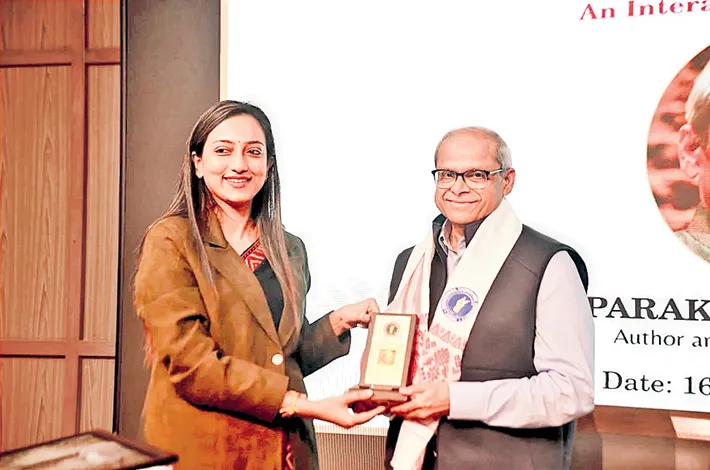
On December 16, 2025, Girijananda Chowdhury University (GCU) in Guwahati, Assam, hosted a thought-provoking interactive session featuring renowned political economist and commentator Dr. Parakala Prabhakar. The event drew a large audience comprising students, faculty members, academics, and concerned citizens eager to engage with pressing national issues. The session, titled “The Crisis of the Indian Republic,” provided a platform for Dr. Prabhakar to explore the deepening challenges facing India's democratic and constitutional framework. As the author of the critically acclaimed book “The Crooked Timber of New India”, Dr. Prabhakar brought his sharp analytical perspective to bear on contemporary political, economic, and social developments.
Dr. Prabhakar opened his address by asserting that India's Republic is experiencing a profound crisis, primarily because it is drifting from the foundational principles enshrined in the Constitution. These principles—secularism, democracy, equality, and justice—form the bedrock of the nation established in 1950. He argued that recent trends indicate a troubling departure from these ideals, placing the very structure of the Republic under strain.
A significant portion of the discussion focused on economic mismanagement. Dr. Prabhakar highlighted how chronic policy failures have exacerbated inequalities across society. High unemployment rates, particularly among the youth, and persistent inflation have eroded the purchasing power of ordinary citizens, widening the gap between the affluent and the marginalized. He pointed out that these issues are not mere cyclical fluctuations but symptoms of deeper structural problems that threaten social cohesion and economic stability.
Beyond economics, Dr. Prabhakar expressed grave concern over the erosion of democratic norms. He described a systematic weakening of key institutions that are meant to act as checks and balances in a healthy democracy. This includes concerns about judicial independence, media freedom, and electoral integrity. According to him, a growing disregard for constitutional values has allowed power to become increasingly centralized, undermining the federal spirit and pluralistic ethos that define India.
The speaker emphasized that these challenges span political, economic, and social spheres, creating a multi-faceted threat to the Republic's health. He warned that without corrective action, the deviations from constitutional principles could become irreversible. The interactive format proved particularly engaging, with a lively question-and-answer session following the main address. Students posed thoughtful questions about the specific roles that young people and the media can play in countering the crisis. Many inquired how informed discourse and activism could help restore balance. Dr. Prabhakar responded by underscoring the critical importance of active and vigilant citizenship. He urged the audience to remain informed, question authority, and participate meaningfully in democratic processes.
Citing Manipur, which has witnessed prolonged violence for nearly two years, he said the nation’s indifference to the suffering of its own citizens reflects a moral and political breakdown. “Manipur is not part of India’s political imagination,” he remarked, calling it a marker of the Republic’s crisis of equality. He also referred to public apathy over incidents such as an attack on the Chief Justice of India inside a courtroom, rising unemployment, rural distress, and the steadily falling value of the rupee. He expressed anguish that When the rupee touches new lows and unemployment rises, we hardly talk about it anymore,” he said.
In his concluding remarks, Dr. Prabhakar delivered an impassioned call to action. He stated that the future of the Indian Republic rests squarely on the shoulders of its citizens. Only through sustained vigilance and a renewed commitment to secular and democratic foundations can the nation navigate these turbulent times. He encouraged the attendees, especially the younger generation, to embody the spirit of responsible citizenship that the Constitution's framers envisioned.
Dr. Prabhakar's session served as a timely reminder of the fragility of democratic institutions and the ongoing need for civic engagement. As India continues to grapple with complex challenges in its 75th year as a Republic, voices calling for introspection and reform remain essential to preserving the nation's core values.