14 October, 2026 | 2:32 AM


Telangana revives temple training institute
02-07-2026 12:00:00 AM
MAHESH AVADHUTHA I hyderabad
In a significant step towards strengthening temple administration and preserving religious traditions, the Telangana Endowments Department has revived the State Institute of Temple Administration (SITA), relaunching a comprehensive training programme for priests, temple employees, administrative staff and trustees across more than 12,000 temples in the State.
The initiative, which remained dormant after the bifurcation of Andhra Pradesh in 2014, has been brought back with the objective of equipping temple personnel with the knowledge, skills and orientation required to efficiently manage both religious and administrative responsibilities.
The first three day training workshop was recently organised in Hyderabad, where nearly 300 participants underwent sessions on temple culture, Agama Shastras, administration and personality development. Similar district-wise training programmes will soon be held at major temple centres including Vemulawada, Basara, Bhadrachalam, Yadagirigutta and other prominent shrines, where participants will stay for three days while attending intensive classes.
Speaking about the initiative, Dr. Chilakapati Vijaya Raghava Charyulu, Director of SITA, described the programme as a major capacity-building exercise for the Endowments Department.
"Training is capacity building. Every employee needs training because it combines three essential elements, knowledge, skill and attitude. Knowledge provides content, skill builds competence and attitude gives confidence. Only when all three come together can an employee become effective and efficient in carrying out responsibilities," he said.
Dr. Charyulu noted that SITA was originally established in 2010 in the undivided State but gradually became inactive after bifurcation. The present Telangana Government has now decided to revive the institution to create a structured training ecosystem for temple administration.
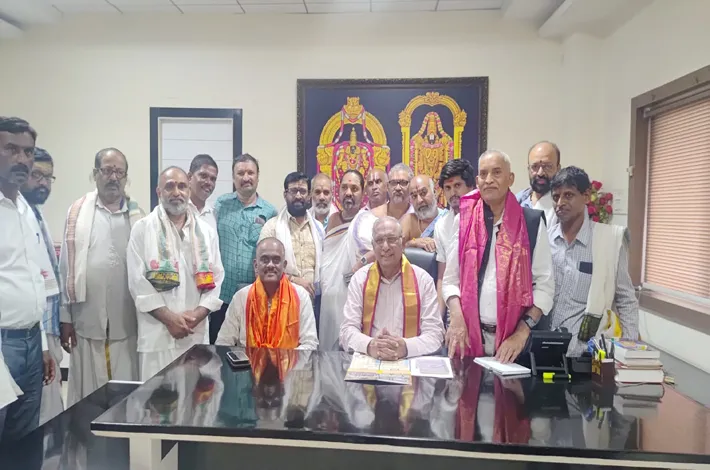
He said the proposal received strong support from the department's Dharmika Advisor, Govinda Hari, while Endowments Commissioner M. Hanumantha Rao directed the relaunch of specialised training programmes covering temple administration, Agama Shastras and temple culture. Dr. Charyulu, one of the founding members of SITA in 2010, has been entrusted with leading the revived initiative.
The programme has been designed especially for newly recruited employees, outsourcing staff, compassionate appointees, junior assistants, religious staff, trustees and other temple functionaries who require orientation in rituals as well as administrative procedures.
The curriculum covers the Endowments Act of 1987, Agama Shastras, temple traditions, festivals, religious practices, personality development and ethical service. Participants will be trained through lectures, workshops, presentations, group discussions and practical sessions. Free boarding, refreshments and meals will be provided during the training, which will be conducted daily from 10.30 am to 5 pm.
Chairman of the Telangana Archaka Udyoga JAC, Gangu Upendra Sharma, said the programme addresses a long standing gap in temple administration. According to him, only around 30 percent of religious and temple staff are presently well versed in the mantras, Agama traditions and ritual procedures required for conducting daily worship.
He explained that many newly appointed priests and staff often lack adequate practical exposure, while priests transferred from one temple to another may need orientation to different rituals and traditions. For instance, an archaka moving from a Shiva temple to a Hanuman temple must adapt to different mantras, slokas and methods of worship. The refresher sessions under SITA, he said, will help temple personnel quickly adapt and perform their duties with greater confidence and precision.
With the revival of SITA, the Telangana Endowments Department aims to professionalise temple administration while preserving the rich spiritual traditions of the State. Officials believe the initiative will improve transparency, enhance service standards and ensure that temple staff are better equipped to meet both religious and administrative responsibilities in an evolving institutional environment.