17 October, 2026 | 2:35 AM


Telangana Urban Local Body elections Alliances of convenience raises box of worms
18-02-2026 12:00:00 AM
In the wake of the February 2026 municipal polls in Telangana, the political landscape has been reshaped by a series of post-poll alliances that have ignited controversy and raised fundamental questions about democratic integrity. With no single party securing outright majorities in many urban local bodies, including councils and corporations, rivals have formed tactical tie-ups to elect mayors and chairpersons. These arrangements often see traditional adversaries supporting each other's candidates to exclude a third party from power.
This mirrors patterns observed in Maharashtra's local elections, where shifting coalitions have bewildered voters and highlighted how local pragmatism can eclipse state or national ideological commitments. The developments prompt a deeper examination: Are these "unholy alliances" a necessary facet of local politics, or do they erode the clarity of electoral mandates? The election results painted a picture of Congress dominance, as the party clinched 1,537 wards across various urban local bodies, establishing a clear lead.
The Bharat Rashtra Samithi (BRS) followed with 781 wards, while the Bharatiya Janata Party (BJP) secured 336. The All India Majlis-e-Ittehadul Muslimeen (AIMIM) won 70 wards, and independents along with other parties claimed 271. Despite Congress's strong performance, the fragmented outcomes in several areas necessitated coalitions. In total, out of 116 municipalities, at least 17 faced hung results, leading to strategic maneuvering that prioritized power-sharing over ideological purity.
Specific instances underscore the opportunistic nature of these alliances. In Nizamabad Municipal Corporation, Congress and AIMIM joined forces, with Congress securing the mayor's post and AIMIM the deputy mayor's position, effectively sidelining the BJP-BRS combine. In Nalgonda, Congress won the mayor's seat unanimously, bolstered by AIMIM's support for the deputy mayor role, ensuring a majority through allied backing.
Karimnagar presented a different twist: BJP swept both mayor and deputy mayor positions, aided by BRS corporators' abstention, which tilted the balance in BJP's favor. Meanwhile, in Khammam Municipal Corporation, the Communist Party of India (CPI) claimed the mayor's post, with Congress taking the deputy mayor, under a rotational power-sharing agreement—a model that has faced scrutiny in other states like Karnataka for its instability.
These tactical understandings extend to municipalities where BRS emerged as the single largest party, only to be isolated by rival coalitions blocking their access to chairperson or mayoral posts. Such moves neutralize local majorities and reflect a broader strategy to counter Chief Minister Revanth Reddy's momentum. However, the alliances have led to chaos: Elections for top posts in 11 civic bodies, including Jangaon, Kagaznagar, and Zaheerabad, were postponed amid confusion.
Critics argue that prioritizing power over principles confuses voters who cast ballots based on distinct party platforms, potentially fostering administrative gridlock due to internal frictions in these forced coalitions. Despite this, Congress's surge is evident, winning 186 out of 112 declared head posts, viewed by some as a necessary counter to rivals' initiatives.
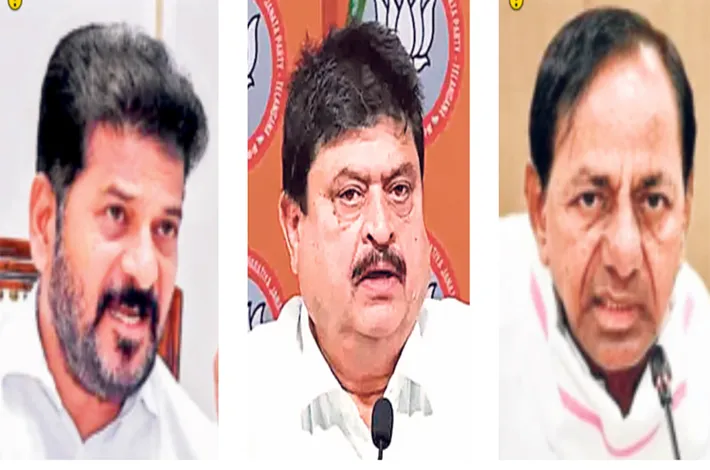
A BRS leader Reddy emphasized his party's principled opposition, insisting BRS fought elections independently and maintains equidistance from both Congress and BJP. He acknowledged local equations in hung situations but denied any formal alliances, accusing Congress of misusing state power to threaten opponents and independents. Reddy pointed to examples like Amanagal, where Congress and BJP allegedly allied, making Congress the chairman and BJP the vice-chairman, to counter claims against BRS.
BJP leaders highlighted his party's solo approach to build grassroots leadership, noting a vote share increase to 15.81% and outperforming BRS in corporations (79 wards vs. BRS's 66). They criticized Congress, BRS, and AIMIM for pre-poll tripartite agreements and defections, arguing these defeat ideological principles. A leader admitted abstentions like in Karimnagar aided BJP but attributed it to rivals' internal decisions, not formal pacts. He accused opponents of uniting solely to stunt BJP's growth, citing Telangana PCC president Mahesh Kumar Gowd’s admission of collaborating with BRS and AIMIM in Nizamabad for that purpose. He portrayed BJP as a rising force in southern states, winning in places like Karimnagar without alliances, contrasting it with Andhra Pradesh's landslides favoring ruling parties.
A Congress spokesperson downplayed alliances as responses to local development needs rather than ideological betrayals. He stressed Congress's clear mandate in most bodies, with only 17 hung, where local issues like development agendas take precedence over party lines. He denied alignments with BJP, attributing any cross-voting to avoiding re-elections in hung scenarios, and clarified no pre-poll pacts existed. On AIMIM, he rejected claims of inconsistency, noting post-result decisions focus on solving immediate problems like municipal administration, which Chief Minister Revanth Reddy personally oversees. He argued voters seek development over religious or caste politics, and alliances reflect faith in Congress's constitutional commitment, not confusion.
The debate circled back to voter disillusionment, with panelists evading direct accountability for confusing mandates. When pressed on how local issues override national ideologies—such as Congress-BJP divides—responses reverted to pragmatism for electing leaders in hung houses. Ultimately, the discussion exposed a pattern where parties absolve themselves by invoking "local dynamics," yet fail to address the core irony: Voters elect based on ideologies, only for post-poll deals to subvert them.