21 October, 2026 | 10:19 PM


The Star Beneath the Clouds
26-07-2025 12:00:00 AM
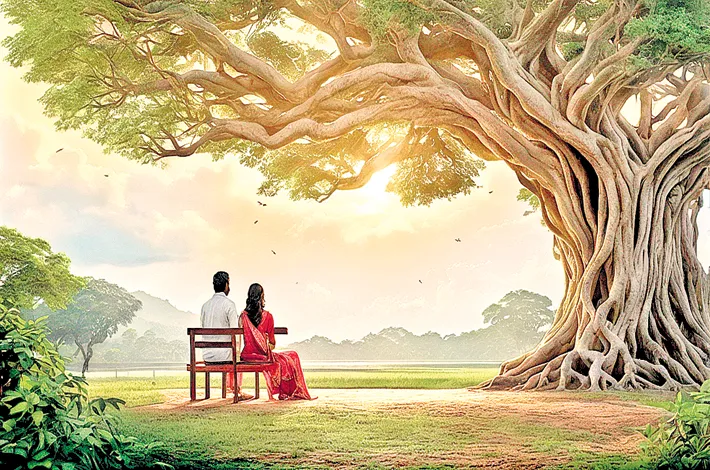
In the bustling heart of post-Partition Calcutta, where the air carried the weight of displacement and dreams, lived Megha, a young woman whose name meant "cloud" but whose spirit shone like a star. Her family, refugees from East Pakistan, had settled in a cramped shanty on the city’s outskirts. The tin roof rattled under monsoon rains, and the walls, thin as hope, barely held back the damp. Megha, with her quiet strength and luminous eyes, was the family’s anchor, their sole breadwinner at twenty-two, teaching children in a nearby school to keep hunger at bay.
Her days began before dawn, weaving through the crowded alleys to reach the school, her sari damp from the morning mist. Yet, her heart carried a secret—a tender love for Arjun, a soft-spoken physics scholar who lived in a neighboring colony. Arjun, with his wire-rimmed glasses and earnest smile, was her refuge. They met by the old banyan tree near the pond, where the world seemed to pause. Under its sprawling branches, they shared dreams: Arjun’s of unlocking the universe’s secrets, Megha’s of a life where love and duty could coexist.
“You’re my star, Megha,” Arjun would whisper, his voice barely audible over the cicadas. “No cloud can hide you from me.” She’d blush, her heart fluttering like the leaves above, believing in a future where they could build a home, free from the burdens she carried.
But Megha’s family leaned heavily on her. Her father, a frail schoolteacher, had grown distant, lost in memories of a Bengal undivided. Her mother, hardened by poverty, saw Megha’s earnings as the family’s lifeline, her dreams secondary. Her elder brother, Shankar, a gifted singer, spent his days practicing ragas, refusing work until fame found him. Her younger sister, Gita, dreamed only of beauty and escape, her eyes fixed on a life Megha’s sacrifices might buy. Then there was Montu, her younger brother, whose football games left no room for responsibility.
Megha’s love for Arjun was her quiet rebellion. She supported his studies, slipping him money from her meager earnings, believing in his promise of a shared tomorrow. But the weight of duty pressed harder each day. Her father’s health worsened, Montu injured himself in a game, and hospital bills loomed. Megha took on extra tutoring, her body thinning, her eyes shadowed, yet she never spoke of her exhaustion.
One evening, as monsoon clouds gathered, Megha’s mother noticed her lingering by the banyan tree with Arjun. Fearful of losing Megha’s income, she devised a cruel plan. Gita, with her youthful charm, was pushed toward Arjun. “He’s educated, a good match,” her mother said, ignoring Megha’s silent pain. Gita, eager for a better life, played along, her laughter ringing where Megha’s once did.
Arjun, caught in his own ambitions and Gita’s flattery, began to waver. Megha saw the change in his eyes—the way they lingered on Gita’s smile. One night, under the same banyan tree, he confessed, “Megha, I… Gita and I… I didn’t mean for this to happen.” His words were a whip’s crack, sharp and surreal, echoing the pain of betrayal. Megha stood still, the rain soaking her sari, her heart fracturing like the partitioned land she’d fled.
“I wanted to live,” she whispered, her voice breaking, “with you.” But Arjun, torn by guilt and confusion, walked away, leaving her under the dripping leaves.
Megha returned to her duties, her sacrifices unnoticed. Shankar, now finding success as a singer, left home without a backward glance. Gita, married to Arjun, moved to a brighter part of the city. Montu recovered but took a laborer’s job, his dreams abandoned. Megha’s health faltered, her cough growing persistent, yet she worked on, her spirit tethered to her family’s survival.
One day, her father, watching her fade, erupted in impotent rage. “I accuse…” he shouted, his voice trailing off. “Nobody,” he admitted, for the enemy was not one person but the weight of a fractured society, where women like Megha were both deity and sacrifice.
In her final days, Megha sought solace in the hills, a sanatorium far from Calcutta’s clamor. There, amidst the pines, she met Shankar again, now a celebrated vocalist. He sang to her a Tagore song, its notes weaving through the mist: “I wasted all my good days, now at the river’s edge…” Megha’s eyes glistened, not with tears but with a fierce will. “Tell me I’ll live,” she pleaded, her voice a fragile thread. Shankar, shaken, promised, but the clouds in her lungs were too heavy.
As Megha’s breath grew shallow, she looked at the sky, imagining the stars beyond the clouds. She wasn’t just Megha, the dutiful daughter, but a woman who loved fiercely, who dreamed despite the weight of a broken world. Her story, like the bhatiyali songs of boatmen, lingered—a melody of longing, of a star that shone even when hidden. In Calcutta, the banyan tree stood witness, its roots deep in the earth, holding the memory of Megha, the cloud-capped star whose love, though betrayed, burned eternal.