17 September, 2026 | 9:52 PM


US trade rep calls India’s offer “best so far”: Can US be trusted?
12-12-2025 12:00:00 AM
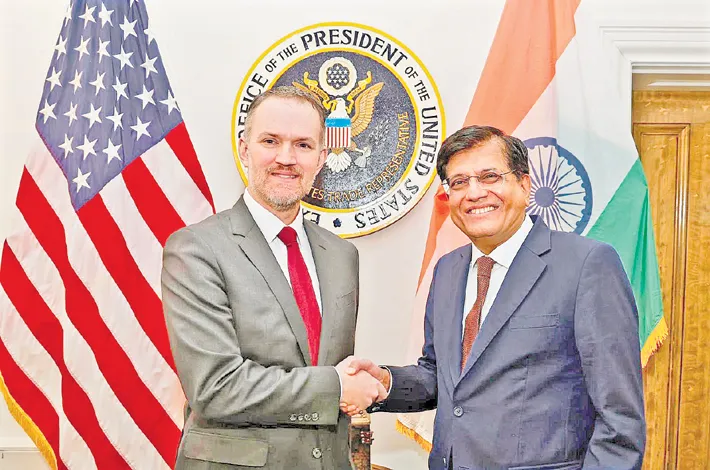
In a significant boost to the ongoing India-US trade negotiations, United States Trade Representative Jamieson Grier told Congress on Tuesday that India’s latest proposal is “the best offer we have received as a country” in the current round of talks. Grier described New Delhi as “quite forward-leaning” and flagged India as a viable alternative market for American agricultural commodities at a time when U.S. farmers are grappling with surplus inventories and erratic demand from China.
The remarks came just hours before a high-level U.S. delegation, led by Deputy Trade Representative Rick Switzer, landed in the Indian capital for intensive discussions with an Indian team headed by Commerce Secretary Rajesh Agarwal. Sources indicate the two sides are racing to resolve outstanding differences and finalise a bilateral trade agreement before the end of December.
While both governments have struck an optimistic tone — Union Commerce Minister Piyush Goyal has called the talks “progressive by nature” — experts and former diplomats warn that major hurdles remain, particularly in the politically sensitive farm and dairy sectors. Speaking on this topic, a retired professor of international relations accused President Donald Trump of “classic bullying and blackmail.” He argued that India has already reached the limit of concessions it can offer without causing “grievous” damage to its farming community, which operates on the margins of subsistence.
He made it clear that if American rice and other subsidised farm products are dumped here, the Indian farmer will be severely affected, adding that Prime Minister Narendra Modi is unlikely to succumb to pressure that compromises national interest. A former ambassador echoed the sentiment, highlighting Trump’s unpredictability as the biggest wildcard. “As long as Trump is on the scene, he can sabotage any progress with a single statement,” the ambassador noted, referring to the U.S. President’s recent threat — made during a meeting with Kansas farmers — to impose fresh tariffs on Indian basmati rice exports.
The ambassador outlined two non-negotiable Indian concerns: Washington’s push for market access for genetically modified soybean and corn, which conflicts with India’s long-standing policy against GM food crops; and U.S. dairy products derived from cattle fed on animal by-products, a practice that clashes with cultural and religious sensitivities of a large section of India’s population.
A Political commentator went further, alleging that the U.S. demands are part of a broader design to drive a wedge between the Modi government and Indian farmers ahead of domestic political battles. He alleged that trump wants to create a narrative that ‘Modi has sold out Indian farmers and milk producers’, pointing out that India is the world’s largest producer and exporter of rice and the largest milk producer globally.
He dismissed the controversy over Indian rice in the U.S. market — which accounts for only 5% of India’s total rice exports and 5% of American consumption — as disproportionate and driven more by ego than economics. Another senior economist acknowledged the pain being felt by Indian exporters hit by earlier U.S. tariffs, particularly in southern India where supply chains have been calibrated for decades to serve the American market.
Yet he cautioned that the atmosphere remains fragile. Hours before the latest round of talks, Trump’s threat of new rice tariffs “soured the congeniality,” he said. Despite the friction, some analysts believe a limited or interim agreement — similar to the temporary truce reached with China on rare-earth minerals — could still materialise by month-end to ease immediate pressure on both sides.
As the delegations huddle in New Delhi, one factor looms larger than tariffs, GM crops, or dairy quotas: the Trump Mood Index, as the economist termed it. Until the U.S. President signals satisfaction, experts agree, the fate of what has been called India’s “best offer ever” hangs in the balance. Both sides insist they are “moving forward.” Whether that momentum survives the next tweet or rally remark from Washington remains the question on everyone’s mind.