13 October, 2026 | 3:24 PM


Where is my footpath? Ask citizens
07-07-2026 12:00:00 AM
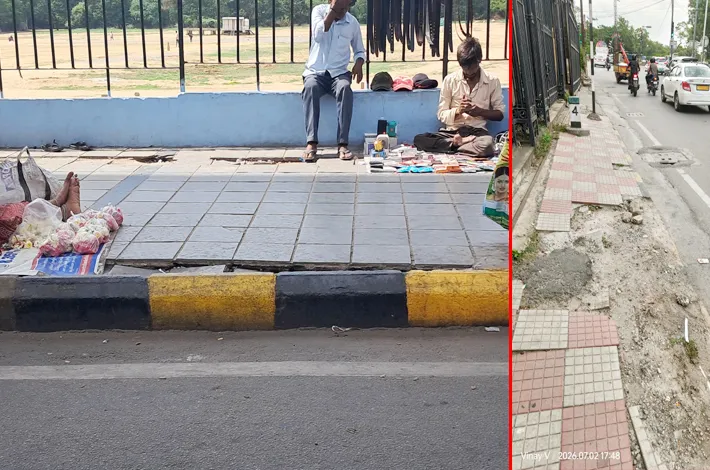
The Supreme Court's June 19 judgment has re-energised citizens, who are documenting unsafe roads and demanding accountability
EKALAVYA MALLEPALLI I hyderabad
The apathy of people towards the deplorable state of footpaths is a thing of the past. Thanks to the Supreme Court's landmark judgment of June 19, 2026, reaffirming the right to walk on demarcated footpaths a fundamental right, has spurred citizens to online campaign with hashtags such as #WhereIsMyFootpath.
Inspired by the ruling, Hyderabadis have taken to social media to share photographs and videos of missing footpaths, broken pavements, illegal encroachments, blocked walkways, unsafe crossings and malfunctioning pedestrian signals. Many posts have also reignited the debate over Hyderabad's ambition of becoming a global city while continuing to overlook one of the most basic elements of urban infrastructure — safe and accessible footpaths.
The campaign has been amplified by citizen-led initiatives such as Move Hyderabad, which has been promoting walkability and active mobility while encouraging residents to report footpath issues through Google Forms. The initiative aims to build a comprehensive database of problem locations and strengthen citizen participation in improving public spaces.
Among those leading the campaign is Santhana Selvan, who heads a Hyderabad cycling community and serves as the city's Bicycle Mayor. Through the Walkability Hyderabad initiative, he has urged citizens to collectively demand safer footpaths, crossings and streets, saying Hyderabad can truly become a global city only when walking is safe, convenient and accessible for everyone.
Complaints have poured in from across the city, including Kondapur, Gachibowli, Hitec City, Botanical Garden Road, Banjara Hills, Malakpet, Masab Tank, Parade Ground, Bank Street, Kukatpally, SR Nagar, Manikonda, Bachupally, Miyapur, Gowlidoddy and Durgam Cheruvu. Residents have highlighted footpaths occupied by parked vehicles, commercial establishments, hoardings and construction debris. In many locations, pavements are either damaged beyond use or missing altogether.
Urban mobility advocate Vinay Vangala described walking in Banjara Hills as a "high-risk stunt" despite it being one of Hyderabad's most prominent neighbourhoods. Other residents have flagged permanent encroachments near Zudio in Malakpet, missing footpaths along Botanical Garden Road, unsafe stretches in Kondapur, broken pavements at Parade Ground, malfunctioning pedestrian signals on Bank Street, poor street lighting along the Bachupally-Miyapur-Gandimaisamma Road and repeatedly dug-up footpaths near Aparna Zenon in Manikonda.
Several citizens have also questioned why pedestrians continue to be forced onto busy roads even where footpaths exist, arguing that poor maintenance, illegal parking and repeated excavation have rendered many walkways unusable.
Hyderabad's walkability movement is steadily gathering momentum, with citizens increasingly demanding that pedestrian rights receive the same attention as roads and flyovers. Whether the campaign will translate into safer, obstruction-free footpaths across the city remains to be seen. Whether walking in Hyderabad will one day become "a walk in the park" is a question only sustained civic action can answer.