28 December, 2025 | 4:13 PM


Congress Redefined Politics in India
28-12-2025 12:00:00 AM
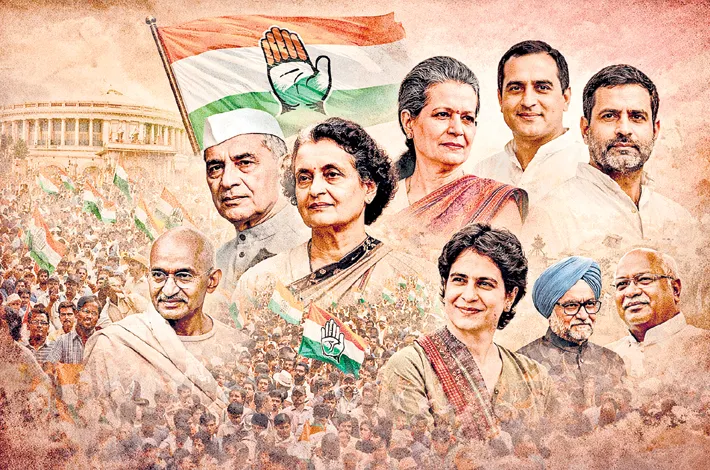
As the Congress celebrates its 140th Foundation Day on December 28, it has carved out a niche as the party that has redefined politics. It is incredible that even after the lapse of such a long period of time, the Congress continues to be connected with the people and with its across the nooks and corners of the country.
Perhaps, Congress is the only party to make the distinction between politics of power and politics as service and sacrifice and pursuit of ideology. Two shining symbols of leaders staying away from power politics are Mahatma Gandhi and, in our own times, Sonia Gandhi.
In the case of Sonia Gandhi, it was by far the toughest. It was no case of sour grapes. It was a conscious decision to stay away from power, after getting it firmly in her hands.
Renunciation of Power
Following her election as Congress Parliamentary Party Leader, she was elected UPA Parliamentary Party Leader, for which Sharad Pawar, who quit the Congress by opposing her foreign origins, proposed her name. Then came the Presidential Invite to Sonia Gandhi to form the Government. At that juncture, Sonia Gandhi politely, but firmly, declined the highest post in the world's largest democracy. Such renunciation of power of power is yet unmatched in the annals of world history.
Again, the Congress is the first party to place social and economic agenda above power politics. Right from the Constructive Programme of Mahatma Gandhi, emphasizing Hindu-Muslim Unity, Popularizing Khadi and Removal of Untouchability, to the Rights-Based Architecture unveiled by Sonia Gandhi, the party has focused on inclusive growth, giving rights and empowering people.
Foreign Origins
The party has earned a rare distinction of being a political force for assimilation and synthesis and not for exclusion and rejection.
The Congress has had three women Congress Presidents of foreign origins, Dr Annie Besant in 1917, Nellie Sengupta in 1933 and Sonia Gandhi from 1998 to 2017 and from 2019 to 2022, making it truly Vasudaiva Kutumbakam. Other women Congress Presidents are Sarojini Naidu in 1925 and Indira Gandhi in 1959 and again from 1978 till her tragic assassination on October 31, 1984. Sonia Gandhi is the longest-serving Congress President in the history of the Congress, surpassing the tenures of Pandit Jawaharlal Nehru and Indira Gandhi.
Never Dogmatic
Never a dogmatic party, the Congress did go in for policy recast to readjust the party to changing times. Pandit Jawaharlal Nehru introduced Socialism of the Fabien variety. In the Avadi Session of the Congress in 1955, Pandit Jawaharlal Nehru committed India to socialistic pattern of society.
During the Emergency, Indira Gandhi introduced Socialist and Secular in the Preamble to the Constitution to show that Congress commitment to these two ideals are non-negotiable.
At the time of the Economic Reforms in 1991, P V Narasimha Rao stayed the course. Since national development reached a stage when it became ineligible for concessional aid, India was forced to go in for Economic Reforms. Yet, P V Narasimha Rao devised a strategy to create safety net for the poor and vulnerable sections with programmes like Employment Assurance Scheme (EAS).
By unveiling the Rights-Based Architecture, Sonia Gandhi proved that providing Basic Needs is no charity or gratis, but the right of the people. Sonia Gandhi pitched in this revolutionary idea for the first time. No political party has demonstrated such sustained commitment to the welfare and well-being of the people.
People-Centric Politics
Drawing a distinction from publicity brand of politics, the Congress focused on raising issues of public concern. Mahatma Gandhi launched the Freedom Struggle with Champaran Movement in 1917 and launched Constructive Programme around 1924. In the Karachi Session of 1931, presided over by Sardar Patel, Pandit Jawaharlal Nehru piloted what has since come to be known as Karachi Resolution, where he brought out Economic Programme and Fundamental Rights.
In 1936, the Congress brought out blueprint for the regeneration of Rural India. It outlined Zamindari Abolition, Tenancy Protection and rationalization of land revenue. This was ahead of the Provincial Elections in 1937. In 1938, Congress President Netaji Subhash Chandra Bose appointed Jawaharlal Nehru as Chairman of National Planning Committee, making Planned Development as the goal.
Often, all the political parties ganged up against the Congress, unable to defeat it in electoral contests, like in 1971, 1977 and 1989. Invariably, the Congress did manage to bounce back on to the national political centrestage, each time efforts were made to corner it.
Prevarication on Secularism
Given the prevarication of all political parties on Secularism, RSS has emerged as the only rival pole to the Congress. All the anti-Congress parties, like the Socialists and the Left and especially CPM, besides regional players, veer round to the RSS, in their zeal to oppose the Congress, without as much as any moral compunction.
There is no political party so far that has remained secular, despite its opposition to the Congress. Samajwadi Party of Mulayam Singh Yadav, Trinamool Congress of Mamata Banerjee, JD (U) of Nitish Kumar, NCP of Sharad Pawar, BSP of Mayawati, YSRCP of Jagmohan Reddy and TDP of N Chandrababu Naidu, all played ball with RSS. In this distinguished club falls MIM leader Asaduddin Owaisi.
Internal Democracy
Singularly, the Congress has brought Independence and has been the Architect of Modern India. The Congress has not only introduced democracy in the country but is perhaps the lone political party to practice internal democracy. All other parties have nominated Party Presidents.
Critics either are unable to guage or understand the democratic spirit in the Congress, or deliberately try to create binaries like Gandhiji versus Subhash Chandra Bose or Jawaharlal Nehru versus Sardar Patel, in order to show the Congress in poor light.
In 1939, at Tripuri Session of the Congress, Netaji Subhash Chandra Bose contested against and defeated Patthabhi Sotaramayya, who was openly backed by Mahatma Gandhi. Soon after the results, Gandhiji acknowledged that Patthabhi Sitaramayya's defeat was his own personal defeat. All followers of Gandhiji resigned from the Congress Working Committee (CWC). Immediately Bose stepped down from the post of Congress President, saying Congress needs Gandhiji more than him.
It was Subhash Chandra Bose who hailed Gandhiji as Father of the Nation in a Radio Broadcast from Singapore on July 6, 1944, showing his deepest respect and regard for the Mahatma.
Similarly, Sardar Patel accepted Pandit Jawaharlal Nehru as Prime Minister and wholeheartedly worked under him. Often it is said that Kashmir would have been resolved if Patel became the Prime Minister. Again a deliberate misinformation campaign. It was Patel, who piloted Article 370 in the Constituent Assembly, as Nehru was away abroad.
They were all men of calibre and stature and were bound to have differences of opinion. Once a decision was taken, all abided by it.
In Fascist organizations, this is unthinkable and so they spread deliberate dubious stories. They cannot assess the intellectual expanse of the Congress leaders. Credit goes to Mahatma Gandhi for building such competent team.
— Venkat Parsa