21 September, 2026 | 8:36 PM


Digvijay praises Modi, sparks political buzz online
28-12-2025 12:00:00 AM
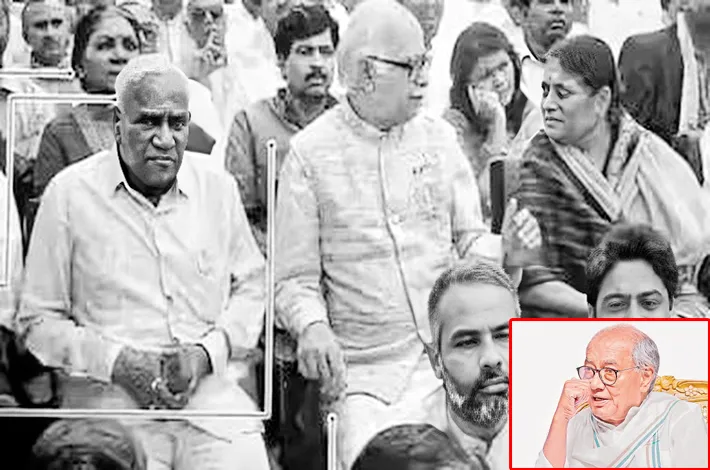
Digvijaya Singh praised how grassroots workers who once sat on the floor could grow within the Sangh-BJP ecosystem and become Chief Minister and Prime Minister
Veteran Congress leader and former Madhya Pradesh Chief Minister Digvijaya Singh set social media abuzz by sharing a striking black-and-white photograph from the mid-1990s on Saturday on X. The image captures a young Narendra Modi, then a dedicated RSS pracharak and BJP organiser, seated humbly on the floor during a Gujarat event—widely believed to be the 1996 swearing-in ceremony of Chief Minister Shankersinh Vaghela—while senior leaders like L K Advani occupy chairs.
In his Hindi caption, Singh described the picture as ‘very impactful’ praising the RSS-BJP eco-system for elevating a grassroots worker who sat ‘at the feet of leaders’ to become Gujarat's Chief Minister and eventually India's Prime Minister. He hailed it as a testament to the "power of organisation"), ending with ‘Jai Siya Ram’ and tagging top Congress figures including Rahul Gandhi, Mallikarjun Kharge, and Priyanka Gandhi Vadra.
The post, seemingly appreciative of Modi's journey and BJP's merit-based structure, quickly drew sharp reactions. BJP supporters flooded the replies with contrasting images of Congress leaders sitting deferentially near the Gandhi family, accusing the party of dynastic politics and sycophancy. Many interpreted Singh's tweet—coming amid his recent calls for internal Congress reforms—as a subtle critique of his own party's rigid hierarchy.
The episode highlights a deeper divide in Indian politics: one side celebrates organisational discipline and upward mobility from humble beginnings, while the other defends ideological continuity and family legacy. Whether intended as praise, sarcasm, or a veiled message to his party, Digvijaya Singh's share reignited the long-standing debate between meritocracy and dynasty in India's democratic landscape.
Speaking to reporters Digvijay Singh said, “I am a strong opponent of PM Modi and RSS. What I said was that the merit-based organisational structure of the RSS provides ample space for growth for grassroot workers.” He further added that when he was the Chief Minister of Madhya Pradesh, he worked for decentralisation of power. I am talking about the organisation of the Congress Party.”
Political analysts state that what Digvijay Singh has said is merely an extension of the whispers within the Congress party. What he meant could be to take a leaf out of the BJP’s organisational structure and improve free-flow of communication, ensure a more dentralised and democratic set-up, and the High Command should open its doors to the grassroot work-ers.