22 September, 2026 | 8:33 PM


A Lilting, Haunting Voice Falls Silent
13-04-2026 12:00:00 AM
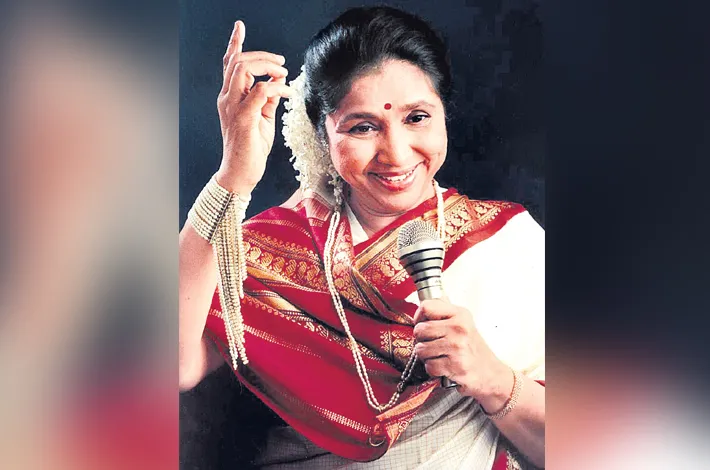
Facing tough competition from her contemporaries, like Suraiya, Shamshad Begum, Mubarak Begum and Geeta Dutt, Asha Bhosle did manage to overcome the same with her unmatched talent
Venkat Parsa
Asha Bhosle's is lilting, haunting voice that has mesmerized successive generations since the dawn of Independence. Though her elder-sister, Lata Mangeshkar, was of a class of her own, Asha Bhosle did carve out a niche, with a voice of unmatched versatility. She rendered songs of different genres, bhajans, folk, classical, ghazal and qawwali, with equal felicity.
Asha Bhosle's life has been one of creating records. A record eight decades in her singing career. An unbeatable record, when, on her 90th birthday in 2023, she chose to celebrate it in a concert in Dubai, standing for three hours, regaling her audience, rather than opting for a quiet celebrations. Perhaps, it will be hard to come across such records created by her.
Born on September 8, 1933, Asha Bhosle's singing career started with Chala Chala Nav Bala in a Marathi film, Majha Bal in 1943. Her debut in Hindi Cinema was with Saawan Aaya in Chunaria in 1948. For a decade, she sang numerous songs, often for B-grade films, or as a secondary voice. A real break came in 1954, with Boot Polish, Nanhe-munhe bachhe teri mutthi mein kya hai.
Facing tough competition from her contemporaries, like Suraiya, Shamshad Begum, Mubarak Begum and Geeta Dutt, Asha Bhosle did manage to overcome the same with her unmatched talent.
Once she recalled how she was nervous, ahead of the recording of a difficult song. Lata Mangeshkar, whom she approached for guidance, told her, you are Mangeshkar first and Bhosle later. People love the singing of Mangeshkars. Go and sing with confidence, was Lata Mangeshkar's message. Sure enough that song became a hit.
Prominence and popularity came her way, with Asha Bhosle singing for O P Nayyar. Overnight, he turned her into a national sensation. O P Nayar is the only music director to create musical magic, without ever using the voice of Lata Mangeshkar. From Naya Daur in 1957, to Pran Jaaye Par Vachan Na Jaaye in 1974, Asha Bhosle became a singing sensation. Asha Bhosle delivered hits, which are difficult to be matched by anyone else.
In a way, Asha Bhosle is responsible for creating the screen persona of Asha Parekh. Phir Wohi Dil Laya Hun in 1963 was the start of a string of haunting melodies. Aankhon se jo utren hain dil mein, tasveer hai ek anjaane ki, khud dhoond rahe hain shama jise, kya baat hai us parwane ki, in Phir Wohi Dil Laya Hun is unparalleled for its grace and melody. In the same film, her duet with Mohammad Rafi is an all-time hit, Zulf ki chhaon mein chehre ka ujala lekar teri veeraan si raaton ko jalaya hum ne.
In Mere Sanam in 1965, Jaaiye aap kahaan jaayenge, yeh nazar laut ke phir aayegi and in Yeh Raat Phir Na Aayegi in 1966, Mohobat cheez hai kya, mohobat kar ke dekhenge are songs with which she raised the bar.
Asha Bhosle gave memorable songs with her elder-sister and a legend, Lata Mangeskar, like, Aie kaash kisi deewane ko hum se bhi mohobat ho jaaye in Aaye Din Bahaar Ke and with Mubarak Begum in Aarzoo, Jab ishq kahin ho jata hai, tab aisi haalat hoti hain mehfil jee ghabrata hai tanhai ki aadat hoti hai.
Another song of hers with Minoo Purushottam in Yeh Raat Phir Na Aayegi, Huzur-e-waala, jo ho ijaazat to hum yeh saare jahaan se kah den, became a great hit.<Two of her songs achieved cult status. One was Parde mein rehne do, parda na utthao in Shikaar and Dum maro dum in Hare Rama Hare Krishna.
Asha Bhosle alone could do justice to sings like, Shokh nazar ki bijliyaan dil pe mere giraye ja in Woh Kaun Thi; Bheegi-bheegi faza and Kyon mujhe itni kushi de di, ke ghabrata hai dil in Anupama; Jahaan mein aisa kaun hai, ke jisko gham mila nahi in Hum Dono; and Tere khayalon mein hum in Geet Gaya Pathron Ne.
Even B-grade films were made memorable, on the sheer strength of the songs of Asha Bhosle. These include songs like, Hum tere bin jee na sakenge sanam in Thakur Jarnail Singh; Achha sanam, kar le sitam, kaash ke hum ne pyaar na kiya hota in Teesra Kaun; and Aaj ki raat jawaan Allah Allah, aur tum bhi ho yahaan Allah Allah, jaane kal honge kahaan Allah Allah, haye Allah, mere mehboob Khuda Hafiz, in Akela.
Most of her songs may seem frothy types. It's only when a lesser singer attempts them that one can gauge the tremendous breath-control and pitch modulation required for these non-classical, light-hearted songs. Perhaps, it's solely because of her mastery that makes these songs seem so easy to execute.
Lata Mangeskar personally listed two of Asha Bhosle's songs among her all-time favourites. These are Yeh rangeen mehfil, ghulabi ghulabi, mere dil ka aalam sharabi sharabi in Shikaar, which was more in Ghazal style; and another, Nighaen mila ne ko jee chaah ta hai in Dil Hi To Hai, in Qawwali style.
A Qawwali of Asha Bhosle with Mohammad Rafi in Qawwali Ki Raat, Husn waale, husn ka anjaam dekh, doobte Suraj ko waqt-e-shaam dekh, is an example of her extreme versatility.
Aaj koyee pyaar se, dil baaten kah gaya in Sawan Ki Ghata; Chehre pe khushi chhaa jaati hai, aankhon mein suroor aa jata hai and Kaun aayaa ki nighaon mein chamak jaag uthi in Waqt bring out the lilting quality of her songs.
Asha Bhosle could bring out pathos and this is borne out by her song in Meri baat rahi mere man mein, kuch keh na saki uljhan mein in Saheb, Bibi Aur Ghulam.
A devotional song like Sun le pukaar aayee, aaj tere dwaar leke aansuon ki dhaar mere Sanvare in Phool Aur Pathar and Mere sune jeevan ka Aasra hai tu, kaun kehta hai be-aasra hai tu in Aasra show that she belongs to a league of her own.
Life was tough for her, but she lived on her own terms. In her teens, her elder sister Lata Mangeshkar’s private secretary Ganpatrao Bhosle lured her, and she eloped with him to marry him. Soon, love flew out of the window. She was tormented by her husband, who forced her to sing and earn money for him.
Asha Bhosle managed to escape from his clutches, only to be ensnared by O. P. Nayyar. Finally, she fell in love with R. D. Burman and married him in 1980. She remained with him till his demise in 1994. But the struggles and difficulties in her life never dampened her spirit. She worked her way up to become a legend in her own lifetime.