23 September, 2026 | 7:33 AM


Centre’s Health Funding to Telangana crashes
13-12-2025 12:00:00 AM
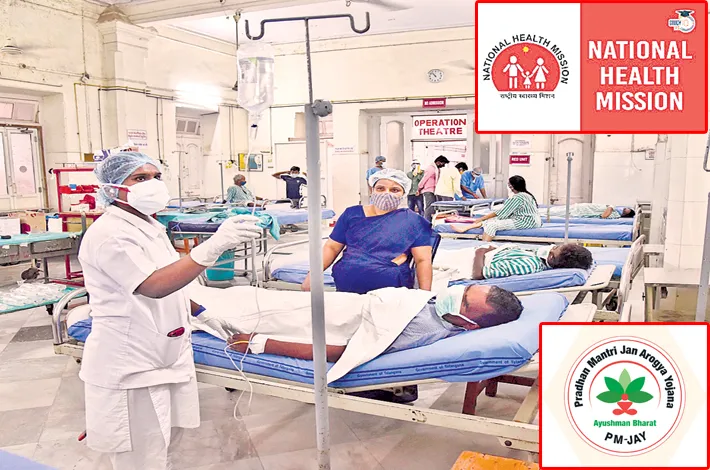
NHM, PM-JAY releases fall below One-Fourth
- NHM funding dropped from ₹1,110.43 crore in 2024–25 to ₹240.14 crore in 2025–26 (till October).
- With only months left in the fiscal year, allocations are set to remain far below last year’s levels.
- PM-JAY support fell sharply from ₹218.29 crore to ₹56.85 crore in the same period.
- Medical colleges saw full Central funding in Phase-I, while Phase-II colleges received only partial releases, affecting PG expansion.
Telangana is facing a sharp decline in Central health funding during the 2025–26 fiscal year, raising alarm about the sustainability of core public health programmes. According to official data placed before the Lok Sabha, the Union Government’s releases under the National Health Mission (NHM) and Ayushman Bharat–Pradhan Mantri Jan Aarogya Yojana (AB-PMJAY) have dropped to less than one-fourth of last year’s levels.
Under NHM, the Centre had released Rs 1,110.43 crore in 2024–25, but the release for 2025–26—only Rs 240.14 crore till October 31, 2025—marks a steep decline. Similarly, funding under AB-PMJAY has fallen from Rs 218.29 crore in 2024–25 to just Rs 56.85 crore in 2025–26 (till October-end).
With less than five months remaining in the current fiscal year, officials acknowledge that the allocations are unlikely to reach last year’s levels, signalling significant fiscal strain on programmes aimed at strengthening primary, secondary, and tertiary healthcare in the state.
NHM funds are crucial for manpower recruitment, diagnostics, maternal and child health services, disease control programmes, and facility upgrades. PM-JAY plays a key role in clearing hospital claims, especially in Telangana, where it is integrated with the state’s Aarogyasri scheme. The Centre clarified that releases under NHM depend on compliance with the Ministry of Finance guidelines, while PM-JAY funds are used specifically for settlement of empanelled hospital claims.
The reduced Central flow comes at a time when Telangana’s public health institutions are already under significant stress. The funding cut has implications beyond operational expenses. Lower NHM allocations can affect infrastructure development, procurement of essential medicines and critical-care equipment, and implementation of national health programmes. Meanwhile, reduced PM-JAY support may slow down claim settlements, impacting both patient access and private hospital participation in the scheme.
BJP MP Godam Nagesh, who posed a question to this effect in Lok Sabha, has singled out Telangana government for its failure in getting desired funds from the Centre this fiscal. Speaking to this paper, he said that the state health department may not have fulfilled the criterion or failed to comply with the rules mandated by the Centre and hence the funds were not released.
How Central Allocations varied across Govt.Medical Colleges
Under the Centrally Sponsored Scheme for strengthening and upgrading Government Medical Colleges by introducing new postgraduate disciplines, Telangana has been sanctioned 511 PG seats with an approved cost of Rs 327.55 crore across two phases. In Phase-I, the Centre released its entire 60% share for three major institutions—Gandhi Medical College in Secunderabad (Rs 5.667 crore), Kakatiya Medical College in Warangal (Rs 7.4716 crore), and Osmania Medical College in Hyderabad (Rs 29.612 crore)—covering 279 PG seats. In contrast, Phase-II funding, which covers 232 PG seats across newer and district-level colleges, has been released only in part. The Centre has so far provided Rs 7.20 crore to GMC Suryapet, Rs 20.14 crore to GMC Siddipet, Rs 8.64 crore to GMC Nalgonda, Rs 4.61 crore to GMC Nizamabad, and Rs 2.88 crore to GMC Mahabubnagar.
Additionally, RIMS Adilabad has received Rs 6.16 crore, KMC Warangal Rs 0.87 crore, and Osmania Medical College (for its additional Phase-II seats) Rs 9.21 crore. Further releases under Phase-II depend on utilisation of earlier funds, submission of utilisation certificates, release of matching state share, and progress of civil and equipment works. In its response in Lok Sabha, the Centre also noted issues such as vacancies across government medical colleges and challenges in super-speciality services, adding to the state’s growing healthcare burden.
e Union Government reiterated that fund releases depend on state-wise utilisation patterns, compliance requirements, and submission of utilisation certificates. However, the steep year-on-year shortfall is expected to place pressure on Telangana’s health budgeting for the remainder of the fiscal year.