6 October, 2026 | 10:25 AM


‘Climate Accord one-sided’
22-02-2025 12:00:00 AM
ANI WASHINGTON
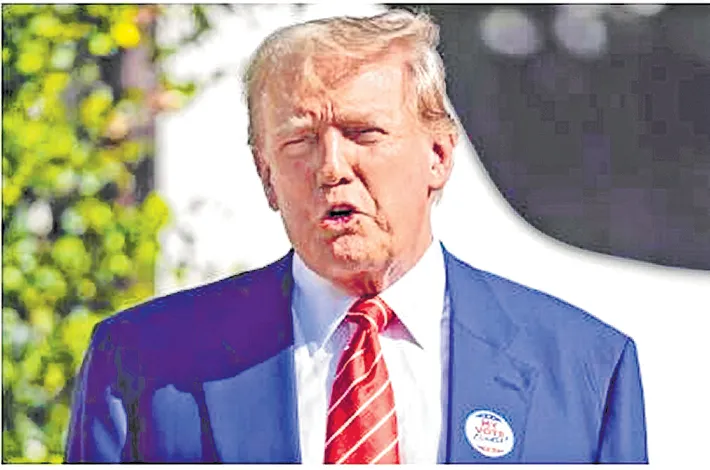
US President Donald Trump has lauded his decision to pull out the United States from the Paris Climate Accord, which he termed a "one-sided and very expensive" affair. Addressing the Republican Governors Association (RGA) meeting, Trump said, "I withdrew from the one-sided and very expensive Paris Climate Accord. It's a one-way street. Under that accord, we pay USD 1 trillion. China doesn't pay anything. India doesn't pay anything, Russia doesn't pay. We just pay everybody. It's like a health organization, and every one of the...every deal is no good. But we're changing it."
He further highlighted that the US pays USD 500 million a year to the World Health Organization (WHO) while China, which has a population of 1.4 billion people, only pays USD 39 million a year. He even mentioned that former US President Joe Biden had agreed to include the US back into the WHO.
"We terminated health. On the World Health (Organisation), we paid USD 500 million a year, and China paid USD 39 million a year. I said, that doesn't sound good. They (China) have 1.4 billion people, and we have nobody knows what the hell our number is, because so many people pour into our country.
We used to say, like, 325. I have no idea. We'll figure it out eventually. But let's put it this way. It should be substantially less than 1.4. But, let's say we have 325 million, they have 1.4. We're paying 500 million and...these aren't huge numbers, but this is an example of what happens when you have bad government, when you have incompetent people," Trump said.
Earlier in January, soon after taking over as US President, Trump signed an executive order to withdraw the United States from the Paris Climate Treaty -- just as he did in his first term. However, the Trump administration's move against the 2015 Paris accord in 2017 was reversed by Joe Biden on his first day in office in 2021.
Paris Agreement is an international agreement to combat climate change, and nearly 200 countries have committed to keep global warming below 2 degrees Celsius and ideally below 1.5 degrees. Each country is responsible for developing its own plan to uphold the commitment. However, the agreement is not a legally binding treaty.