23 October, 2026 | 2:25 PM


Cooler Roofs, Higher Solar Output
28-08-2026 12:00:00 AM
Metro India News | Hyderabad
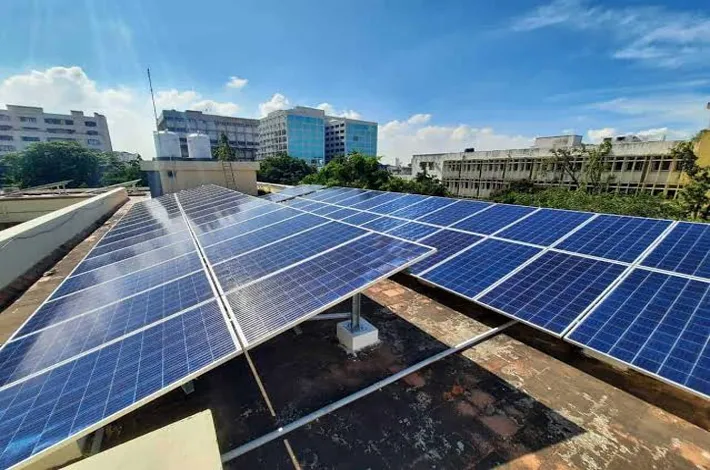
India’s rooftop solar program is entering a phase in which the question is no longer simply how much electricity a household can generate, but how effectively a rooftop can perform under increasingly hot conditions. A new study published in Applied Energy, led by Rupali Khatun and co-authored by Ansar Khan and an international team of researchers, examines how the design of the roof beneath photovoltaic panels can influence both solar generation and urban heat.
The research comes as the Government of India expands residential rooftop solar through the PM Surya Ghar: Muft Bijli Yojana, which aims to enable households to generate electricity from their own roofs and reduce their dependence on grid electricity. The study suggests that the next policy opportunity could be to consider the thermal performance of rooftops alongside solar capacity. Researchers compared photovoltaic systems installed over conventional reinforced-cement-concrete roofs with systems using green roofs, cool roofs and super cool roofs under extreme summer conditions.
The strongest results came from super cool roofs. When combined with photovoltaic panels, they increased electricity generation by 14.3% and reduced panel temperatures by 27.3°C. Roof temperatures fell by 22.5°C, while ambient and surface air temperatures declined by as much as 1.7°C and 4.7°C, respectively. Cool roofs increased photovoltaic output by 9.6%, while green roofs increased output by 5.1%. A rooftop that limits heat accumulation can therefore potentially improve solar generation while also reducing thermal stress on buildings.
The study also highlights the importance of airflow. Under comparable solar-radiation conditions, every 1 m/s increase in wind speed reduced panel temperature by 18.3°C and increased electricity output by 9.9%. This suggests that rooftop configuration, building density and local ventilation may deserve greater attention when planning solar installations in dense urban areas. Under the conditions simulated in the study, super cool roof and photovoltaic systems could offset up to 104.6% of daytime cooling demand. PM Surya Ghar is creating a large-scale platform for residential solar deployment.
Future demonstration projects could examine whether photovoltaic systems can be integrated with reflective roofing, green infrastructure, improved ventilation and other heat-mitigation measures. Such an approach could be particularly useful in cities where high temperatures, rooftop heat and air-conditioning demand increasingly coincide. Policy pilots could assess not only installed solar capacity, but also energy yield, panel temperature, household cooling demand, peak electricity consumption and thermal comfort.
– Rupali Khatun