14 October, 2026 | 8:52 AM


Death deserves dignity, not a battle: Dr. Kalantri
17-06-2026 12:00:00 AM
Metro India News | Hyderabad
Dr. S.P. Kalantri of the Mahatma Gandhi Institute of Medical Sciences (MGIMS), Sevagram, has urged both doctors and society to rethink their approach to death, saying it should not be viewed as a medical failure but as a natural transition that deserves dignity, compassion and acceptance.
Speaking from the perspective of nearly 40 years in medicine, Dr. Kalantri said India has witnessed a profound shift in how people die. While births and deaths once took place at home surrounded by family, advances in healthcare gradually moved both into hospitals and eventually into intensive care units (ICUs). Although ICUs have saved countless lives through modern interventions, he cautioned against their overuse in patients with irreversible and terminal illnesses.
He noted that patients with metastatic cancers, advanced dementia, severe strokes, end-stage liver disease, kidney failure and other chronic incurable conditions are increasingly subjected to invasive procedures despite minimal chances of recovery. Many spend their final days attached to ventilators and multiple life-support systems, often isolated from loved ones.
Dr. Kalantri said medical education equips doctors to diagnose diseases and perform complex interventions but rarely teaches them how to communicate about death or guide families through end-of-life decisions. This has led to death being perceived as defeat, creating guilt among doctors and anguish among relatives.
He highlighted inequalities in end-of-life experiences across social groups. According to him, affluent patients often undergo aggressive treatment in sophisticated hospitals, middle-class families struggle with uncertainty and guilt, while poorer patients frequently face neglect and abandonment.
Quoting renowned palliative care pioneer Dr. M.R. Rajagopal, he remarked that "the poor die in agony in neglect, the middle class die in agony in ignorance, and the rich die in agony on ventilators."
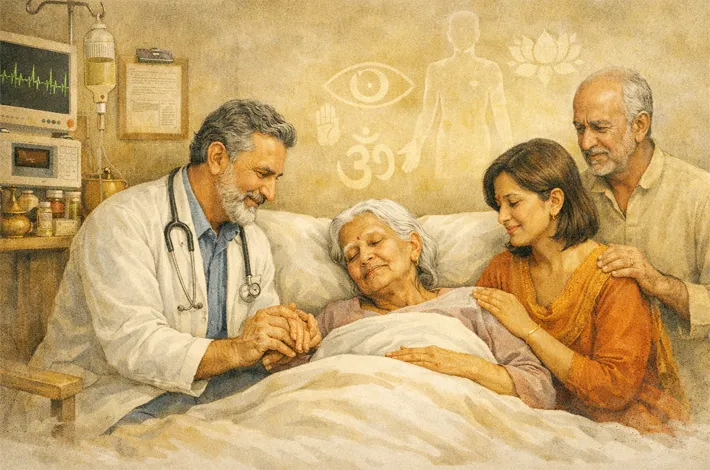
Inspired by Kerala's acclaimed palliative care model, Dr. Kalantri helped establish a 30-bed palliative care unit at MGIMS, Sevagram. The unit focuses on symptom relief, emotional support and open conversations about death. Family members are encouraged to remain with patients, allowing them to spend their final moments surrounded by loved ones rather than medical equipment.
He stressed that palliative care does not mean giving up on patients. Instead, it prioritises relieving pain, addressing emotional needs and helping individuals live meaningfully until the end.
Referring to Supreme Court guidelines that have simplified living wills and advance medical directives, Dr. Kalantri encouraged doctors and citizens to document their wishes regarding end-of-life care.
He said the healthcare system must move towards ensuring that people are not subjected to painful and lonely deaths but are instead given the opportunity to die peacefully, with dignity and according to their own choices.
Dr. S. P. Kalantri's reflections on death and end-of-life care have revived an important debate on the true purpose of medicine. Echoing the themes of Atul Gawande's Being Mortal, he reminds us that death should not always be seen as a medical failure, but as a natural part of life that deserves dignity and compassion.
Modern medicine is often trained to fight death relentlessly, focusing on extending life at any cost. Yet, patients nearing the end of life frequently seek simpler comforts: freedom from unbearable pain, the familiarity of home, the presence of loved ones, dignity and the ability to make their own choices. In such moments, the greatest act of healing may not be another intervention, but a doctor's willingness to ask, "What matters most to you now?"
Ayurveda recognised this truth centuries ago. Classical texts describe life as the harmonious union of sharira (body), indriya (senses), manas (mind) and atma (consciousness). Death is viewed not as an enemy to be conquered at all costs, but as the natural separation of these elements when their time is complete. The physician's duty is therefore twofold: to preserve health and prolong meaningful life whenever possible, and to relieve suffering with compassion when cure is no longer within reach.
Dr. Kalantri represents a tradition of Indian physicians who combine scientific rigour with humility and service. Institutions such as the Karnataka Medical Centre in Ghataprabha continue to uphold these values, proving that the soul of medicine lies not in spectacle or technology, but in humanity.
Dr. Jonnagadla J Vijeyapall, Sr. Ayurvedic Consultant