4 October, 2026 | 7:15 AM


Family planning drive in national interest
13-03-2026 12:00:00 AM
Venkat Parsa | Hyderabad
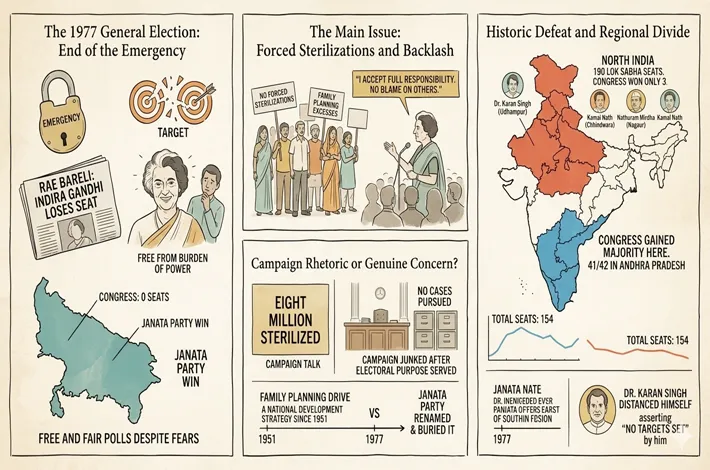
During the 1977 General Election, held at the end of the Emergency, Prime Minister Indira Gandhi lost her Rae Bareli seat and the Congress party failed to win a single seat in Uttar Pradesh. The defeat reflected public backlash against the Emergency policies she believed were in the national interest.
Despite fears that the elections might be manipulated, the polls were widely regarded as free and fair. When results showed her trailing, aide R.K. Dhawan hesitated to inform her. On hearing the news, Indira Gandhi reportedly smiled with relief, feeling freed from the burden of power.
The most emotive issue in the 1977 General Election was the alleged excesses during the family planning drive, particularly forced sterilizations. As Prime Minister, Indira Gandhi accepted full responsibility for what happened during its implementation and did not blame others.
The controversy became a major factor in the Congress party’s historic defeat, marking the first time since 1947 that it lost power at the Centre. In North India, Congress won only 3 of 190 Lok Sabha seats—including victories by Dr. Karan Singh (Udhampur), Nathuram Mirdha (Nagaur), and Kamal Nath (Chhindwara). Although Congress secured 154 seats overall, most came from the South, including 41 of 42 seats in undivided Andhra Pradesh.
Campaign Rhetoric
Eight million people sterilized, is the figure bandied about. It would have been the best way to pursue the cases and punish the Congress leaders and send to jail. Why, then, this entire campaign was junked, soon after the Janata Party Government was formed at the Centre on March 24, 1977?
Was it no more than mere campaign rhetoric? Or so it seemed, as neither the Media nor the Janata Party Government evinced any interest after the electoral purpose was served, of dislodging the Congress from power. Surprisingly, no cases were pursued, no one was booked and much less, anyone punished under due processes of law.
Family planning drive since 1951
Family Planning Programme has been an essential part of the national development strategy since Independence. It was launched in 1951, after the Census, following an assessment that population growth may spiral in the years to come. It was fully funded by the Centre, making India the first country in the world to undertake it. It always figured in the Five-Year Plan Plans, till the Janata Party buried it for good in 1977.
Indira Gandhi tried to give push to Family Planning drive, as part of the larger poverty alleviation plan. Population control is an essential, inescapable and integral part of national development strategy, to bring prosperity to the widest sections of the people.
The very critics, who successfully made Family Planning a dirty word, are the first to cite examples of countries with small, limited population as the ideal, creating social security net for all.
At the Book-Release of Dr Karan Singh's Authorized Biography by Harbans Singh, "A Statesman And A Seeker, The Extraordinary Life and Legacy of Dr Karan Singh," at the India International Centre (IIC) in New Delhi recently, a conversation by Shashi Tharoor with Dr Karan Singh followed. Shashi Tharoor drew out Dr Karan Singh on Family Planning issue, as Dr Karan Singh was the Union Minister for Health & Family Planning during the Emergency from 1975-77. After the Emergency, the Janata Party Government under Morarji Desai that came to power in 1977, renamed it as the Ministry of Health & Family Welfare.
In his conversation with Shashi Tharoor, Dr Karan Singh held his ground, asserting he had not set any targets. Sanjay Gandhi adopted Family Planning, making it part of his Five-Point Programme. As a result, targets were set by some State Chief Ministers, in order to please Sanjay Gandhi. Dr Karan Singh further distanced himself, saying he never shared a dias with Sanjay Gandhi. Shashi Tharoor, then in Jawaharlal Nehru University (JNU) in New Delhi, has vivid memories of the times.
Whisper Campaign
The passage argues that opposition groups, particularly the Bharatiya Jan Sangh, played a major role in turning public opinion against the Family Planning Programme during the 1977 elections by portraying it as a Western conspiracy and using religious sentiments in whisper campaigns. Rumours and scare tactics—such as stories of people being forcibly taken for sterilization—spread widely and fueled fear among the public.
Indira Gandhi, however, maintained that she supported persuasion rather than compulsion in family planning and launched the programme to address concerns about rapid population growth affecting food security, employment, and development. The text notes that incentives and disincentives for small families exist in many states, and mistakes can occur in large national programmes. It concludes that the key to successful family planning is public awareness and voluntary participation, as people must understand its benefits for it to work effectively.