13 September, 2026 | 11:10 PM


Growing intolerance for environmental non-compliance
17-01-2026 12:58:56 AM
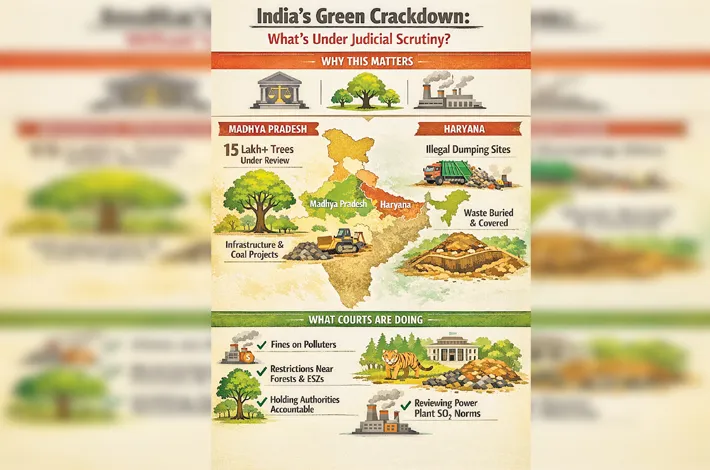
Recent orders signal a clear shift: development can no longer bypass environmental safeguards, and regulatory authorities may be held accountable for lapses.
As environmental violations mount across Indian states, the country’s higher judiciary — including the Supreme Court, High Courts and the National Green Tribunal (NGT) — has intensified scrutiny of projects affecting forests, biodiversity and waste management.
Recent orders signal a clear shift: development can no longer bypass environmental safeguards, and regulatory authorities may be held accountable for lapses. Courts have imposed penalties on polluters, restricted activities near forests and eco-sensitive zones, and sought government accountability over garbage dumping, mining and deforestation. The focus has moved beyond isolated violations to systemic failures in compliance and enforcement.
One of the most significant interventions has come from the NGT in response to reports that over 15 lakh trees could be felled in Madhya Pradesh in 2026. In an order dated January 13, 2026, the tribunal sought responses from multiple authorities, flagging possible violations of the Environment (Protection) Act, the Indian Forest Act and the Biological Diversity Act.
The NGT directed the Director General of Forests, the Union Ministry of Environment, Forest and Climate Change (MoEF&CC), the Central Pollution Control Board, the Madhya Pradesh Forest Department, the State Environment Impact Assessment Authority (SEIAA), and the ministry’s regional office in Bhopal to file their replies before the next hearing scheduled for March 9, 2026.
The concern stems from reports that 50- to 100-year-old trees are proposed to be cut for infrastructure, coal projects and urban expansion across several districts. In Singrauli alone, over 35,000 trees have already been removed across nearly 1,400 hectares — much of it dense forest — with plans to cut another 5.7 lakh trees. Railway, highway and road-widening projects in Khandwa, Vidisha, Indore, Bhopal and Gwalior account for tens of thousands more trees slated for removal.
Similar issues have surfaced in Haryana, where the NGT is examining illegal excavation and waste dumping in Dhauj, Faridabad. A joint inspection by the Mines and Geology Department and the Haryana State Pollution Control Board found unauthorized digging and burial of solid waste at six sites. Residents alleged that garbage from the Bandhwari landfill in Gurugram was transported, dumped into pits and covered with soil.
In a submission dated January 13, 2026, the Faridabad Deputy Commissioner confirmed these findings and expressed concern that residential colonies could be planned over reclaimed, waste-filled land. Multiple departments — including municipal bodies, town planning authorities and the police — were instructed to take remedial and enforcement action, following a coordination meeting held in December 2025.
Beyond these cases, courts across India have tightened restrictions on construction near forests, tiger reserves and eco-sensitive zones, while closely monitoring air and river pollution. The Supreme Court has reiterated that ecological justice is a constitutional duty, especially in cases involving endangered species and large infrastructure projects.
Meanwhile, the MoEF&CC has defended in an affidavit its decision to extend deadlines for thermal power plants to meet SO2 emission norms — a move now under judicial scrutiny amid worsening air pollution.
Taken together, these developments reflect a growing judicial intolerance toward environmental non-compliance. From tree felling and mining to waste dumping and emissions, environmental protection is increasingly being treated as mandatory — not optional.