24 September, 2026 | 9:16 PM


India hits historic milestone as 160 districts go malaria-free
08-01-2026 12:00:00 AM
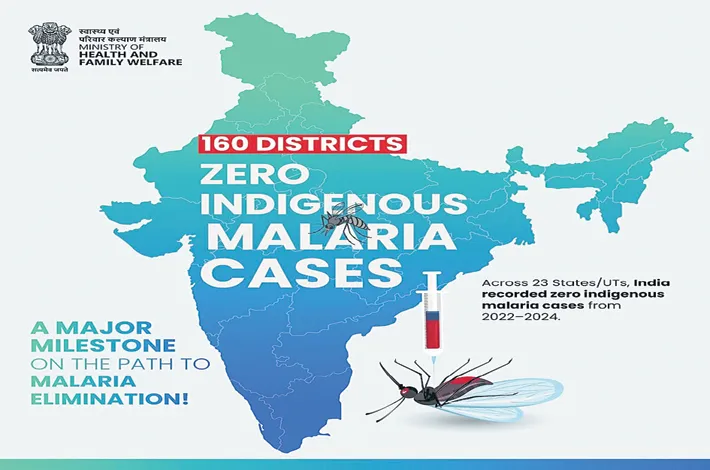
India has achieved a remarkable milestone in its fight against malaria, with 160 districts across 23 States and Union Territories reporting zero indigenous malaria cases between 2022 and 2024. This landmark accomplishment reflects decades of sustained public health efforts and is being hailed by experts as one of the most significant shifts in the nation’s battle against vector-borne diseases. It underscores India’s growing capacity to control and eliminate a disease that once claimed hundreds of thousands of lives annually.
Malaria once claimed hundreds of thousands of lives every year and now the India’s sharp decline in infections and fatalities reflect decades of sustained public health action and robust surveillance displays a noticeable shift. The Ministry’s latest data show that malaria deaths have dropped from almost 800,000 at the time of independence in 1947 to just 83 in 2023, a reduction of more than 99 percent, underscoring a profound transformation in national health outcomes.
However, experts credit this progress to a blend of strategic and effective measures, including the extensive distribution of the insecticide treated nets, expanded diagnostic testing, targeted indoor residual spraying and the strengthened surveillance systems. This implementation of the Integrated Health Management Information Platform (IHIP) has enabled the real time monitoring of the cases and deaths, ensuring the faster response and more accurate reporting.
The country’s journey against malaria has a deep historical context. It was Sir Ronald Ross, a British Army officer in India, who first demonstrated in 1897 that mosquitoes transmit the malaria parasite, laying the foundation for modern malaria control efforts. The disease’s toll was massive, including an estimated 100 million cases and one million deaths in 1935 alone. A national eradication programme in 1958 brought early success, virtually eliminating malaria by the mid-1960s, only for the disease to resurge in the 1970s due to insecticide resistance and programmatic satisfaction.
In more recent decades, India has regenerated its fight. In 2015, it joined a regional roadmap to eliminate malaria by 2030, and later pledged to achieve zero indigenous cases by 2027, which is three years ahead of the global targets. Progress has been tangible, between 2015 and 2023, malaria cases nationwide dropped by roughly 80–85 percent, while deaths decreased by nearly 78 percent.
Yet the battle is not over. Although most states now report minimal transmission, malaria persists in pockets of forested, tribal and hard-to-reach areas, especially in Odisha, Chhattisgarh, Jharkhand, Madhya Pradesh and Maharashtra, which together contribute the lion’s share of residual burden. Public health officials highlight that the surveillance and community engagement remain critical.