12 October, 2026 | 11:01 PM


India targets 100 GW nuclear power capacity
13-02-2026 12:00:00 AM
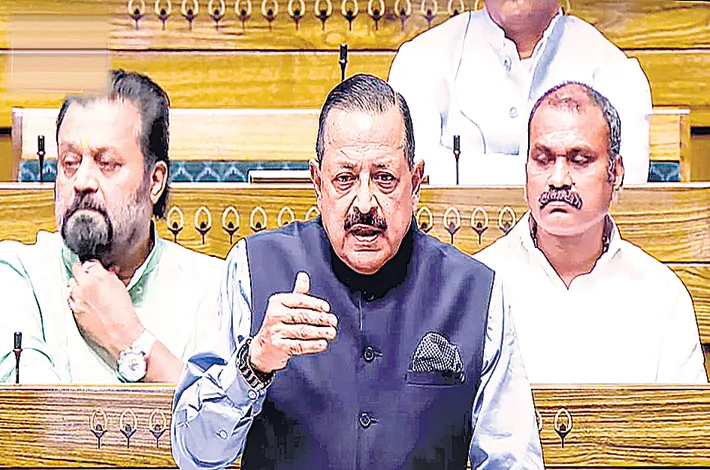
India has charted an ambitious roadmap to scale up its nuclear power capacity to 100 gigawatts (GW) by 2047, with the government asserting that the country is steadily moving towards self-reliance in the nuclear energy sector while adhering strictly to safety norms and project timelines.
Replying to supplementary questions in the Rajya Sabha on Thursday, Minister of State in the Prime Minister’s Office Jitendra Singh said India’s installed nuclear capacity, which stood at 4,780 MW in 2014, has more than doubled to 8,780 MW in 2026. He added that the capacity is projected to triple to 22,380 MW by 2031-32, marking a significant expansion in the country’s clean energy portfolio.
Singh outlined a phased growth plan, stating that India aims to reach 22 GW by 2032, 47 GW by 2037, 67 GW by 2042, and ultimately 100 GW by 2047. “For the first time, this government has set its own timelines in the nuclear energy sector. We are moving with confidence, not just self-reliance but also self-confidence,” he said.
The minister highlighted progress at key projects, noting that the third unit of the Kudankulam Nuclear Power Plant is likely to be completed by 2026 and the fourth by 2027. He said the first two 1,000 MW units became functional after 2014, reflecting renewed momentum under the present government. He also recalled that although Kudankulam was conceived in 1988 and construction began in 2002, substantial progress was achieved only in the last decade.
Singh further informed the House that the Rajasthan Atomic Power Project at Rawatbhata achieved its rated capacity of 700 MW on February 10, describing it as a significant milestone. He credited policy reforms, including opening up the nuclear sector to private players, as a major shift that has accelerated growth.
Emphasising safety, the minister reiterated that the guiding principle of India’s nuclear programme is “safety first, production next.” He urged members to dispel fears regarding nuclear plant safety, asserting that stringent measures are in place.
Responding to concerns about local communities, Singh said the Nuclear Power Corporation of India Limited (NPCIL) has been utilising CSR funds for rehabilitation, resettlement, and welfare of people residing near nuclear plants. He maintained that geopolitical developments would not derail India’s nuclear expansion plans, underscoring the government’s commitment to discipline, timelines, and self-reliance in the strategic sector.