3 October, 2026 | 7:38 PM


Is “unbiased media” a thing of the past?
07-12-2025 12:00:00 AM
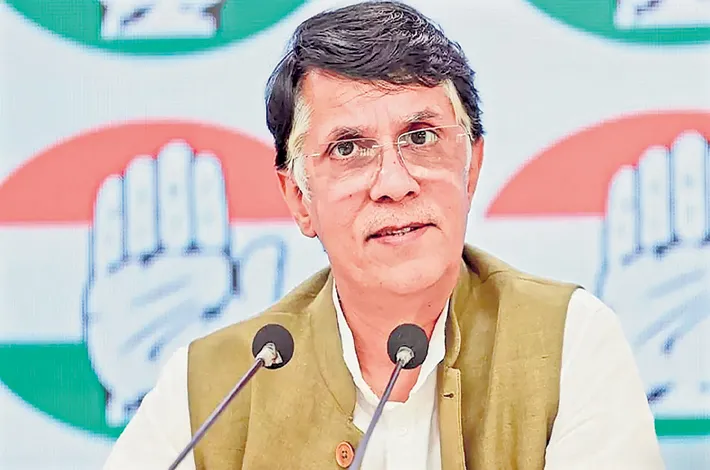
In a charged gathering that echoed the spirit of India's resilient democracy, Congress spokesperson Pawan Khera unleashed a scathing indictment of the mainstream media's alleged subservience to the ruling Bharatiya Janata Party (BJP).
Speaking at a high-profile roundtable hosted by the Communist Party of India (Marxist) [CPI(M)] in the heart of the capital, Khera accused a shadowy figure known as "Hiren-the Godi Coordinator" of orchestrating a chokehold on journalistic independence. The event, attended by stalwarts from across the opposition spectrum, has ignited fresh debates on press freedom amid escalating political tensions ahead of the 2026 state assembly polls.
The venue was a modest yet symbolic conference hall at the CPI(M) headquarters, its wooden-panelled walls bearing witness to decades of ideological battles. The video of the session, shared widely on social media by journalist Sanjoy Ghose ( @advsanjoy), has amassed over 500,000 views in less than 24 hours, trending under hashtags like #GodiMediaExposed and #FreeThePress.
Ghose's caption – "Pawan Khera brutally exposes how the media has allowed it to be dictated by Hiren-the Godi Coordinator!" – captured the raw outrage that permeated the room. The clip, clocking in at just over two minutes, shows Khera, dressed in his signature navy vest and white shirt, microphone in hand, dismantling what he called the "architecture of propaganda."
"Brothers and sisters of the fourth estate," Khera began, his voice rising gradually "you were once the watchdogs of democracy. Today, you are like pets, fed scraps by one man: Hiren Joshi, the invisible puppeteer of Godi Media." The term "Godi Media," a combination of "godi" (lap) and "media," has long been opposition slang for outlets perceived as cozying up to the powers-that-be. Joshi, a low-profile BJP functionary reportedly heading the party's media cell, emerged as the evening's villain – a faceless coordinator allegedly dictating headlines, scripting debates, and blacklisting critical voices.
Khera's monologue was no mere rant; it was a meticulously gathered exposé, drawing on leaked emails, anonymous whistleblower accounts and patterns of coverage that, he argued, bordered on sedition against truth. "Look at the numbers," he thundered, pointing to a projected slide (visible in the video's background).
"In the last fiscal year, 87% of prime-time slots on top English channels were devoted to government narratives. Farmers' protests? A footnote. Adani's empire? A fairy tale. But a single tweet from the PM? Wall-to-wall joy." His words elicited nods from communist leaders, who interjected with a measured barb: "This is not journalism; it's a war against the marginalized."
The roundtable, titled "Media in the Mirror: Reflections on a Fractured Fourth Estate," was convened by the CPI(M)'s media wing in response to a string of recent controversies. Just last month, a consortium of independent journalists released a damning report from the Network of Women in Media, India (NWMI), highlighting how female reporters critical of the government faced disproportionate harassment. The event also comes on the heels of the Supreme Court's landmark ruling in the Prashant Bhushan contempt case redux, where the apex court reiterated safeguards for satirical speech but stopped short of addressing systemic media capture.
Brinda Karat, ever the strategist, took the floor next, weaving in historical parallels. "Remember the Emergency? We fought tooth and nail against censorship then. Today, it's subtler – algorithmic shadows and advertiser boycotts – but no less tyrannical."
Her reference to the 1975-77 period, when Indira Gandhi's regime muzzled the press, drew murmurs of agreement. Raja, representing the CPI's southern strongholds, added a regional flavor: "In Tamil Nadu and Kerala, where our voices still resonate, we've seen local papers starved of ads for daring to question crony capitalism. Hiren's tentacles reach far."
The discussion wasn't without wit and humour. A senior union leader remarked funnily, "If media were a marriage, Hiren would be the in-law dictating the dowry – and we're all paying the price." Yet, the undercurrent was quite grim. Attendees shared instances of colleagues sidelined for "unpatriotic" reporting: a Delhi-based editor demoted after covering caste atrocities in Haryana; a Mumbai stringer whose bylines vanished post a piece on urban displacement.
Beyond the rhetoric, the roundtable yielded tangible calls to action. A joint declaration, signed by all participants, urged the Press Council of India (PCI) to investigate "coordinated media manipulation" and proposed a "People's Media Fund" – a crowdfunded initiative to bolster independent outlets.
Reactions poured in swiftly. BJP spokesperson Sambit Patra dismissed the event as "sour grapes from the opposition's echo chamber," accusing Khera of "peddling conspiracy theories to distract from Congress's electoral flops." In a counter-post on X, Patra shared clips of opposition-led media during the UPA era, labeling them "Sonia's sycophants." Meanwhile, digital rights group Internet Freedom Foundation (IFF) endorsed the critique, tweeting: "Khera's words are a wake-up call. Data shows 70% of Indians now distrust TV news – time to decentralize the narrative."
Critics, however, caution against oversimplification. A left oriented media analyst argued that while BJP influence is undeniable, corporate ownership – from Reliance to Adani – only enhanced the problem. "Hiren may coordinate, but it's the conglomerates that own the strings," she wrote. The roundtable touched on this, with Karat calling for antitrust probes into media mergers post-2014.
In an era where deepfakes and AI-generated news blur realities, Khera's unfiltered fury feels almost analog – a reminder that passion, not pixels, still powers protest. Whether this translates to electoral dividends or fades into digital dust remains to be seen. For now, in the corridors of Lutyens' Delhi, the opposition's roar against the "Godi" has grown a decibel louder, challenging not just Hiren, but the very soul of Indian journalism.